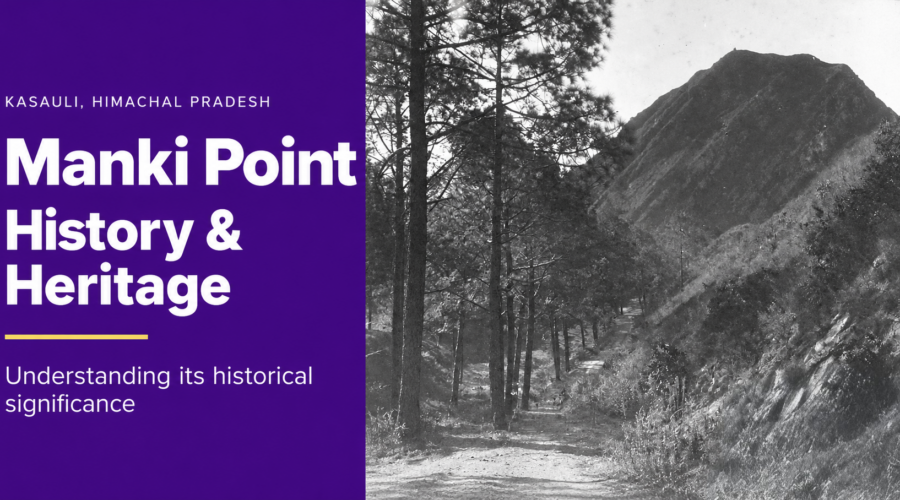
Understanding Manki Point’s Historical Significance
Manki Point is a hilltop sacred site in Kasauli, Himachal Pradesh, known for its Hanuman temple, Ramayana tradition and commanding position above the surrounding landscape. Its significance brings together religious belief, the development of a cantonment town and the continuing presence of the Indian Air Force. Understanding those layers makes a visit more meaningful than simply reaching a viewpoint. (prod.incredibleindia.gov.in)
This article separates documented history from devotional tradition, explains what gives the hill its cultural importance and outlines the practical questions to settle before visiting. The aim is to appreciate the place without turning a cherished legend into an unsupported historical claim.
Why is Manki Point historically significant?
Manki Point is historically significant because it brings together a Hanuman pilgrimage tradition, a prominent landscape feature and Kasauli’s military setting. Official tourism material associates the hill with Hanuman’s journey for the life-saving Sanjeevani herb, while government planning records describe its temple, scenic importance and relationship with Air Force installations. These sources establish its cultural significance, but they do not provide a verified founding date for the present shrine. (prod.incredibleindia.gov.in)
That distinction matters. A sacred place can be important because of the stories, worship and meanings attached to it, even when the surviving building cannot be assigned an ancient construction date. Equally, recognising religious belief as belief does not diminish its importance to devotees.
A useful way to understand the site is through three overlapping perspectives:
- Sacred geography: the hill is associated with an episode from the Ramayana, giving its physical form a devotional meaning.
- Town history: it belongs within the wider story of Kasauli’s development as a hill station and cantonment.
- Modern stewardship: its military setting affects how visitors approach and experience it today. (prod.incredibleindia.gov.in)
Taken together, these perspectives suggest a better way to visit: look beyond the shrine alone, but do not allow the scenery to overshadow its religious purpose. The interesting story is how these different meanings share the same hill.
The Hanuman tradition behind the hill
The best-known tradition links Manki Point with Hanuman’s journey connected to the Sanjeevani herb needed to revive Lakshmana. Incredible India describes Hanuman’s foot touching the Kasauli hilltop on his return journey and associates the hill’s shape with a foot. A Himachal Pradesh planning document records a variant in which his left toe touched the hill while travelling towards the upper Himalayas. (prod.incredibleindia.gov.in)
The shared idea is more important than forcing these accounts into identical wording: a moment from the epic is connected to a particular feature of the landscape. For a devotee, that connection can make the summit a place of remembrance rather than merely an elevated patch of ground.
A landscape interpreted through devotion
The foot-shaped hill is meaningful within the tradition because it offers a visible connection between story and place. However, its appearance should not be presented as archaeological proof that the event occurred. The careful description is that the shape is associated with Hanuman’s footprint in local religious tradition. (prod.incredibleindia.gov.in)
This distinction allows different visitors to appreciate the site without being asked to adopt the same interpretation. A pilgrim may approach it through faith; another traveller may be interested in how an epic becomes rooted in a local landscape. Both can recognise that the association deserves respectful treatment.
Different tellings need careful wording
The variations in official accounts are a reason to use phrases such as “tradition holds” or “is believed to”, rather than declaring a single detailed itinerary as fact. The sources agree on the central association with Hanuman and Sanjeevani, while differing over the direction of travel. (prod.incredibleindia.gov.in)
When discussing the story with children or fellow travellers, keep those two levels clear. Explain what devotees believe, then explain what the written sources actually establish. That approach preserves the story’s character without making claims the evidence cannot support.
What can the evidence tell us about the temple’s age?
The official sources reviewed establish that a Hanuman temple stands at Manki Point, but they do not establish a precise founding date, named original patron or continuous building history. The 2009 Himachal Pradesh planning record describes a “new temple” on the crest without supplying a construction date. It would therefore be misleading to assign the present structure an ancient age solely because its tradition concerns the Ramayana. (rajpatrahimachal.nic.in)
Three different questions are easily confused: how old the religious story is, how long this particular hill has been associated with it, and when the current temple was built. An answer to one does not automatically answer the others. The distinction is especially useful when reading travel descriptions that move quickly from epic narrative to architectural claims.
For a more reliable understanding, assess claims according to what would support them:
| Claim | Evidence that would help establish it |
|---|---|
| A precise temple construction date | A dated inscription, building record or securely identified contemporary account |
| A named founder or patron | A dedication, archival document or other attributable record |
| Long-standing association with the hill | Earlier descriptions, maps, accounts or documented local testimony |
| Present visitor arrangements | Current instructions from the authority controlling access |
This is a method for evaluating information, not a claim that all these records exist for Manki Point. If a source supplies an exact year without explaining where it came from, treat that detail cautiously. Repetition across travel pages is not the same as independent verification.
There is no need to compensate for missing dates with grander language. Describing the Kasauli Hanuman temple as a culturally significant shrine associated with Hanuman is informative in its own right. Leaving an uncertain date unresolved is more useful than giving readers a confident answer that cannot be checked.
Kasauli’s cantonment history provides the wider setting
Kasauli’s documented military history offers a firmer chronological framework. The Ambala District Gazetteer, 1923–24 records that the cantonment was formed in 1842 following a survey by Colonel Tapp, and that its first troops arrived in 1843. This establishes a nineteenth-century context for the town’s development, not a construction date for the Hanuman temple. (cdnbbsr.s3waas.gov.in)
That separation prevents a common misunderstanding. The founding of a cantonment, the naming of a summit and the establishment of a shrine are different events. Even where they concern the same landscape, their dates should not be exchanged or combined without evidence.
The summit in colonial records
The same gazetteer associates Colonel Tapp with the name “Tapp’s nose” for Kasauli’s highest point. Its account places the summit within a colonial system of surveying, naming and describing the hills. Read alongside modern descriptions of Monkey Point, it offers a useful historical perspective on how prominent landscape features were recorded. (cdnbbsr.s3waas.gov.in)
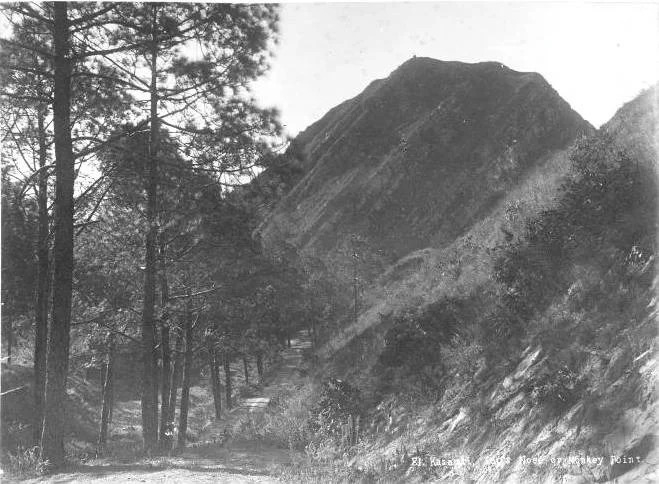
A colonial name should not be treated as the whole identity of a place. Such records were written for administrative purposes and reflect the priorities of their authors. They are valuable evidence, but they do not necessarily capture every religious association or local way of understanding the landscape.
Reading the town alongside the shrine
A broader heritage walk can place the hilltop visit in context. Himachal Pradesh’s government describes Christ Church in Kasauli as an Anglican building whose foundation stone was laid in 1844. The Solan district administration also identifies the Lawrence School at Sanawar, established in 1847, among the area’s significant institutions. (himachal.nic.in)
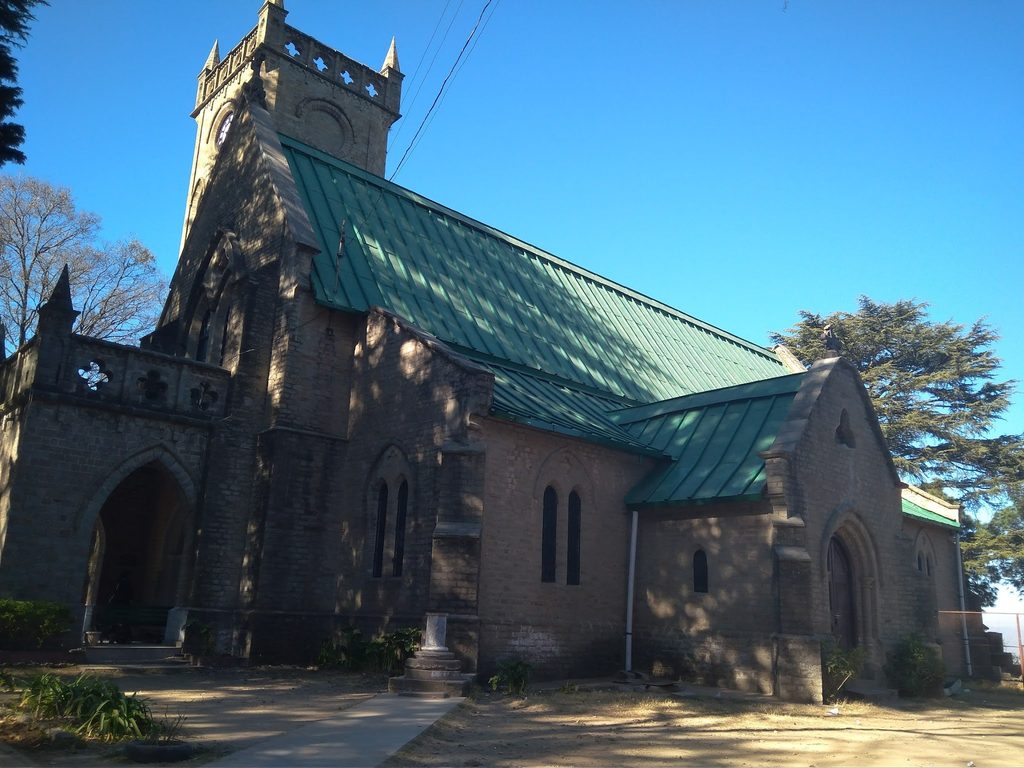
These places should not be collapsed into a single story. A church, a school, a cantonment and a Hanuman shrine have different purposes and histories. Considering them together instead reveals why Kasauli is better understood through several histories than through one simple description of a “colonial hill station”.
For visitors, the practical implication is straightforward: allow time to notice contrasts. Consider who used each place, what activities it supported and which details are actually documented. That produces a richer understanding than collecting dates without examining what they mean.
The viewpoint is part of the cultural story
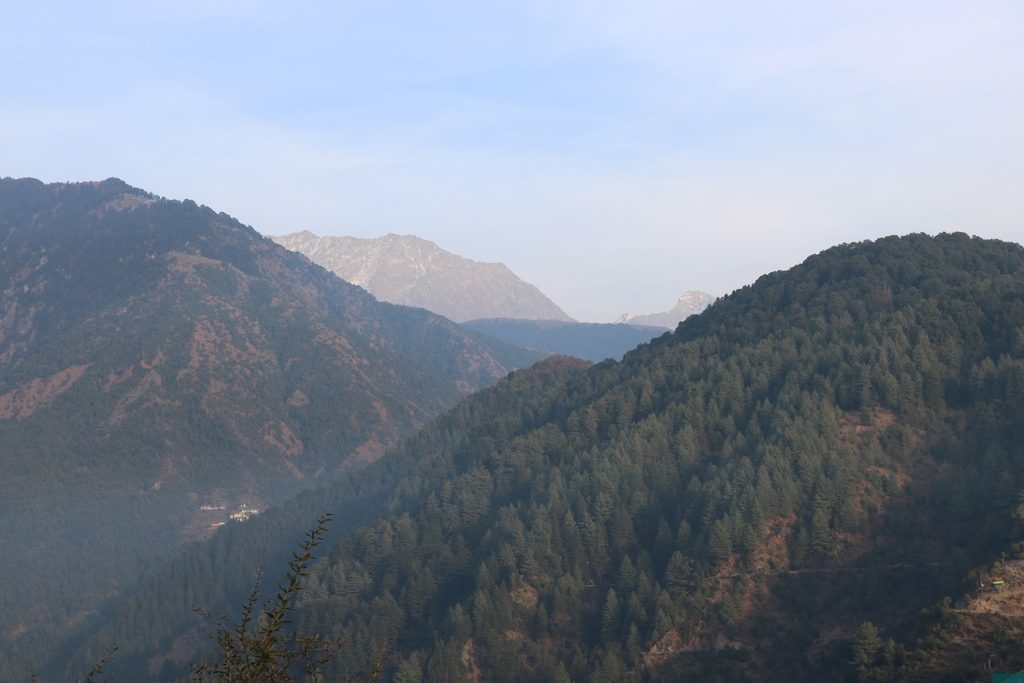
The hill’s outlook is not incidental to its appeal. Official descriptions identify Monkey Point as Kasauli’s highest point and note views towards Chandigarh in clear conditions. Solan district’s account of Kasauli also emphasises the relationship between its hillside setting and the Punjab and Haryana plains below. (prod.incredibleindia.gov.in)
From a visitor’s perspective, the contrast between hill and plain can help explain why the summit attracts attention. Its prominence gives the place a distinctive physical identity, while the Hanuman tradition gives that identity a sacred interpretation. This is an interpretation of the setting, rather than evidence that one particular factor caused the temple to be established.
Spend a few moments looking at the landscape before searching for distant landmarks. Notice the relationship between the ridge, neighbouring slopes and the lower country beyond. Even when visibility is limited, the hill’s position remains part of the experience; a successful visit need not depend on a perfectly clear horizon.
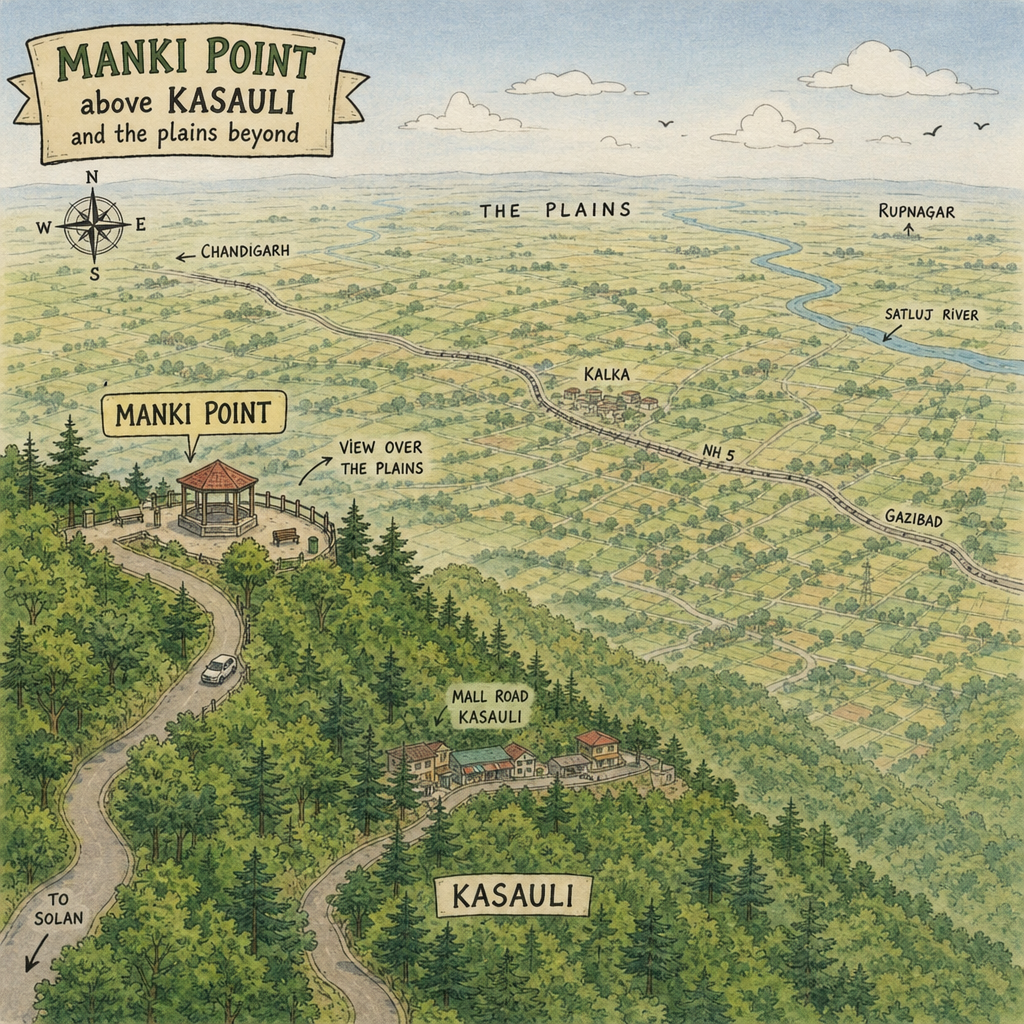
A labelled illustration is particularly useful here because it can explain the setting without relying on photographs taken within a restricted area. Treat any illustrated route as orientation only, not as permission to use a path or enter military land.
Names, spellings and the place you are looking for
Manki Point and Monkey Point are both used for the Kasauli attraction. Incredible India uses Manki Point in its town description and Monkey Point in its dedicated attraction material, while also identifying the Hanuman temple. These naming variations can make online research look more complicated than it needs to be. (incredibleindia.gov.in)
If you are searching for Hanuman Mandir Kasauli, check that the result identifies the hilltop shrine at Manki Point. Likewise, a listing for Monkey Point Kasauli may focus on the viewpoint rather than the religious significance. Read the description rather than assuming that a different heading means a different destination.
For maps or accommodation enquiries, “Manki Point, Kasauli, Himachal Pradesh” provides clear geographical context. Avoid relying on a temple name alone when arranging transport. Ask which authorised visitor entrance is intended and where your driver will meet you afterwards, particularly if you expect to be without your phone during the visit.
The spelling itself should not carry more historical weight than the evidence allows. These sources establish that both names are used; they do not establish a definitive linguistic origin. Claims that one spelling conclusively explains the site’s earliest identity need separate support.
How should you check Monkey Point Kasauli timings and entry rules?
Check Monkey Point Kasauli timings directly before travelling, because access involves an Air Force-controlled area rather than an unrestricted public viewpoint. Delhi Tourism’s published itinerary describes registration at the Air Force Guard Station and gives a 5 pm entry closure, while Incredible India states that electronic devices are not permitted inside the temple complex. Treat those published details as planning references, not a guarantee of admission on your chosen day. (delhitourism.gov.in)
The important question is not simply when the temple is described as open. You also need to establish when visitors may pass the entrance and what conditions apply. Avoid building a tightly timed afternoon around an unconfirmed listing, especially if this is the main purpose of your journey.
Before leaving your accommodation, seek answers to these practical questions:
- Is visitor entry available that day? Confirm access rather than assuming a published timetable guarantees it.
- What is the latest admission time? Ask about entry separately from any closing time.
- Which identification is required? Check requirements for everyone in your group, including children and overseas visitors.
- What must be left outside? Establish the current policy for phones, cameras, bags and other belongings.
- What arrangements exist for deposited items? Do not assume storage will be available or suitable for valuables.
- What does the approach involve? Ask about steps, walking conditions and any accessibility concerns before committing.
These are verification questions, not a statement that every item is a universal requirement. Instructions given by authorised personnel on the day should guide your visit. If access is unavailable, accept the decision and choose another permitted activity rather than looking for an alternative entrance.
Respectful conduct protects the experience
Approach the shrine first as a place of worship. Even if your main interest is history or scenery, give worshippers space and follow the temple’s instructions. A quiet, observant visit allows you to appreciate the setting without treating someone else’s devotional practice as a spectacle.
Ask before photographing people wherever photography is permitted, and never assume that permission in one part of town extends into the military area. The official restriction on electronic devices makes advance planning particularly important here. Arrange a meeting place beforehand rather than relying entirely on messages or digital navigation. (prod.incredibleindia.gov.in)
Keep your conduct simple:
- Follow directions about footwear, offerings and movement around the shrine rather than guessing local practice.
- Avoid blocking approaches while talking, resting or waiting for companions.
- Do not pressure priests, staff or worshippers to interrupt their activities for a photograph or explanation.
- Keep food packed away and avoid feeding or approaching monkeys.
- Take litter away and leave stones, plants and religious objects undisturbed.
If you want to learn more, ask a focused question when someone is available to answer. “Is there a recorded date for this building?” is more useful than demanding a complete history during a busy moment. Listen carefully, and distinguish a personal account or oral tradition from a dated documentary source when sharing what you have learnt.
Respect also means accepting limits. A closed area, a prohibited photograph or an unanswered historical question does not make the visit incomplete. Some experiences are better approached through attention than through unrestricted access or a large collection of images.
Build a visit around understanding, not a checklist
A thoughtful visit begins before you reach the gate. Read the Hanuman tradition, note the distinction between the shrine and the cantonment’s history, and settle practical arrangements. That preparation leaves more room to observe rather than spending the entire outing resolving avoidable uncertainties.
Use a flexible sequence instead of a minute-by-minute itinerary:
- Prepare the context. Read a short account of the Sanjeevani association and identify which details belong to tradition.
- Confirm admission. Check current access, identification requirements and belongings policies before setting off.
- Visit attentively. Allow worshippers priority and take time to understand the summit’s position in the landscape.
- Broaden the perspective. If practical, explore an accessible heritage site elsewhere in Kasauli rather than treating the hill as the town’s entire history.
- Review what you learnt. Separate documented dates, devotional accounts and your own impressions when discussing the visit afterwards.
For families, this can become a simple exercise in reading places. Ask children to identify something they observed, something they heard in a story and something supported by a written record. The aim is not to test belief, but to show how different kinds of knowledge contribute to understanding a destination.
For travellers with limited time, prioritise the shrine’s meaning over collecting additional stops. A shorter, well-prepared visit can be more rewarding than an ambitious schedule that leaves no time for worship, reflection or questions. Keep an alternative plan so that restricted access does not turn disappointment into pressure on staff.
Appreciating the history without overstating it
Manki Point rewards an approach that takes faith seriously and evidence carefully. Its Hanuman association, hilltop setting and place within Kasauli’s cantonment landscape offer several ways to understand its significance. None requires inventing an ancient building date or treating every repeated travel claim as established fact. (prod.incredibleindia.gov.in)
Read the tradition, check the practical arrangements and leave room to notice the place itself. The most valuable takeaway is not a dramatic claim about its age, but a clearer understanding of how sacred meaning, landscape and documented history meet on one hill.
Frequently asked questions about Manki Point
Where is Manki Point, and is it the same as Monkey Point?
Manki Point is a hilltop sacred site in Kasauli, Himachal Pradesh. Manki Point and Monkey Point are names used for the same attraction, which is associated with a Hanuman temple and views across the surrounding landscape.
Why is Manki Point associated with Lord Hanuman?
Local tradition connects the hill with Hanuman’s journey to bring the Sanjeevani herb for Lakshmana. Devotees associate the hill’s shape with his foot touching the ground. This is a religious tradition; it should not be presented as archaeological proof of the event.
How old is the Hanuman temple at Manki Point?
The sources discussed in this article do not establish a verified construction date or original founder for the present temple. A 2009 Himachal Pradesh planning record describes a temple on the crest, but does not give its building date. The age of the Ramayana tradition does not date the current structure.
What are the visiting hours for Manki Point?
Delhi Tourism’s published itinerary mentions a 5 pm entry closure. Treat this as a planning reference and confirm access and the latest admission time before travelling, because entry is controlled through an Air Force area and arrangements may change.
Are mobile phones, cameras and photography allowed?
Incredible India states that electronic devices are not permitted inside the temple complex. Confirm the current rules for phones, cameras and belongings before setting out, and follow the instructions at the entrance. Arrange a meeting point in advance if your group will be without phones.
What identification should visitors carry?
Confirm the current identification requirements with the authorised visitor entrance before going. Ask specifically about documents for children and overseas visitors. Delhi Tourism advises foreign citizens visiting Kasauli to carry their passports; do not assume that any one document guarantees admission to Manki Point.
Is Manki Point suitable for a visit with children?
It can be a meaningful family outing when the approach suits your child’s stamina. Check walking conditions, steps, belongings rules and weather beforehand, and allow time for breaks. Keep children close around monkeys and avoid feeding them. Choose another activity if access or the climb does not suit your family.
What other Kasauli heritage sites can families explore?
Christ Church in Kasauli offers another way to explore the town’s heritage. The Lawrence School at nearby Sanawar is also part of the area’s history, but a working school should not be treated as an unrestricted tourist stop. Check visitor access separately and keep the day’s plan flexible.