

Hawa Mahal Timings and Ticket Price 2026: Entry Fee, Online Booking & Jaipur Visitor Guide
Planning to visit Jaipur’s most photographed landmark? Knowing the Hawa Mahal timings and ticket price before you arrive can save you from outdated ticket information, unnecessary queues and the common mistake of searching for the entrance below the famous façade.
Hawa Mahal is one of those Jaipur landmarks that many travellers photograph from the street but never actually enter. Going inside gives you a completely different perspective: narrow passages, latticed jharokhas, courtyards and elevated views over Jaipur’s historic Pink City.
There is also an important change for anyone visiting in 2026. Rajasthan revised entry fees for several state-run monuments from 1 January 2026, including Hawa Mahal. As a result, older travel blogs that still quote ₹50 for Indians and ₹200 for international visitors are using pre-2026 prices. Recent reporting on the Rajasthan Archaeology and Museums Department’s revised tariff puts Hawa Mahal at ₹100 for Indian visitors, ₹50 for Indian students, ₹600 for foreign visitors and ₹300 for foreign students.
This guide covers the latest Hawa Mahal entry fee, opening and closing time, ticket booking, location, nearest metro station, best time to visit, photography, history, what you can see inside and the best places to visit nearby.
Last fact-check: 22 August 2026. Monument prices, special closures and ticketing systems can change, so verify the final amount at the official counter before payment.
Hawa Mahal Timings and Ticket Price 2026: Quick Information
If you only need the essential information before leaving for Hawa Mahal, use this table.
| Visitor information | 2026 details |
|---|---|
| Hawa Mahal opening time | 9:00 AM |
| Hawa Mahal closing time | Around 4:30 PM |
| Days open | Normally open daily |
| Ticket price for Indian visitors | ₹100 |
| Indian student ticket | ₹50 |
| Ticket price for foreign visitors | ₹600 |
| Foreign student ticket | ₹300 |
| Children | Published Rajasthan monument rules provide free admission for children up to age 7; confirm current application at the counter |
| Recommended visit duration | 45–90 minutes |
| Best time to visit | 9:00–11:00 AM |
| Nearest metro station | Badi Chaupar |
| Location | Hawa Mahal Road, Badi Choupad, Pink City, Jaipur, Rajasthan 302002 |
| Photography | Generally suitable for personal photography; follow on-site instructions |
| Famous for | 953 jharokhas, honeycomb façade, ventilation and Jaipur city views |
Current visitor listings consistently place the public visiting window at approximately 9:00 AM to 4:30 PM. Because closing and last-entry procedures can occasionally vary, reaching the monument by 4:00 PM at the latest is safer than planning a late-afternoon arrival.
Hawa Mahal ticket price for Indians in 2026
The revised Hawa Mahal ticket price for Indian visitors is ₹100 per person.
Indian students are reported at ₹50, normally subject to valid student identification. The Rajasthan government’s 2026 revision also increased admission prices at other state monuments including Albert Hall Museum, Nahargarh Fort, Jantar Mantar and Amer Palace.
Hawa Mahal ticket price for foreigners
The revised Hawa Mahal Jaipur ticket price for foreign tourists is ₹600 per person.
Foreign students are reported at ₹300 with appropriate student identification.
Hawa Mahal ticket price for children
Rajasthan’s published monument rules state that children up to seven years of age are not charged an entrance fee. Because ticket structures were revised in 2026, families should carry some form of age proof where practical and confirm the exemption at the ticket counter.
Why do some websites still show ₹50 and ₹200?
This is currently one of the biggest sources of confusion around the Hawa Mahal entry fee.
For years, commonly quoted rates were around ₹50 for Indian visitors and ₹200 for foreign visitors. Numerous tourism directories still display those older rates.
However, Rajasthan announced revised entrance charges effective 1 January 2026. Reporting based on the Department of Archaeology and Museums’ revised orders gives Hawa Mahal the same tariff as Albert Hall, Jantar Mantar and Nahargarh: ₹100 Indian, ₹50 Indian student, ₹600 foreign visitor and ₹300 foreign student.
For a 2026 travel guide, the revised tariff should therefore be treated as the current reference, while clearly advising travellers to check the counter for any subsequent changes.
Hawa Mahal Opening and Closing Time: When Should You Visit?
For practical trip planning, use 9:00 AM to 4:30 PM as the Hawa Mahal visiting hours.
The palace is generally listed as open seven days a week. Current visitor listings, including Tripadvisor’s 2026 information, show 9:00 AM–4:30 PM throughout the week.
Is Hawa Mahal open today?
Under its normal schedule, Hawa Mahal is open daily.
However, “open today” queries should always be treated slightly differently from standard opening hours. Government monuments may occasionally close or adjust entry because of maintenance, conservation work, public holidays, security arrangements or special events.
If you are travelling specifically to enter the palace rather than only photograph its exterior, check for a same-day government notice before making a long journey.
The famous street-facing façade can, of course, be viewed from Hawa Mahal Road even outside the monument’s ticketed visiting hours.
What time should you arrive?
For most travellers, 9:00 AM to 11:00 AM is the best window.
There are three practical reasons.
First, the main façade faces the morning light, giving the pink and red sandstone a warmer appearance. Second, Jaipur becomes considerably hotter later in the day for much of the year. Third, arriving early usually makes the narrow interior passages easier to explore.
If photography is your main purpose, consider reaching Hawa Mahal Road shortly before the ticketed monument opens. Photograph the façade first, then enter when the gates open.
How long does a Hawa Mahal visit take?
Allow approximately 45 to 90 minutes.
A traveller interested mainly in architecture and the upper-level views may finish in about 45 minutes. Families, photographers and visitors who like reading interpretive displays should allow around an hour to an hour and a half.
You do not normally need half a day for Hawa Mahal itself. Its central location makes it particularly easy to combine with City Palace, Jantar Mantar and the old-city markets.
Hawa Mahal Online Ticket Booking and Ticket Counter
The Rajasthan Department of Archaeology and Museums states that online ticket-booking facilities are provided at various Jaipur monuments and maintains an Online Monuments Ticket page for Jaipur attractions.
However, there is an important 2026 caution for travellers.
A current online-booking issue worth knowing
At the time this guide was checked on 22 August 2026, the Rajasthan Archaeology Department’s official “Online Ticket for Jaipur based Monuments” page linked visitors to bookrajmonuments.in.
That destination currently displays unrelated news/editorial content rather than a recognisable Rajasthan monument-ticket booking interface.
For that reason, we would not recommend entering payment or personal details simply because a third-party page claims to sell Hawa Mahal tickets.
The safest approach in the current situation is:
- Start only from the Rajasthan Government Department of Archaeology and Museums website.
- Check whether its online-ticket destination has been updated.
- If the linked booking system does not clearly identify itself as the official Rajasthan monument-ticket platform, purchase your Hawa Mahal entry ticket at the physical counter instead.
- Avoid paying an unknown portal merely to “skip the queue”.
This kind of real-time verification matters because ticketing domains and government systems can change faster than ordinary travel articles are updated.
Official Rajasthan Archaeology online monument ticket page
Hawa Mahal ticket counter
Tickets can be purchased at the monument entrance.
During busy tourism periods—particularly weekends and the October-to-March season—arriving earlier in the day is sensible.
Keep your ticket until you have completed the visit, and carry your student ID if purchasing a concessionary ticket.
Where is the Hawa Mahal entry gate?
One detail surprises many first-time visitors: you do not enter through the famous honeycomb façade facing Hawa Mahal Road.
That façade was essentially designed as an elaborate screen overlooking the street. Visitor access is from the rear/inner side of the complex, so follow the entrance signs around the building rather than searching for a large doorway beneath the famous street view.
This small tip can save several minutes in a busy part of the old city.
Best Time to Visit Hawa Mahal in Jaipur
The best overall period to visit Hawa Mahal is October to March, when sightseeing weather in Jaipur is usually more comfortable.
But the best time of day matters nearly as much as the season.
October to March: easiest for sightseeing
Jaipur’s cooler months are better suited to walking through the old city, visiting several monuments in one day and exploring markets around Hawa Mahal.
This is also peak tourism season, so mornings are particularly valuable if you prefer lighter crowds.
April to June: visit early
Late spring and early summer in Jaipur can be intensely hot.
If your visit falls during these months, make Hawa Mahal one of your first sightseeing stops of the day. Carry drinking water, wear light clothing and avoid planning long outdoor walks around the Pink City in the hottest part of the afternoon.
July to September: good colours, variable weather
Monsoon months can bring clouds, occasional rain and higher humidity.
The upside is softer light, greener surroundings in parts of Jaipur and some dramatic photography conditions. The downside is less predictable weather.
Best time for Hawa Mahal photography
For the iconic exterior image, morning is usually best because the eastern façade receives direct early light.
The opposite side of Hawa Mahal Road also provides a more complete head-on perspective of the building than standing immediately underneath it.
If photographing from a privately operated rooftop café or terrace, remember that food or seating charges belong to the business and are separate from the official Hawa Mahal entry ticket.
Hawa Mahal Location and How to Reach It
Hawa Mahal address:
Hawa Mahal Road, Badi Choupad, Pink City, Jaipur, Rajasthan 302002.
The palace stands in Jaipur’s historic walled city, surrounded by bazaars, heritage buildings and some of Jaipur’s most important attractions.
Rajasthan Tourism recommends local buses, taxis and auto-rickshaws as practical ways to reach Hawa Mahal from elsewhere in Jaipur.
Hawa Mahal nearest metro station
The nearest metro station to Hawa Mahal is Badi Chaupar on the Jaipur Metro corridor.
An official Jaipur Metro planning document places Hawa Mahal within approximately 100 metres of Badi Chaupar Station, making metro one of the easiest options when traffic in the old city is heavy.
From the station, simply follow signs toward Hawa Mahal Bazaar/Hawa Mahal Road.
From Jaipur Railway Station
Travellers arriving at Jaipur Junction can use Jaipur Metro, an auto-rickshaw or a cab.
Using the metro toward Badi Chaupar can be particularly convenient at busy times because the old-city roads around Hawa Mahal, Johari Bazaar and Tripolia Bazaar frequently have dense local traffic.
From Jaipur airport
A cab is normally the simplest option for families or travellers carrying luggage.
Travel time depends heavily on city traffic, so avoid planning your palace entry too close to closing time if travelling directly from the airport.
By auto-rickshaw or e-rickshaw
Autos and e-rickshaws are readily available throughout central Jaipur.
Agree on the fare or use a metered/app-based option where available. Ask specifically for “Hawa Mahal, Badi Chaupar” to avoid ambiguity.
Hawa Mahal History and Architecture: Why It Is More Than a Photo Stop
Hawa Mahal was built in 1799 by Maharaja Sawai Pratap Singh. Its distinctive five-storey design is closely associated with architect Lal Chand Usta and has become one of the defining visual symbols of Jaipur.
Rajasthan Tourism explains that one of the principal purposes of the building was to enable women of the royal household to observe activity and processions along the busy streets below without themselves being seen.
The famous 953 jharokhas
The façade contains 953 small windows or jharokhas, many decorated with intricate latticework.
These openings were not purely ornamental. Together they helped circulate air through the narrow structure, creating the ventilation associated with the name Hawa Mahal, usually translated as the “Palace of Winds” or “Palace of Breeze.” Rajasthan Tourism specifically highlights the building’s numerous windows and the airflow they produce.
A blend of Rajput and Mughal design
Hawa Mahal combines elements associated with Rajput and Mughal architecture.
Rajasthan Tourism highlights Rajput-style canopies and fluted pillars alongside Mughal-influenced arches and stone filigree work. The result is less like a conventional massive palace and more like an extraordinarily ornate architectural screen.
Why does Hawa Mahal look like a honeycomb?
The repeated jharokhas create the honeycomb effect visible from the street.
The five-storey form narrows toward the top, producing its distinctive pyramidal silhouette. The official Rajasthan Tourism description also associates the building’s shape with the crown of Lord Krishna.
What Is Hawa Mahal Like Inside?
Visitors sometimes expect huge royal rooms because the exterior looks so monumental.
The experience inside is quite different.
Hawa Mahal is comparatively narrow. Instead of enormous ceremonial halls, much of the interest comes from passages, courtyards, ramps, small chambers and the views through the famous jharokhas.
Looking outward through the latticework also helps explain the building’s original purpose much better than a street photograph can.
Is going inside Hawa Mahal worth it?
Yes, particularly if this is your first Jaipur visit.
The exterior is the architectural icon, but going inside helps you understand how the façade actually worked. You can see how narrow the building is, experience the airflow and look down toward Jaipur’s old-city streets.
If you are extremely short on time, photographing the exterior is still worthwhile. But families, architecture enthusiasts and first-time Jaipur visitors should budget the extra hour for the interior.
Hawa Mahal with kids
Hawa Mahal works well as part of a family sightseeing day because the visit itself is relatively short.
Children may particularly enjoy looking through the jharokhas, spotting landmarks from the upper levels and learning why royal families needed the unusual screened design.
A simple way to make the visit more engaging is to ask children to look for three things: different window patterns, evidence of natural ventilation and the best view over the Pink City.
Parents should supervise younger children closely around narrow passages, ramps, busy entrance areas and elevated viewpoints.
Hawa Mahal Photography and Real Images for Your Trip
Hawa Mahal is one of Jaipur’s strongest photography locations, but where you stand makes a major difference.
Standing directly below the façade makes it difficult to fit all five levels into a photograph. Moving across Hawa Mahal Road gives a much better perspective.
Morning light usually provides the classic warm pink-and-gold appearance.
Inside, use the jharokhas to frame Jaipur’s streets rather than photographing only the façade. These images help show what makes the building architecturally interesting.
Real images you can legally source for this article
For publishers, Wikimedia Commons is particularly useful because every image has a clear licence and attribution page.
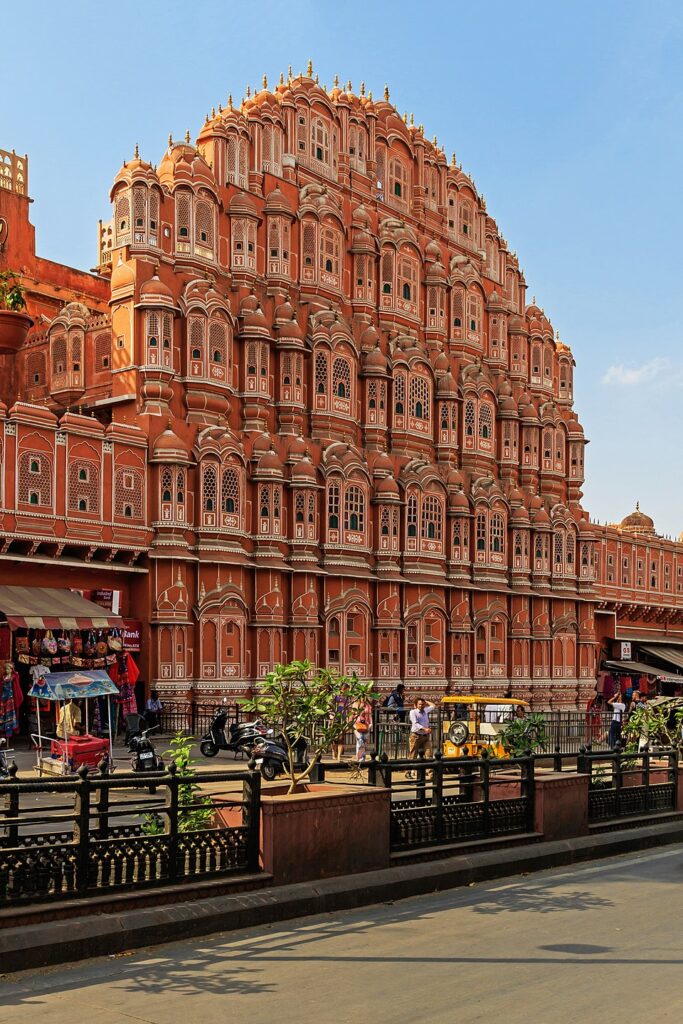
Image 1 – Main Hawa Mahal façade
Suggested placement: Immediately after the introduction.
Suggested alt text: “Hawa Mahal Jaipur façade showing its five-storey jharokha architecture”
A high-resolution photograph by A. Savin is available under a Free Art Licence, with attribution information supplied on Wikimedia Commons.
View/download the Hawa Mahal exterior image on Wikimedia Commons
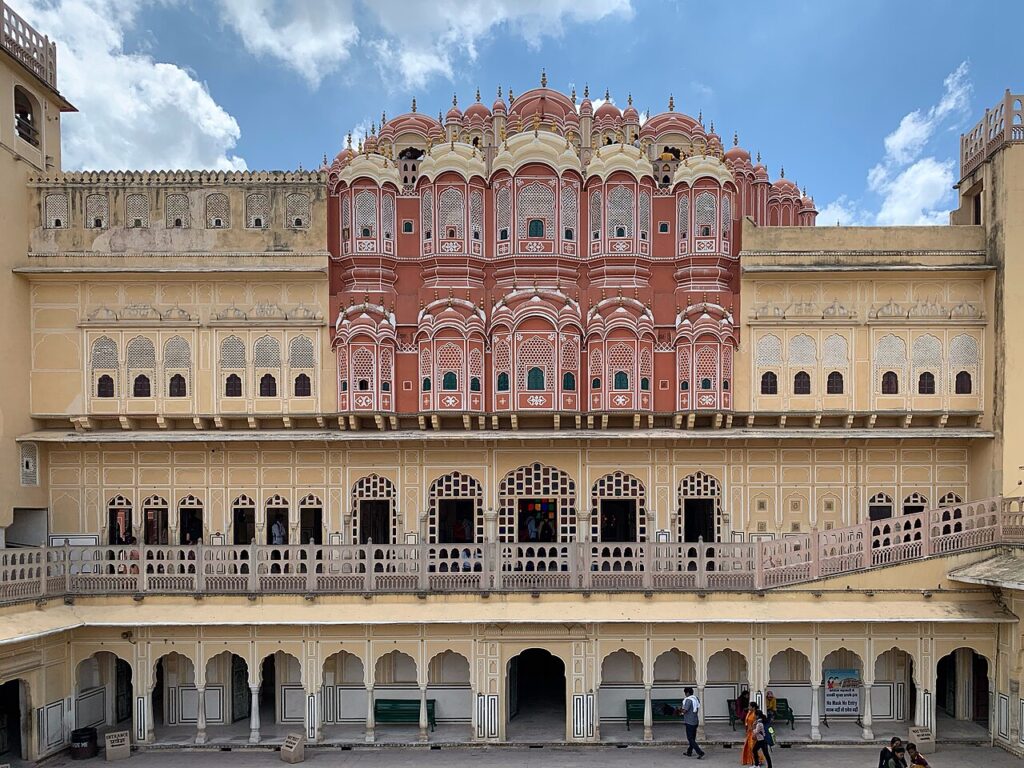
Image 2 – Hawa Mahal inside view
Suggested placement: Under “What Is Hawa Mahal Like Inside?”
Suggested alt text: “Inside view of Hawa Mahal Jaipur showing the inner façade and courtyard”
This real photograph was taken in 2022 by Chainwit and is published under CC BY-SA 4.0, which requires attribution and compliance with the share-alike licence.
Hawa Mahal inside-view image and licence
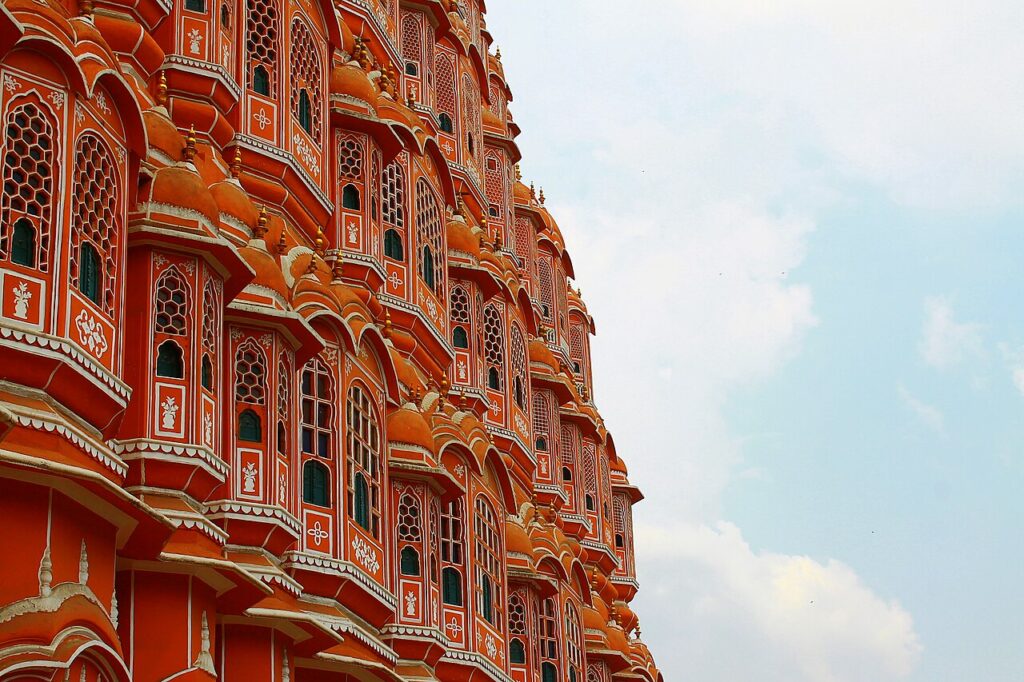
Image 3 – Detailed Hawa Mahal jharokhas
Suggested placement: Under the architecture section.
Suggested alt text: “Close-up of red sandstone jharokhas at Hawa Mahal Jaipur”
The photograph by Akhilesh Pareek is available under Creative Commons Attribution-ShareAlike 4.0.
Hawa Mahal architectural detail image and licence
Always preserve the photographer credit and licence information when using Creative Commons images.
Places to Visit Near Hawa Mahal
One of the biggest advantages of Hawa Mahal’s location is that several important Jaipur attractions can be combined into one walkable old-city itinerary.
1. Jantar Mantar
Jantar Mantar is one of the easiest attractions to pair with Hawa Mahal.
The UNESCO-listed astronomical observatory contains large-scale instruments designed for observing celestial positions and measuring time.
2. City Palace Jaipur
City Palace is also nearby and offers a very different type of heritage experience, with royal courtyards, gateways, museum spaces and palace architecture.
Because City Palace requires more time than Hawa Mahal, consider visiting Hawa Mahal first in the morning.
3. Johari Bazaar
Johari Bazaar is ideal if you want to combine sightseeing with Jaipur’s traditional shopping streets.
Expect jewellery, textiles, handicrafts and the busy atmosphere of the historic Pink City.
4. Govind Dev Ji Temple
Located within the broader City Palace area, Govind Dev Ji Temple is an important Krishna temple and a useful addition for travellers interested in Jaipur’s religious and cultural heritage.
A practical half-day sequence is:
Hawa Mahal → Jantar Mantar → City Palace → Johari Bazaar
That keeps most of your sightseeing concentrated around the historic centre instead of spending your day repeatedly crossing Jaipur.
Important External Resources
For information that may change after publication, prioritise official sources over third-party travel blogs.
Rajasthan Tourism – Hawa Mahal: Official overview covering the monument’s history, architecture and access information. The page was updated on 30 July 2026.
Official Rajasthan Tourism Hawa Mahal guide
Department of Archaeology and Museums, Rajasthan: Useful for monument administration, composite-ticket information and visitor facilities.
Rajasthan Archaeology and Museums Department
Official Jaipur monument online-ticket page: Check this before travelling, but verify the destination carefully because the linked booking domain was not displaying a normal monument-booking interface when checked in August 2026.
Rajasthan online monuments ticket page
Rajasthan Archaeology protected-monuments list: Confirms Hawa Mahal among Jaipur’s protected monuments.
Frequently Asked Questions About Hawa Mahal
What are the Hawa Mahal timings in 2026?
Hawa Mahal is generally open from 9:00 AM to 4:30 PM daily. To avoid problems with last entry, try to arrive before 4:00 PM. Current visitor listings show the same 9:00 AM–4:30 PM schedule throughout the week.
What is the Hawa Mahal ticket price in 2026?
Following Rajasthan’s January 2026 fee revision, the reported Hawa Mahal entry fee is ₹100 for Indian visitors, ₹50 for Indian students, ₹600 for foreign visitors and ₹300 for foreign students.
Can I book Hawa Mahal tickets online?
The Rajasthan Archaeology Department maintains an online-ticket page and states that online ticketing facilities are provided at various Jaipur monuments. However, when checked on 22 August 2026, the destination linked from the government’s Jaipur monument-ticket page was not displaying a normal monument-ticketing service. Until that is updated, buying from the official ticket counter is the safer option.
Which metro station is nearest to Hawa Mahal?
Badi Chaupar Metro Station is the nearest Jaipur Metro stop. An official Jaipur Metro document places Hawa Mahal within roughly 100 metres of the station area.
How much time is enough for Hawa Mahal?
Plan approximately 45 to 90 minutes. Around one hour is enough for most visitors to explore the courtyard, passages, jharokhas, upper levels and city views without rushing.
Final Tips for Visiting Hawa Mahal
Hawa Mahal is easy to add to a Jaipur itinerary, but a little planning makes the experience considerably better.
For a 2026 visit, remember the essentials: aim to arrive between 9:00 and 11:00 AM, budget around one hour, use Badi Chaupar Metro Station if convenient and expect the revised ticket tariff rather than the older ₹50/₹200 prices still appearing on many websites.
Most importantly, do not treat Hawa Mahal as only a roadside photo stop. The famous façade is what draws people in, but walking behind those jharokhas explains why the building has remained one of Jaipur’s most recognisable pieces of architecture for more than two centuries.
If you’re planning a full day in the Pink City, continue from Hawa Mahal to Jantar Mantar, City Palace and Johari Bazaar rather than travelling back and forth across Jaipur.
Next read: Explore our Jaipur Tourist Places Guide, Things to Do in Jaipur with Kids, or One Day Jaipur Itinerary to plan the rest of your visit.



Pingback: Birla Mandir Jaipur Timings and Ticket Price (2026): History, Distance & Complete Visitor Guide
Pingback: Jal Mahal Jaipur Timings and Ticket Price (2026): History, Distance & Visitor Guide - Magick World
Pingback: Statue Circle Jaipur: History, Location, Timings & Distance (2026)
Pingback: Jaipur Itinerary for 1, 2, 3 or 4 Days: Routes, Costs & Family Tips (2026) - Magick World
Pingback: Guna Caves Kodaikanal: Timings, Entry Fee & Travel Guide 2026