Statue Circle Jaipur: History, Location, Directions, Distances & Visitor Guide (2026)
Statue Circle is one of those Jaipur landmarks that is easy to pass and surprisingly easy to misunderstand. It is not a ticketed palace, a museum or a large sightseeing complex. It is a prominent city roundabout in C-Scheme, centred on a white-marble statue of Jaipur’s founder, Maharaja Sawai Jai Singh II. Locals know it as an evening meeting point, a coffee stop and a familiar reference for navigating central Jaipur.
For a visitor, the real questions are practical: Is Statue Circle open all day? Is there an entry fee? Can you actually enter the garden? Does the fountain run every night? How far is it from Jaipur Junction, the airport or Hawa Mahal? And is it worth fitting into a short Jaipur itinerary?
This guide answers those questions without treating a traffic circle like a full-day attraction. You will find the verified history of Statue Circle Jaipur, its address and map reference, realistic travel distances, the best time to visit, what to expect at night, nearby places, photo ideas and current parking advice. Where online listings disagree, the difference is explained rather than hidden.
The short answer: Statue Circle is a free, always-visible public landmark in central Jaipur. Plan around 20-40 minutes, preferably near sunset or in the early evening. Go for the illuminated statue, the local atmosphere and a coffee stop; do not plan your visit around a guaranteed fountain show because no dependable official daily schedule is published.
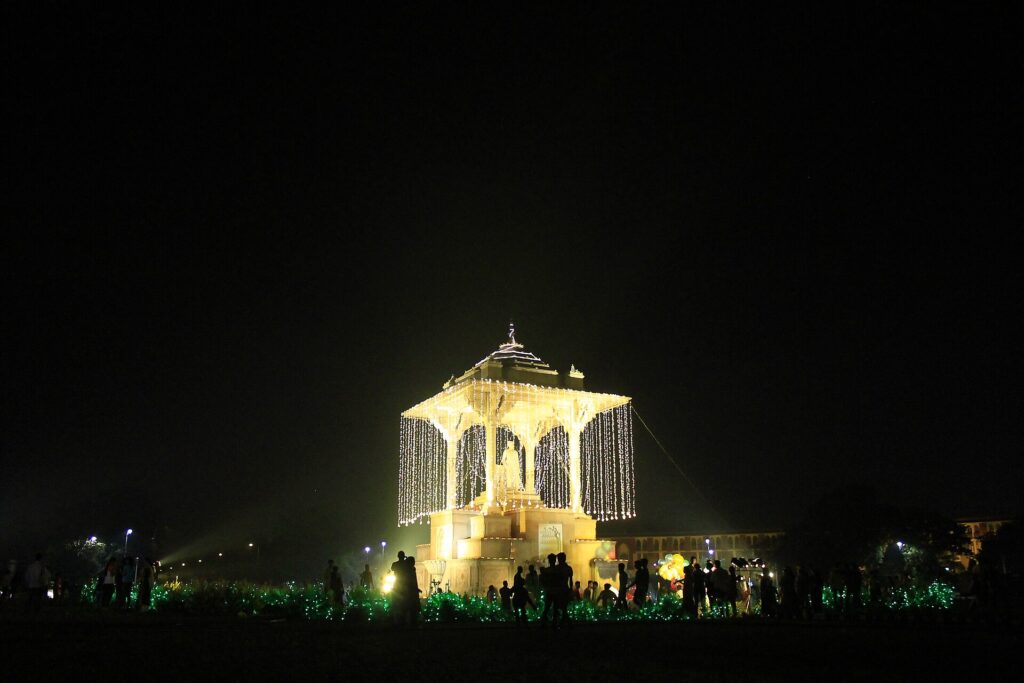
Statue Circle illuminated at night in Jaipur.
Statue Circle Jaipur quick facts
| Visitor question | Practical answer |
| What is Statue Circle famous for? | The life-size white-marble statue of Jaipur’s founder, Sawai Jai Singh II; evening illumination; landscaped surroundings; and long-standing coffee and snack culture. |
| Where is it? | Jai Singh Circle, C-Scheme/Ashok Nagar, Jaipur, Rajasthan 302001, near Central Park and B. M. Birla Auditorium. |
| Is there an entry ticket? | No. Statue Circle is a public landmark and there is no general entry fee. |
| What are the timings? | The road landmark is visible 24 hours. Access to landscaped areas, lighting, vendors and fountains can vary. |
| How much time is needed? | About 20-40 minutes; allow 60 minutes if you stop for coffee or combine it with a nearby walk. |
| Best time to visit | October to March, around sunset to early evening. In hotter months, choose early morning or after sunset. |
| Is the fountain guaranteed? | No. A fountain is part of the setting, but a reliable official daily operating schedule is not published. |
| Nearest commonly used metro station | Civil Lines on Jaipur Metro’s Pink Line, followed by a short auto or cab ride. Confirm the live route before leaving. |
| Good for children? | Fine for a short family stop, but it remains a busy roundabout. Central Park is better for running or extended play. |
| Photography | Generally free from public areas. Use the outer pavement or a safe viewpoint; never stand in live traffic for a photograph. |
Statue Circle Jaipur history and significance
Who is the statue at Statue Circle?
The statue depicts Maharaja Sawai Jai Singh II, the ruler of Amer who founded Jaipur in 1727. Rajasthan Tourism identifies it as a life-size white-marble statue erected in his honour in the C-Scheme area. This is the most important fact to get right because several travel pages and user reviews incorrectly name Sawai Man Singh II, Sawai Ram Singh II or simply “Jai Singh.”
Jai Singh II was not remembered only as a ruler. He conceived Jaipur as a new capital on the plains, with Vidyadhar Bhattacharya associated with its planning. UNESCO describes the walled city as an exceptional example of indigenous urban planning, organised on a grid and designed as a trade and commercial capital. That wider story makes the statue more meaningful: it honours the person whose decisions shaped the city visitors still navigate today.
Why is Sawai Jai Singh II shown with an astronomical diagram?
The statue is commonly described as showing Jai Singh II holding an astronomical or astrological diagram. The detail points to his deep interest in observation, calculation and astronomy. His best-known scientific legacy in Jaipur is Jantar Mantar, an observatory whose monumental instruments were designed to observe astronomical positions with the naked eye. UNESCO recognises Jantar Mantar as the meeting point of several scientific traditions and as an outstanding expression of astronomy, cosmology and royal authority.
This gives Statue Circle a useful interpretive role. The monument is not just a generic royal figure on a pedestal. The diagram connects Jaipur’s founder with the city’s planned form and with the intellectual curiosity behind Jantar Mantar. If you are visiting both places, Statue Circle works well as the modern-city prologue and Jantar Mantar as the fuller historical experience.
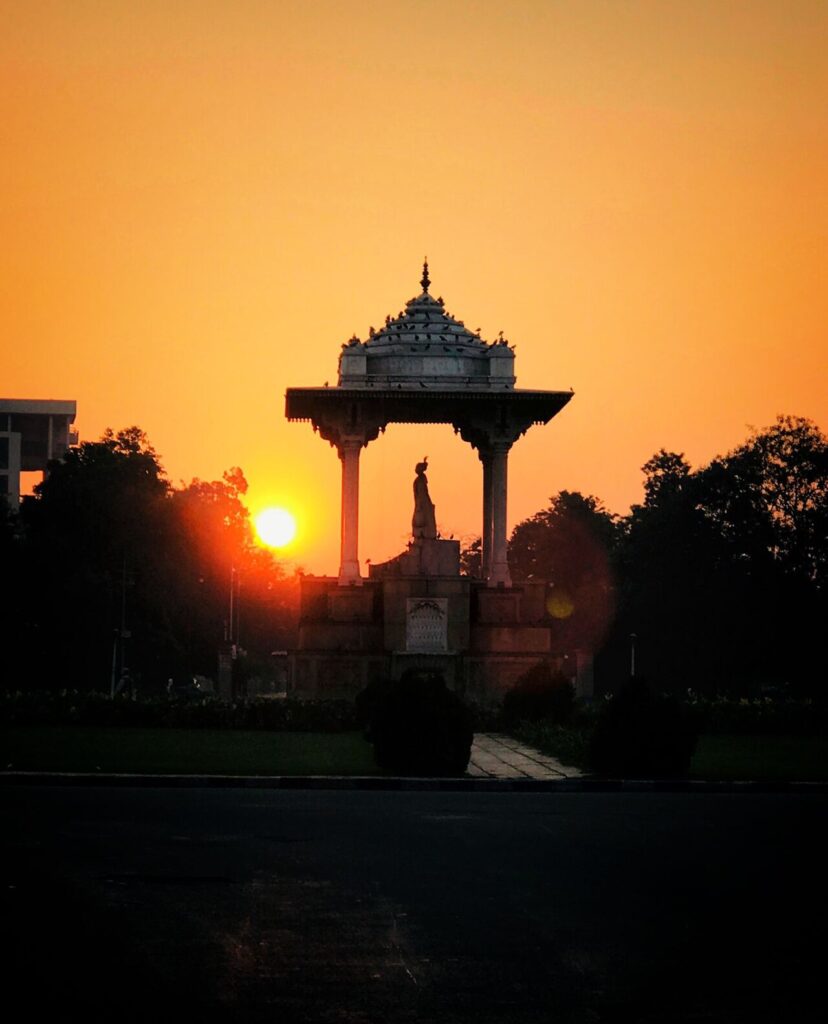
A closer view of the monument to Sawai Jai Singh II at Statue Circle.
When was Statue Circle built?
This is where a trustworthy guide should be careful. Many pages say that the circle was “built as a tribute,” but few cite an official construction or inauguration record. One recent article claims an inauguration in 1968; another local account places its commissioning in the pre-Independence rule of Sawai Man Singh II. Neither claim was corroborated by the official Rajasthan Tourism description reviewed for this guide.
The defensible statement is straightforward: Statue Circle was erected to honour Sawai Jai Singh II, and the statue represents Jaipur’s founder. Unless a municipal, archival or contemporary newspaper record is produced, an exact construction year should not be presented as settled fact. This is a small but important E-E-A-T distinction. Repeating a precise year without a source may look authoritative, but it makes the page less reliable.
Why is Statue Circle famous in modern Jaipur?
Its importance is partly historical and partly everyday. Statue Circle sits at a conspicuous junction in central Jaipur, close to offices, cultural venues, green spaces, hotels and restaurants. It acts as a navigation marker as much as an attraction. In the morning, walkers and commuters pass through the area. By evening, lighting, coffee kiosks and snack vendors create a more social atmosphere.
The site is also used as a civic gathering point. Jaipur’s 298th Foundation Day celebrations were held at Statue Circle in November 2025, with cultural performances and special illumination. Political demonstrations and public events can also affect access. That means the circle is not a preserved monument isolated from city life; it remains part of Jaipur’s active public landscape.
Statue Circle Jaipur location, address, directions and distance
Statue Circle Jaipur address
Use this destination in your navigation app:
Statue Circle / Jai Singh Circle, C-Scheme, Ashok Nagar, Jaipur, Rajasthan 302001, India
Plus code: WR54+259, Jaipur
Nearby reference points: B. M. Birla Auditorium, Central Park, Rajasthan Secretariat and Prithviraj Road
Open the live pin before travelling: https://www.google.com/maps/search/?api=1&query=Statue+Circle+Jaipur
C-Scheme and Ashok Nagar are often used together in addresses around the circle. Do not confuse Statue Circle with Jawahar Circle, the much larger circular park near Jaipur International Airport. Jawahar Circle is known for a scheduled musical fountain; Statue Circle is a central-city memorial roundabout and does not publish the same kind of dependable show timetable.
Distance from major Jaipur arrival points
The figures below are practical planning ranges, not survey measurements. Road distance changes with the selected route, drop-off point, diversions and traffic. Evening journeys can take longer even when the distance is short.
| Starting point | Approx. road distance | Typical travel time | Practical option |
| Jaipur Junction railway station | 3-4 km | 10-20 minutes | Auto-rickshaw or cab |
| Sindhi Camp bus stand | 3-4 km | 15-25 minutes | Auto-rickshaw or cab |
| Civil Lines Metro station | About 2-3 km | 8-15 minutes by road | Metro plus auto/cab for the last mile |
| Jaipur International Airport | 10-12 km | 25-45 minutes | Prepaid taxi, app cab or hotel transfer |
| Hawa Mahal | 4-5 km | 20-30 minutes | Auto or cab via central-city roads |
| City Palace / Jantar Mantar | 4-5 km | 20-30 minutes | Auto or cab |
| Albert Hall Museum | 2.5-3.5 km | 10-20 minutes | Auto, cab or a planned multi-stop route |
| B. M. Birla Auditorium | Roughly 0.2-0.5 km | 3-7 minutes on foot | Walk from a safe outer pavement |
| Central Park | Roughly 0.5-1 km, depending on gate | 7-15 minutes on foot | Walk or use a short vehicle hop in heat |
Why do websites quote different distances? Some calculate from a neighbourhood centre, some from a particular gate, and others appear to use straight-line distance. Jaipur Junction is variously listed at 3.2 km and 4 km, while the airport is listed between 10 km and 12 km. Treat a range as more useful than a false decimal-level promise.
How to reach Statue Circle Jaipur
By cab or auto-rickshaw
This is the simplest option for most visitors. Ask for “Statue Circle, C-Scheme” or show the live pin. If you only want a quick photograph and coffee, arrange a safe outer-road drop-off and agree on a pickup point away from the moving roundabout. App cabs may stop where traffic conditions allow, not necessarily beside the garden.
By Jaipur Metro
Civil Lines is commonly cited as the nearest operational Pink Line station, but the metro does not drop you at Statue Circle. Plan a last-mile auto or cab. A long walk may look manageable on a map, yet midday heat, broad junctions and uneven pedestrian conditions can make it uncomfortable, especially with children, luggage or limited mobility. Check Jaipur Metro’s current service information and a live map on the day of travel rather than relying on a blog’s fixed fare or walking time.
By city bus
City buses use corridors around central Jaipur, and services may pass through or near Statue Circle. Routes and stops can change, so ask the conductor for Statue Circle or Birla Auditorium and verify the return route before boarding. For a first-time visitor with a tight schedule, an auto is usually easier.
By private car
Driving is possible, but stopping is the problem. In February 2026, Jaipur Police declared the stretch from Statue Circle to Ambedkar Circle and onward to the Assembly T-point a no-parking zone to reduce congestion. Do not assume that roadside space beside a kiosk is legal parking. Use authorised parking connected to a hotel, venue or commercial property, or choose a cab.
Direction tips that save time
Save the destination as “Statue Circle, C-Scheme,” not only “Statue Circle,” before starting.
If a driver seems unsure, mention B. M. Birla Auditorium or Central Park.
Avoid planning an exact arrival during office rush or a major event; this is a working city junction.
Check traffic advisories on public holidays, Jaipur Foundation Day and days of demonstrations.
Keep the return pickup pin on the outer side of the road so nobody has to cross multiple live lanes.
Statue Circle Jaipur timings, ticket price and best time to visit
What are the Statue Circle Jaipur timings?
The monument is visible 24 hours because Statue Circle is a public road landmark, not a gated museum. There is no universal ticket counter or controlled opening session.
That does not mean every part of the experience operates around the clock. Online listings currently show three different answers: 24 hours, 9:00 am-5:00 pm, and 9:00 am-10:30 pm. Those narrower hours may reflect a garden listing, vendor activity or an aggregated business profile rather than the visibility of the monument itself.
For visitors, the safest interpretation is:
The statue and roundabout can be seen at any time.
Landscaped-area access may change because of maintenance, security, events or traffic management.
Decorative lighting is an evening feature but may be altered for maintenance or special occasions.
Food stalls and coffee kiosks keep their own hours.
The fountain may not operate every day or throughout the evening.
Statue Circle Jaipur ticket price
Entry is free for Indian and international visitors. There is no general admission ticket and no standard camera charge for photography from public areas. If someone asks for money, confirm whether the charge relates to parking, a private service, food or an event rather than admission to Statue Circle itself.
Best time to visit Statue Circle Jaipur
For most travellers, the best window is 30 minutes before sunset until about 8:30 pm. You get softer light for photographs, cooler weather and a better chance of seeing the monument illuminated. Weekdays usually feel less crowded than weekend evenings.
| Season | Best visiting window | What to expect |
| October-March | Late afternoon to early evening; early morning also pleasant | Jaipur’s most comfortable outdoor weather, with cool winter nights. |
| April-June | Around sunrise or after sunset | Strong daytime heat; carry water and keep the stop short. |
| July-September | After rain or in the early evening | Greener surroundings, humidity and possible sudden showers or waterlogging. |
If you want calm photographs, try early morning. If you want atmosphere, food stalls and lighting, choose evening. Avoid the peak summer afternoon simply because the landmark is technically accessible; open does not mean comfortable.
Things to do at Statue Circle Jaipur, especially at night
1. Look closely at the statue and its symbolism
Start with the monument itself. Notice the white stone, elevated pedestal and the diagram associated with Jai Singh II’s interest in astronomy. The quickest way to make this stop meaningful is to connect what you see with Jaipur’s planned-city story and Jantar Mantar. Even five minutes of context turns it from “another roundabout” into a readable piece of the city.
2. See Statue Circle illuminated after sunset
Statue Circle at night is the version most visitors remember. White marble takes on warmer tones under artificial lighting, while vehicle trails and the surrounding city give photographs a sense of movement. Illumination is especially elaborate during selected civic celebrations and festivals, but everyday lighting can vary.
The best blue-hour photographs usually come just after sunset, before the sky becomes fully black. Use a safe outer pavement, stabilise your phone against a fixed surface if necessary and zoom rather than stepping toward traffic.
3. Check the fountain, but do not build your plan around it
The Statue Circle fountain appears in many descriptions and photographs. When operating with the lights, it adds colour and energy to the scene. However, unlike Jawahar Circle’s better-known musical fountain, no reliable official source reviewed for this guide publishes a fixed daily Statue Circle fountain timetable.
Fountains can be switched off because of maintenance, water management, weather or event arrangements. Think of it as a possible bonus. If a fountain show is your main reason for going, verify locally that evening or choose an attraction with an officially published schedule.
4. Take a short pause near the landscaped garden
The Statue Circle garden is a landscaped green area around the memorial, not a substitute for Central Park. It can be pleasant for a brief sit or a short walk when access is open, but the roundabout remains surrounded by busy roads. Noise, dust and crowding rise at peak traffic times.
Families should not treat the inner circle as an open play lawn. Keep young children beside an adult and choose Central Park for running, a stroller walk or a longer outdoor break.
5. Try the local coffee-and-snack ritual
Coffee is part of Statue Circle’s local identity. Visitors commonly stop for hot coffee, sweet cold coffee, ice cream, chai, chaat and quick savoury snacks. The scene is informal rather than curated: vendors and menus change, seating may be limited, and roadside parking can create congestion.
A sensible food-stall check takes seconds. Choose a busy stall with clean utensils, covered ingredients and visibly fresh preparation. Ask whether water or ice is filtered if you have a sensitive stomach. Carry digital payment and a little cash because connectivity and payment preferences vary.
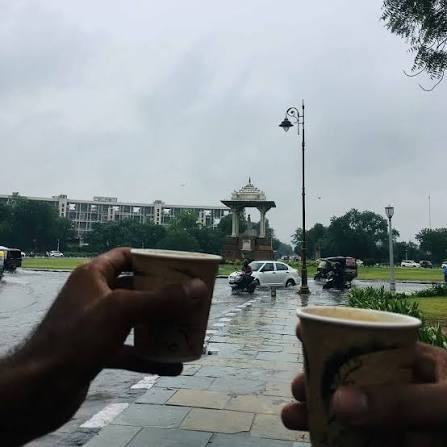
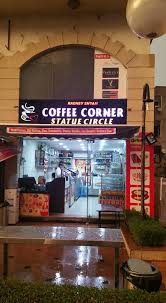
Avoid publishing permanent claims such as “the best coffee stall” unless the business has been checked recently. A stall name, price or operating hour can become outdated much faster than the monument’s history.
6. Photograph Statue Circle without taking a road risk
Useful compositions include:
A wide blue-hour frame showing the statue, fountain area and moving city.
A tighter vertical image of Sawai Jai Singh II and the astronomical diagram.
A night exposure with light trails, taken from a legal stationary viewpoint.
A human-scale coffee shot with the monument softly visible in the background.
A detail of the landscaped edge after rain, when the greenery appears richer.
Do not stop a vehicle in a live lane, sit on a median or ask children to pose near moving traffic. A telephoto setting or phone zoom produces a safer close view than crossing toward the centre.
Things to do near Statue Circle Jaipur at night
A relaxed evening can be simple:
Reach Statue Circle around sunset and spend 20-30 minutes viewing and photographing the monument.
Stop for coffee or a light snack if a clean, active stall appeals to you.
Continue to Central Park for a walk, or see Amar Jawan Jyoti’s evening illumination near the Vidhan Sabha area.
Finish with dinner in C-Scheme, where there are casual cafes as well as family and fine-dining options.
This sequence works because it follows Jaipur’s modern central district rather than forcing a return to the Walled City after dark. Check each venue’s live hours before leaving, especially if travelling with children or older family members.
Places to visit near Statue Circle Jaipur
Statue Circle works best as an add-on to nearby places, not as a standalone half-day outing. Distances below are approximate and can change by gate and route.
| Nearby place | Approx. distance from Statue Circle | Why combine it | Suggested time |
| B. M. Birla Auditorium and Planetarium area | 0.2-0.5 km | Cultural venue and familiar navigation landmark | Check programme; 30-90 minutes if attending |
| Central Park | 0.5-1 km | Green space, walking and a better family pause | 30-60 minutes |
| Amar Jawan Jyoti | About 1.5-2 km | Memorial with attractive evening illumination | 15-30 minutes |
| Raj Mandir Cinema | About 2 km | Iconic cinema architecture and a possible evening show | Photo stop or full film duration |
| Albert Hall Museum / Ram Niwas Garden | 2.5-3.5 km | Museum, Indo-Saracenic architecture and night exterior views | 60-120 minutes |
| Birla Mandir | About 3 km | White-marble temple, especially appealing near evening prayer | 30-60 minutes |
| Hawa Mahal | 4-5 km | Jaipur’s best-known facade in the Walled City | 20-minute exterior stop or longer old-city visit |
| City Palace and Jantar Mantar | 4-5 km | Royal history and Jai Singh II’s astronomical legacy | 2-3 hours together |
A practical 60-minute plan
Reach 20-30 minutes before sunset. Photograph Statue Circle in daylight, read the monument details, wait for the evening lights, and finish with one coffee. This is the right plan if you are between appointments, staying in C-Scheme or heading to dinner nearby.
A two-hour family plan
Spend 20 minutes at Statue Circle, then move to Central Park for a proper walk. Return to C-Scheme for an early dinner. This gives children space without asking them to stay beside a traffic junction for too long.
A heritage connection plan
Visit City Palace and Jantar Mantar earlier in the day. After a break, come to Statue Circle at sunset. The sequence links Jai Singh II’s royal and scientific legacy with the modern city that commemorates him.
A modern Jaipur evening plan
Start at Statue Circle, continue towards Amar Jawan Jyoti, and end with dinner or a cinema visit around C-Scheme/MI Road. It is a useful counterpoint to a day spent among forts and bazaars.
Practical visitor advice: families, accessibility, safety and honest expectations
Visiting with children
Statue Circle can hold a child’s attention for a short stop, particularly when the lights or fountain are on. The story of a king who studied the sky also creates an easy bridge to Jantar Mantar. Still, the location is a roundabout first. Hold younger children by the hand, avoid peak traffic crossings and do not rely on the garden as a play area. For a family outing, pair it with Central Park, a planetarium programme or an early dinner.
Accessibility and older travellers
The surrounding district is largely flat, but kerbs, crossing distances, traffic and temporary vendor placement can make the last few metres harder than the map suggests. Wheelchair users and travellers with limited mobility should arrange a safe outer-road drop-off, avoid crossing multiple lanes and confirm whether the desired garden approach is open and step-free. Viewing the monument from the vehicle-side pavement may be more comfortable than entering the central landscaped area.
Traffic and parking safety
Statue Circle’s visual appeal can distract from its main function as a busy junction. Use designated crossings where available, follow police directions and never park beside a stall simply because another vehicle has done so. The 2026 no-parking restriction on the Statue Circle-Ambedkar Circle-Assembly corridor makes a cab or auto especially sensible at busy times.
Weather and comfort
Carry drinking water from March to October. Winter evenings can feel much cooler after sunset than the afternoon, so a light layer helps. In the monsoon, watch for slippery edges and sudden rain. Air quality, road dust and noise can vary with traffic; visitors who need a quiet green space should go directly to Central Park.
Is Statue Circle Jaipur worth visiting?
Yes, if you are nearby, enjoy city landmarks or want a short local evening stop. It is free, central and visually appealing after dark. It is also a useful link between Jai Singh II’s history and modern Jaipur.
Do not make a long cross-city detour if your first Jaipur visit is extremely short. Amber Fort, City Palace, Jantar Mantar, Hawa Mahal and Albert Hall offer much deeper sightseeing. Statue Circle is best treated as a 20-40 minute addition, not a replacement for them.
That honest expectation is the key to enjoying it. Arrive for a small, atmospheric piece of Jaipur life rather than a formal monument tour.
Frequently asked questions about Statue Circle Jaipur
What is Statue Circle Jaipur famous for?
Statue Circle is famous for its life-size white-marble statue of Maharaja Sawai Jai Singh II, the founder of Jaipur. It is also known for evening illumination, landscaped surroundings, coffee and snack stalls, and its central location in C-Scheme.
Is Statue Circle open at night?
Yes. The public road landmark is visible at night and is commonly visited in the evening. Garden access, vendors, decorative lights and fountains may follow variable schedules, so “open 24 hours” should not be read as a guarantee that every feature will operate all night.
Is there an entry fee for Statue Circle Jaipur?
No. There is no general entry ticket for Statue Circle. Visitors can view and photograph the public landmark free of charge. Parking, food, transport or special-event services may cost extra.
Does the Statue Circle fountain have a fixed show time?
No dependable official daily show time was found during the August 2026 fact-check. The fountain may operate in the evening, but availability can change. Verify locally if seeing the fountain is important to your visit.
How far is Statue Circle from Jaipur railway station and airport?
Statue Circle is roughly 3-4 km by road from Jaipur Junction and around 10-12 km from Jaipur International Airport. Allow about 10-20 minutes from the railway station and 25-45 minutes from the airport, depending on traffic and the route used.
Useful external resources
Rajasthan Tourism’s official Jaipur guide and Statue Circle listing: https://www.tourism.rajasthan.gov.in/jaipur.html
UNESCO’s Jaipur City, Rajasthan page: https://whc.unesco.org/en/list/1605/
UNESCO’s Jantar Mantar, Jaipur page: https://whc.unesco.org/en/list/1338/
Rajasthan Tourism’s Jantar Mantar history page: https://www.tourism.rajasthan.gov.in/jantar-mantar.html
Live Google Maps search for Statue Circle: https://www.google.com/maps/search/?api=1&query=Statue+Circle+Jaipur
Jaipur Metro information portal: https://transport.rajasthan.gov.in/content/transportportal/en/metro.html
February 2026 no-parking update for the Statue Circle corridor: https://timesofindia.indiatimes.com/city/jaipur/now-statue-circle-to-assembly-t-point-a-no-parking-zone/articleshow/127950505.cms
Conclusion
Statue Circle Jaipur is a free central landmark that makes most sense as a short morning or evening stop. Its white-marble statue honours Sawai Jai Singh II, the founder whose planning vision and astronomical interests shaped Jaipur’s identity. The circle is easy to reach from C-Scheme, Jaipur Junction and the Walled City, but traffic and parking deserve more attention than most guides admit.
Visit around sunset for the best balance of light and atmosphere, allow 20-40 minutes, and treat the fountain as a bonus rather than a promised show. If you have more time, combine Statue Circle with Central Park, Jantar Mantar, Albert Hall or a C-Scheme evening. Next, read a one-day Jaipur itinerary or a guide to the best family-friendly places in central Jaipur to plan the rest of your route.