

Nahargarh Fort Jaipur: Timings, Entry Fee, History, Distance & Architecture
Nahargarh Fort is easy to spot from Jaipur and surprisingly easy to plan badly. The fort sits directly above the old city, yet the motorable route winds around the Aravalli ridge. Many travel pages still show pre-2026 ticket prices or an old closing time. And if you arrive only a few minutes before sunset, you may get the view but miss Madhavendra Bhawan—the part that gives the visit its architectural depth.
This guide brings together current timings, revised 2026 fees, road distances, transport, parking, sunset planning, history, architecture, photo spots and nearby places. Details were checked on 23 August 2026; use the linked official portal as the final authority on your travel date.
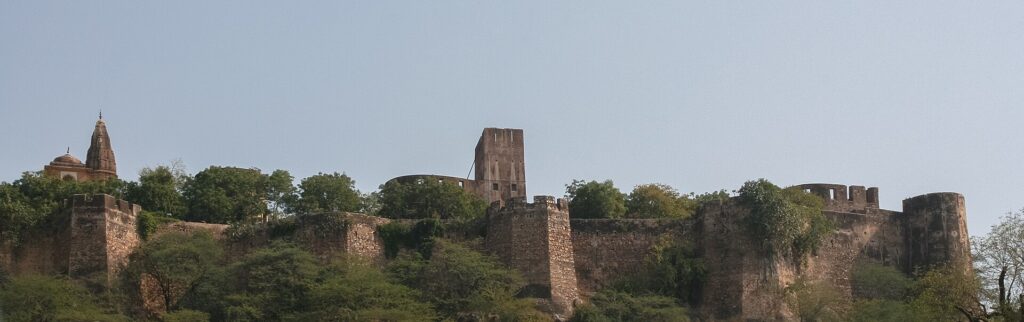
Nahargarh Fort Jaipur quick facts
| Detail | Current planning information |
|---|---|
| Location | Krishna Nagar, Brahampuri, Jaipur, Rajasthan 302002 |
| Map coordinates | 26.9375° N, 75.8158° E |
| Nahargarh Fort opening time | 10:00 AM |
| Nahargarh Fort closing time | 10:00 PM on the current official OBMS listing |
| Weekly holiday | Open daily; the official listing identifies Dhulandi as a holiday |
| Entry fee for Indian adult | ₹100 |
| Entry fee for Indian student | ₹50; carry a valid current student ID |
| Entry fee for foreign adult | ₹600 |
| Entry fee for foreign student | ₹300; carry valid student ID |
| Time needed | 2–3 hours for the fort, palace and viewpoints |
| Best season | October to March |
| Best time of day | About 90 minutes before sunset |
| Built by | Maharaja Sawai Jai Singh II in 1734 |
| Main architectural highlight | Madhavendra Bhawan |
Nahargarh Fort is open from 10:00 AM to 10:00 PM according to Rajasthan’s current official booking portal. In 2026, the main fort ticket costs ₹100 for Indian adults and ₹600 for foreign adults. Student concessions are available with valid identification. Separate attractions and restaurants on the hill may have different prices and earlier closing times.
Nahargarh Fort timings and entry fee in 2026
What are the current Nahargarh Fort timings?
The current Rajasthan government OBMS listing for Nahargarh Fort shows 10:00 AM to 10:00 PM. It also identifies Dhulandi—the day after Holika Dahan—as a holiday. This is the most useful source to check immediately before visiting.
You may still find websites that list 5:30 PM or 6:00 PM as the Nahargarh Fort closing time. Those timings often come from older daytime schedules or refer to a particular museum, palace section or ticket counter rather than the whole visitor complex. Do not assume that every interior remains accessible until 10:00 PM. If Madhavendra Bhawan matters to you, arrive by late afternoon and confirm the last admission time at the counter.
Nahargarh Fort ticket price: revised rates from January 2026
Rajasthan revised admission charges for state-controlled monuments from 1 January 2026. The updated adult rate for Nahargarh Fort is ₹100 for Indian visitors and ₹600 for foreign visitors. That change is important because many search results still quote the former ₹50 and ₹300 rates.
| Visitor category | Nahargarh Fort entry fee 2026 |
| Indian citizen | ₹100 |
| Indian student | ₹50 |
| Foreign citizen | ₹600 |
| Foreign student | ₹300 |
Student tickets normally require a valid, current identity card from a recognised institution. If a child does not qualify under the current concession rules, the counter’s decision applies. Online booking or payment charges may also make the final amount slightly different from the base ticket.
The official OBMS portal also lists a two-day Jaipur composite package: ₹550 for an Indian citizen, ₹180 for an Indian student, ₹1,700 for a foreign citizen and ₹800 for a foreign student at the time of checking. Review the live inclusion list before buying; City Palace and Jaigarh Fort are independently managed.
What the main ticket does not automatically include
Do not treat every attraction carrying the “Nahargarh” name as part of the fort ticket.
- Jaipur Wax Museum and Sheesh Mahal: Rajasthan Tourism currently lists a separate combined ticket of ₹500 for Indian visitors and ₹700 for foreign visitors, with 10:00 AM–6:00 PM hours. Recheck before paying.
- Padao or other food outlets: A cover charge, minimum spend or separate entry condition may apply. Ask what is included before ordering.
- Guide services: A guide is optional and charged separately.
- Professional shoots: Drones, extensive lighting, commercial video work or large equipment may require prior permission even when ordinary personal photography is allowed.
Money-saving tip: If Nahargarh is your only paid state monument that day, buy the individual ticket. If you are entering Hawa Mahal, Jantar Mantar, Albert Hall and Amer Palace as well, compare the live composite package with the sum of individual prices.
Nahargarh Fort location, distance from Jaipur and how to reach
Nahargarh Fort is on the northern edge of Jaipur’s Aravalli Hills at approximately 26.9375° N, 75.8158° E. Use the fort name or coordinates rather than searching only for “Nahargarh”: the area also contains a biological park, wildlife sanctuary, hotels and similarly named businesses. Open the exact point in Google Maps before leaving.
How far is Nahargarh Fort from Jaipur?
The answer depends on whether someone is quoting straight-line distance, walking distance or the motor road. The fort looks close to the old city, but vehicles must follow the longer hill road.
| Starting point | Approximate road distance | Usual planning time* |
| Hawa Mahal / old city | About 13 km | 30–45 minutes |
| Jal Mahal | About 9–10 km | 20–35 minutes |
| Amer Palace | About 10 km | 25–40 minutes |
| Jaipur Junction railway station | About 18–20 km by motor road | 35–55 minutes |
| Sindhi Camp bus stand | About 18–20 km by motor road | 35–55 minutes |
| Jaipur International Airport | About 26–27 km | 50–75 minutes |
*Drive times are estimates, not promises. Weekends, public holidays, wedding-season traffic and congestion around Amer Road can add time. Rajasthan Tourism itself describes the fort as roughly 20 km from the railway station and bus stand by the practical road route.
Best ways to reach Nahargarh Fort
Cab or private car: This is the simplest option for families and sunset trips. The road is paved but winding, with narrow bends. Ask whether the driver will wait or arrange your return before going up; finding a fresh ride after sunset can be unpredictable.
Auto-rickshaw: Autos do travel to Nahargarh, but not every driver wants the hill climb. Agree on the round-trip fare, waiting time and drop point before starting. A screenshot or written confirmation helps avoid confusion later.
Public transport: There is no dependable direct city bus to the fort entrance. A bus or metro can take you closer to the old city, but it does not solve the uphill section. Rajasthan Tourism recommends a taxi or rented car for the to-and-fro journey.
On foot: A steep cobbled route rises from the old-city side. Fit adults may enjoy it in mild weather, but it is not a casual shortcut. Carry water, wear shoes with grip, climb in daylight and do not walk back alone after sunset. A vehicle is better for small children, older adults and anyone with mobility concerns.
Nahargarh Fort parking
Vehicle parking is available near the visitor area, followed by a short walk to the main sections. Space can tighten around sunset, on Sundays and during holiday periods. Parking charges and traffic arrangements are not consistently published, so carry a small amount of cash, follow on-site signs and ask for a receipt if a fee is collected. Do not leave luggage, cameras or other valuables visible inside the vehicle.
Best time to visit Nahargarh Fort and plan the sunset
October to March is the most comfortable season for a Nahargarh Fort visit. Rajasthan Tourism’s climate guidance puts January–March broadly around 10°C–27°C and October–December around 13°C–30°C. By contrast, April–June can reach about 45°C. The fort has exposed terraces and long stretches with limited shade, so a pleasant city temperature can still feel sharper on the stone and open ridge.
July to September brings greener Aravalli views, dramatic clouds and fewer dusty horizons. It also brings slippery surfaces, sudden rain and a greater chance of haze hiding the city. Check the IMD Jaipur forecast and warnings on the morning of your visit, particularly during monsoon.
The easiest Nahargarh Fort sunset plan
Check Jaipur’s local sunset time for your date and reach the parking area at least 90 minutes earlier. That buffer gives you time to buy tickets, explore Madhavendra Bhawan and move to an authorised viewpoint without racing through the fort.
A practical two-and-a-half-hour visit looks like this:
- First 15 minutes: Park, use the restroom if needed, buy or validate tickets and ask about the day’s last-entry rules.
- Next 60 minutes: Explore Madhavendra Bhawan, its courtyards, painted passages and terraces.
- Next 30 minutes: Walk through the rampart and water-management areas that are open to visitors.
- Final 45 minutes: Settle at a permitted west-facing viewpoint for golden-hour and city-light photographs.
“Nahargarh Fort sunset point” is often used as if it were one marked platform. In practice, visitors use several terraces, rampart viewpoints and the Padao side, subject to current access control. Stay behind barriers. A wider view is not worth sitting on an exposed wall or stepping into a closed section.
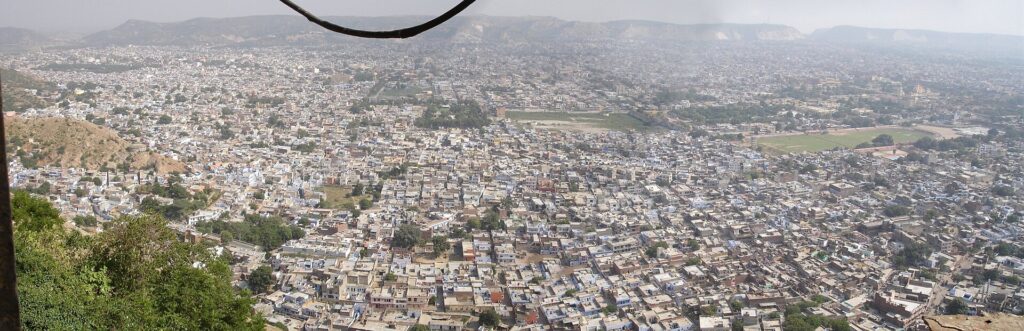
Where to take the best Nahargarh Fort Jaipur photos
- Frame Jaipur through an arch or jharokha instead of taking only a wide skyline.
- Photograph Madhavendra Bhawan’s repeating doors and corridors from the centre line; its symmetry is the subject.
- Use the last side-light of the day on yellow plaster, fresco details and textured ramparts.
- Take one panorama before sunset and another after the city lights appear, if the area remains open.
- Never cross a rope or railing for a cleaner frame.
Nahargarh Fort history: who built it and why?
Maharaja Sawai Jai Singh II, the founder of Jaipur, built Nahargarh Fort in 1734. Its ridge-top position strengthened the northern defence of the new capital and complemented the older fortifications around Amer and Jaigarh. The fort was also conceived as a place of royal retreat—not simply as a battlefield stronghold.
The earliest fort was reportedly called Sudarshangarh. “Nahargarh” is commonly translated as “abode of tigers” and is also tied to the legend of Nahar Singh Bhomia. The fort was expanded in 1868 under Sawai Ram Singh II. Sawai Madho Singh II later commissioned Madhavendra Bhawan, completed around 1892.
Nahargarh’s strength was largely preventive: historical accounts do not place it at the centre of a major assault. It did, however, participate in Jaipur’s political life. During the 1857 uprising, Europeans living in the region—including the British Resident’s family—were moved to the fort for protection under Sawai Ram Singh II. That episode shows how the ridge functioned as a secure refuge as well as a symbol of authority.
Is the Nahargarh Fort haunted story true?
The haunted story belongs to local folklore, not verified paranormal history. According to the best-known version, construction work kept failing because the spirit of Nahar Singh Bhomia, a local prince or warrior, objected to the fort being built on the hill. The spirit was said to have been appeased after a shrine was dedicated to him and the fort was named in his honour.
A temple associated with Nahar Singh helps explain why the legend endured, but it is not evidence that the fort is haunted. Do not confuse Nahargarh with Bhangarh Fort, a different Rajasthan site with separate legends and access rules.
For deeper historical context, consult Rajasthan Tourism’s official Nahargarh Fort overview and historian Jadunath Sarkar’s A History of Jaipur, c. 1503–1938.
Nahargarh Fort architecture and Madhavendra Bhawan
Nahargarh’s architecture makes more sense when read as two overlapping ideas. The outer fort responds to defence, terrain and water scarcity. Madhavendra Bhawan responds to privacy, comfort, ceremony and the visual order of a royal residence.
Defensive walls and water engineering
The fort follows the ridge rather than imposing a neat city-style rectangle on the landscape. Long ramparts, bastions, controlled gateways and elevated sightlines allowed the rulers to watch the approaches to Jaipur. The official booking portal also highlights extensive tankas—covered rainwater-storage cisterns—and two stepwells. On a dry hilltop, these were not decorative extras. They were the infrastructure that made extended occupation possible.
Look at how the walls bend with the land and how openings balance observation with protection. Nahargarh feels less monumental than Amer Palace at first glance, but its relationship with the Aravalli ridge is the architectural story.
What makes Madhavendra Bhawan special?
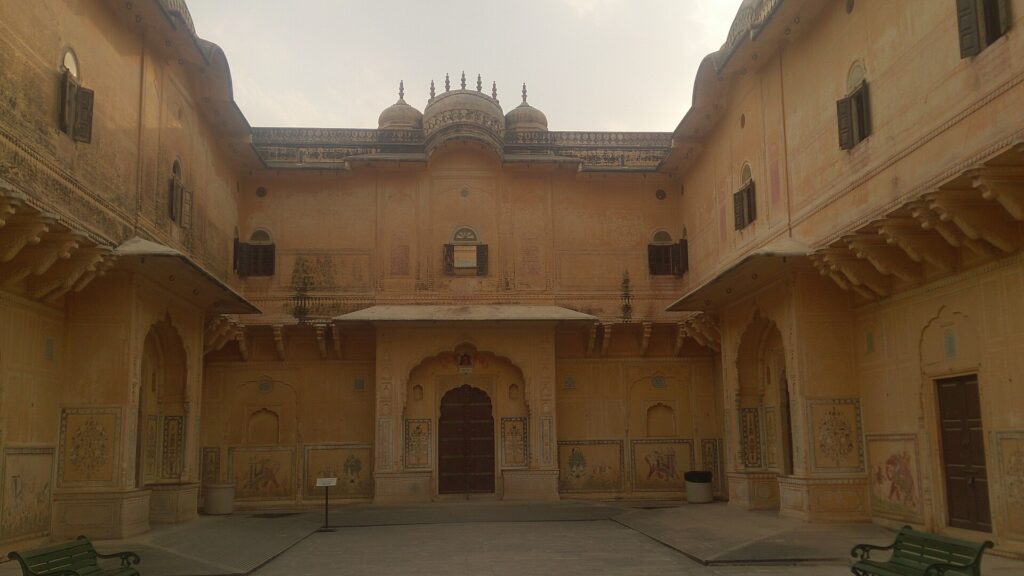
Madhavendra Bhawan is a late-19th-century, two-storey palace organised around courtyards and a repeating sequence of royal apartments. Suites are linked by corridors, with delicate floral frescoes, arched openings, small rooms, painted surfaces and terraces that frame Jaipur below. Repetition creates both privacy and visual rhythm: from one doorway, the next appears almost like a reflection.
Descriptions disagree over nine queen’s apartments or 12 matching boudoirs, partly because an apartment contains several rooms. The Rajasthan Tourism page uses “12 matching boudoirs”; architectural accounts commonly describe nine apartment groups plus the king’s section.
The palace is often labelled “Indo-European.” Its enclosed courtyards, screened circulation and controlled privacy are strongly Rajput, while some windows, fittings and late-19th-century domestic details show European influence.
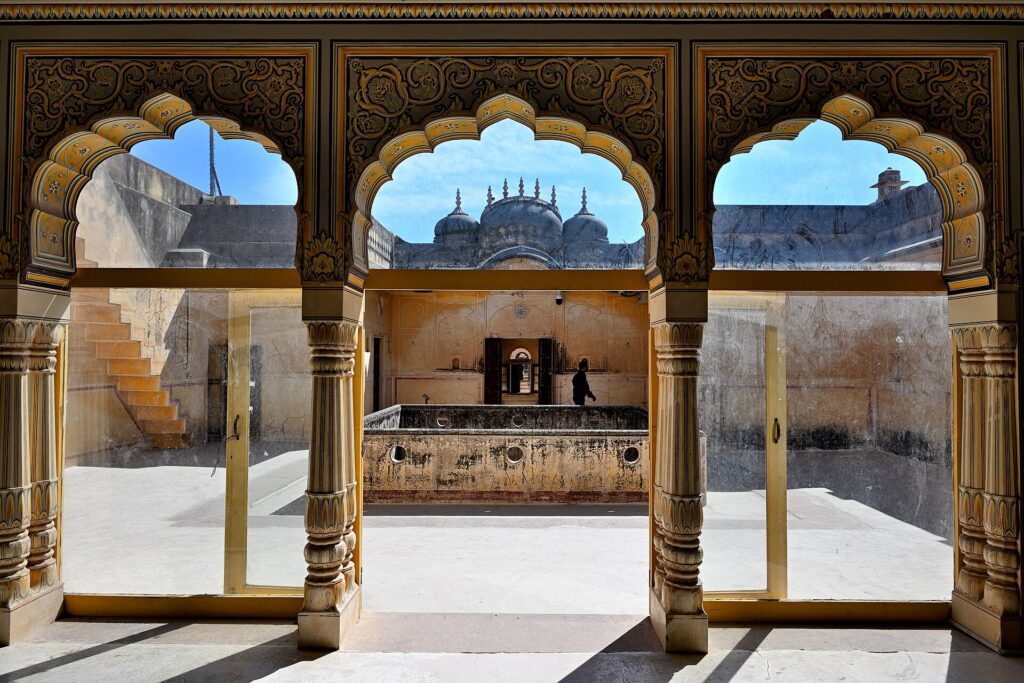
What to notice while walking through the palace
- Stand in a courtyard and trace the repeated apartment entrances before entering a room.
- Look for surviving floral lines and colour on walls and ceilings rather than expecting every surface to be fully restored.
- Notice how narrow passages let the building reveal itself gradually.
- Compare the sheltered inner rooms with the bright, exposed terraces.
- From the roofline, relate the palace geometry to Jaipur’s street grid below.
Plan a comfortable visit: guide, family tips and nearby places
How much time should you keep?
Allow two to three hours for the fort, Madhavendra Bhawan, photographs and sunset. A one-hour stop works only if your aim is a quick city view. Architecture lovers may want closer to three hours. Add extra time for the Wax Museum, a meal or heavy weekend traffic.
Do you need a Nahargarh Fort tour guide?
A guide is not essential for navigation, but a good guide helps visitors notice the water system, construction phases, frescoes and the difference between documented history and legend. If hiring someone at the gate, ask to see identification and agree on four things before starting: total fee, language, route and duration. Do not pay a vague “per point” rate.
For a more reliable starting point, use Rajasthan Tourism’s guide and recognised travel-agency resources or contact its Jaipur information office. Guide availability at an individual monument can vary, so book ahead if you need a particular language or a child-friendly storytelling style.
Visiting Nahargarh Fort with children or older adults
The hilltop can be reached by vehicle, but step-free access to every palace room and terrace should not be assumed. Expect uneven thresholds, staircases, narrow corridors and sun-exposed walking. A stroller may help near the entrance but becomes awkward inside historic sections.
For a smoother family visit:
- carry drinking water, caps and sunscreen;
- use closed, non-slip footwear;
- keep young children beside an adult near terraces and ramparts;
- plan a restroom break before beginning the palace circuit;
- avoid the harsh 12:00–3:00 PM window in hot months;
- ask staff about the easiest available route if someone has limited mobility;
- leave before the return journey becomes tiring, even if the complex remains open later.
Places to visit near Nahargarh Fort
| Nearby attraction | Why combine it | Planning note |
| Amer Palace | Jaipur’s grandest palace-fort experience | Visit early; it needs 2–3 hours |
| Jaigarh Fort | Strong military architecture and ridge views | Best for visitors interested in fortifications |
| Jal Mahal viewpoint | Quick photo stop beside Man Sagar Lake | The palace itself is not a routine walk-in visit |
| Gaitore Ki Chhatriyan | Quieter royal cenotaphs with detailed stone carving | Check its separate hours before going |
| Hawa Mahal and City Palace area | Old-city architecture, markets and food | Allow for traffic and parking |
| Nahargarh Biological Park | Wildlife-focused outing near the Amer–Delhi Road side | It is a separate attraction, not inside the fort |
A workable hill-forts day starts with Amer Palace in the morning, continues to Jaigarh before lunch and ends at Nahargarh about 90 minutes before sunset. With younger children, choose Amer or Jaigarh, not both, before Nahargarh; three forts in one day can turn an interesting trip into a tiring checklist.
Frequently asked questions about Nahargarh Fort Jaipur
What is the Nahargarh Fort opening and closing time in 2026?
The current official Rajasthan OBMS page lists Nahargarh Fort from 10:00 AM to 10:00 PM. Some interior sections and separate attractions may close earlier, so arrive by late afternoon if you want to see Madhavendra Bhawan before sunset.
What is the Nahargarh Fort entry fee in 2026?
The base ticket is ₹100 for an Indian adult and ₹600 for a foreign adult. Current student rates are ₹50 for Indian students and ₹300 for foreign students with valid identification. Separately operated attractions such as the Wax Museum are not included.
How far is Nahargarh Fort from Jaipur city?
It is close to Jaipur in a straight line but farther by road because vehicles must wind around the hill. Hawa Mahal is about 13 km away, while Jaipur Junction and Sindhi Camp are roughly 18–20 km away by the practical motor route.
Can I watch the sunset from Nahargarh Fort?
Yes. Nahargarh is one of Jaipur’s best-known sunset viewpoints. Reach at least 90 minutes before sunset so you can see the palace first, then move to a permitted terrace or rampart viewpoint. Confirm the day’s access and last-entry rules when you arrive.
Is Nahargarh Fort really haunted?
There is no verified evidence that Nahargarh Fort is haunted. The story comes from folklore about Nahar Singh Bhomia, whose spirit was said to have disrupted construction until a shrine was built and the fort took his name.
Conclusion
Nahargarh Fort is worth more than a rushed sunset stop. The current official listing gives visitors a generous 10:00 AM–10:00 PM window, while the 2026 state entry fee is ₹100 for Indian adults and ₹600 for foreign adults. Keep two to three hours, travel by cab or car if possible, reach well before sunset and spend time inside Madhavendra Bhawan before heading to the city viewpoints.
Before leaving, check the official Rajasthan ticket portal for live timings, prices and closures, then build the rest of your day around one or two nearby attractions—not every fort on the map. For a family trip, the next helpful step is to read a Jaipur-with-kids itinerary and choose a pace that leaves room to enjoy the view.



Pingback: Places to Visit in Jaipur in 3 Days: Itinerary, Prices & Timings- 2026
Pingback: Jaipur Itinerary for 2 Days: Timings & Costs (2026)