
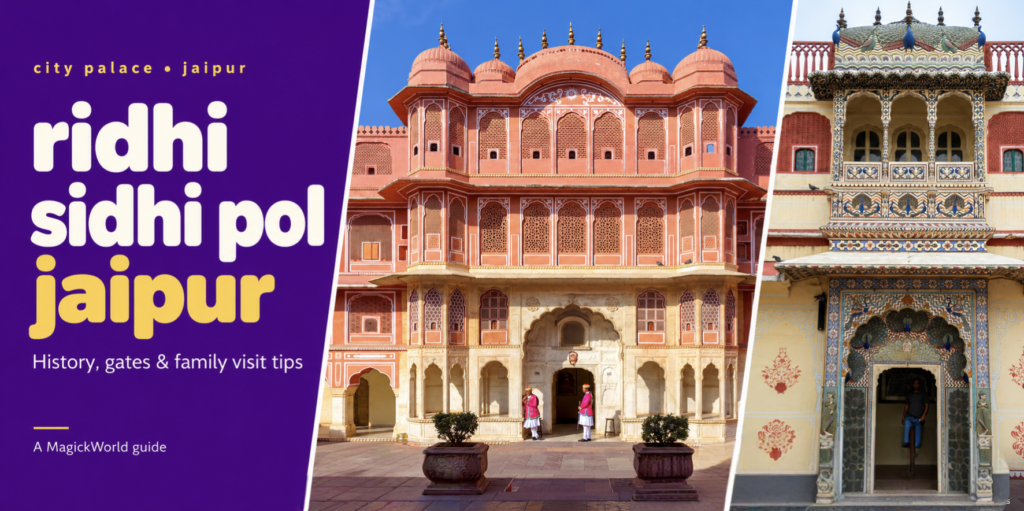
Ridhi Sidhi Pol Jaipur Guide to Gates Tickets and Family Visits
You have seen Jaipur’s beautifully painted palace doors in photographs. Planning a visit should be straightforward, yet one page calls them Ridhi Sidhi Pol, another says Pritam Niwas Chowk, and the ticket prices seem to change with every search. For a family trying to fit sightseeing around lunch, naps and the afternoon heat, that uncertainty matters.
The useful starting point is simple: Ridhi Sidhi Pol belongs within the City Palace visit in Jaipur. It is associated with the approach to Pritam Niwas Chowk, the courtyard known for its four decorated doorways. Plan your arrival at the palace, rather than treating the name as a separate attraction across town. [1]
This guide explains how the gateway and courtyard fit together, what to notice beyond the famous Peacock Gate, which admission options to compare, and how to build a manageable outing. There is also an important correction to a story repeated in many travel guides: the four gates’ supposed connection with four seasons is an interpretation the museum itself questions.
What Ridhi Sidhi Pol is and where it fits inside City Palace
The gateway and the courtyard are connected but different
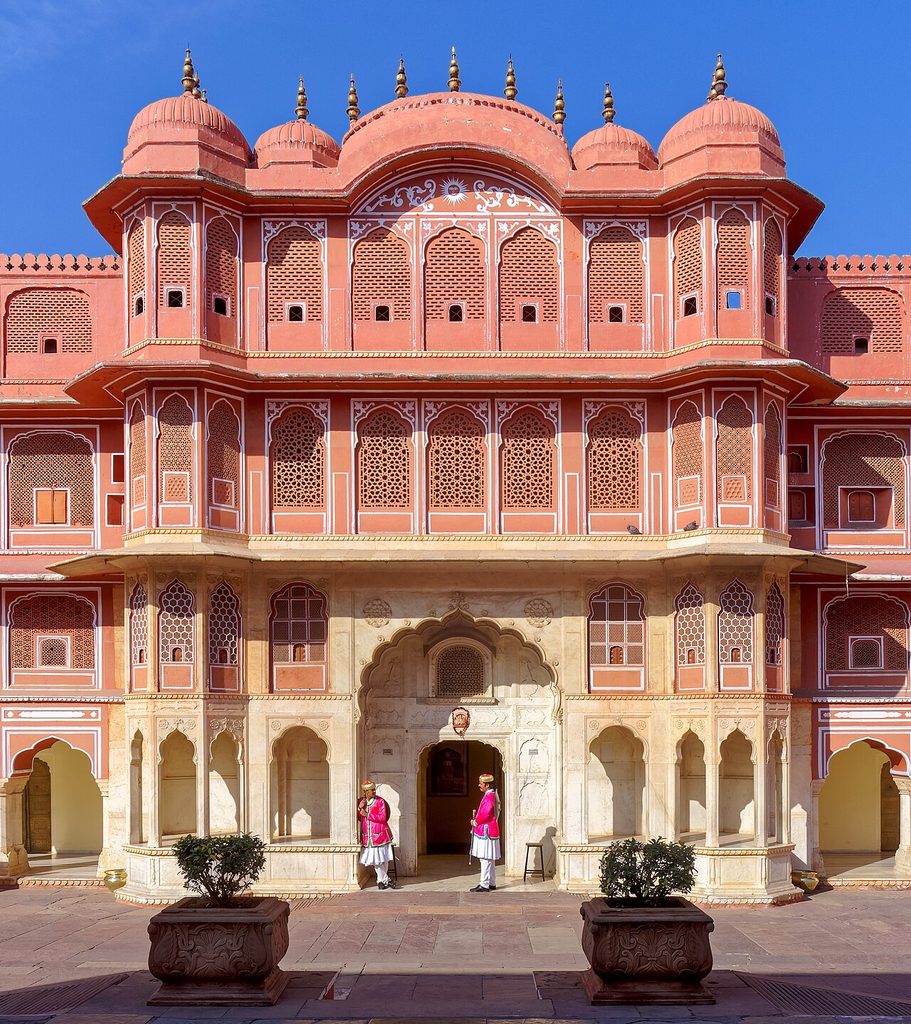
Ridhi Sidhi Pol is an internal palace gateway associated with the passage towards Pritam Niwas Chowk. The Peacock, Lotus, Green and Rose doors belong to the courtyard beyond. Travel listings sometimes use the gateway’s name loosely for the whole group, which explains why photographs and descriptions do not always match. [1][2]
For directions, ask for City Palace Museum and Pritam Niwas Chowk. Once inside, use the visitor map and staff guidance to find the courtyard. This is more useful than trying to identify every historical doorway from a search-result photograph before you arrive.
Think of the visit in three stages: entering the museum complex, moving between its public courtyards, and reaching the decorated inner courtyard. That distinction also helps when buying tickets. A picture of an internal doorway does not show where you should queue outside, and a photograph of an ornate royal room does not establish what general admission includes.
The alternative spelling Riddhi Siddhi Pol Jaipur refers to the same attraction in travel listings. You may also see Pritam written as Pitam. Keep the palace name in your map search so a spelling variation does not become a navigation problem. [1][2]
A short history without an invented construction date
Ridhi Sidhi Pol history makes more sense within the development of the palace. The museum’s brochure records that Maharaja Sawai Jai Singh II moved his court from Amber to Jaipur in 1727. It describes a palace organised around seven interconnected courtyards, with Chandra Mahal at its heart. Those spaces provided privacy and protection as well as room for court life. [3]
The present museum website describes construction and additions continuing across generations. It also dates the museum’s establishment to 1959. The complex therefore combines buildings, collections and uses from different periods; it should not be read as something completed in one uninterrupted building campaign. [4]
That context matters when a guide assigns a precise year to every gate. A date associated with Jaipur’s founding or the early palace does not automatically establish the date of an individual doorway. For this visit, understanding the movement from public court spaces towards a royal residential setting is more valuable than memorising an unsupported year.
Is it worth making time for?
Include this part of the palace if you enjoy decorative art, architectural details or a short visual introduction to Jaipur’s court culture. You can appreciate the doorways without knowing specialist terms: flowers, birds, repeating patterns and figures above the openings give you plenty to notice.
It also works well for mixed-interest groups. One person can study the decoration while another enjoys the larger courtyard setting. Children can compare shapes and colours without being expected to read every museum label.
If you want only one quick photograph and have little interest in the rest of City Palace, weigh the full admission cost against that goal. The better-value visit is usually one in which the courtyard forms part of a broader museum outing. Allowing time for a few other displays makes the journey, queue and ticket purchase feel more worthwhile.
What to see around Pritam Niwas Chowk and the four gates
How to read Ridhi Sidhi Pol architecture
Before joining a photograph queue, stand where you can take in the arrangement of the space. Look at how the doorways sit within larger walls and how the palace rises around them. A tightly cropped photograph can make each entrance appear to be a freestanding attraction; seeing the courtyard restores its architectural setting.
The museum describes Pritam Niwas Chowk as directly attached to Chandra Mahal and associated with smaller private royal celebrations. Its brochure calls the decorated entrances aaraish gates or deories. These terms are useful to recognise, although you do not need them to enjoy the visit. [3]
A practical approach is to make one slow circuit before deciding where to take portraits. You will see more, identify the busiest spot, and avoid spending your entire visit waiting at the first doorway that catches your attention.
The four decorated doorways at a glance
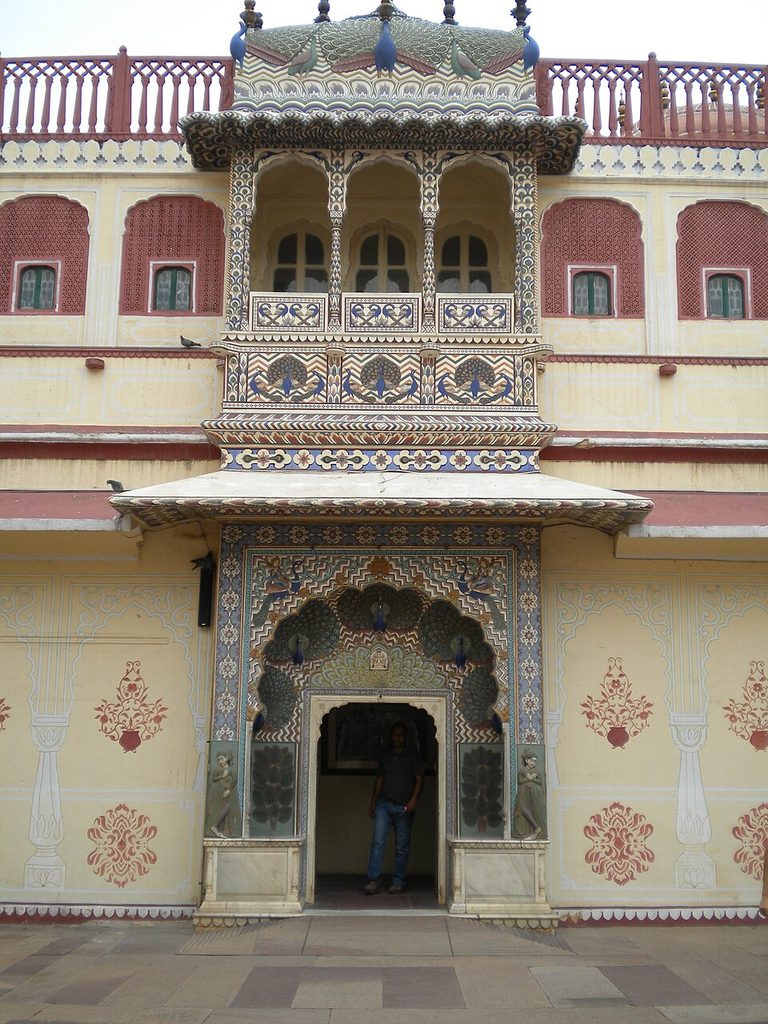
| Doorway | Main visual clue | Deity association described by The Heritage Lab |
| Peacock Gate | Peacocks surrounding the entrance | Vishnu |
| Lotus Gate | Repeated lotus decoration | Shiva |
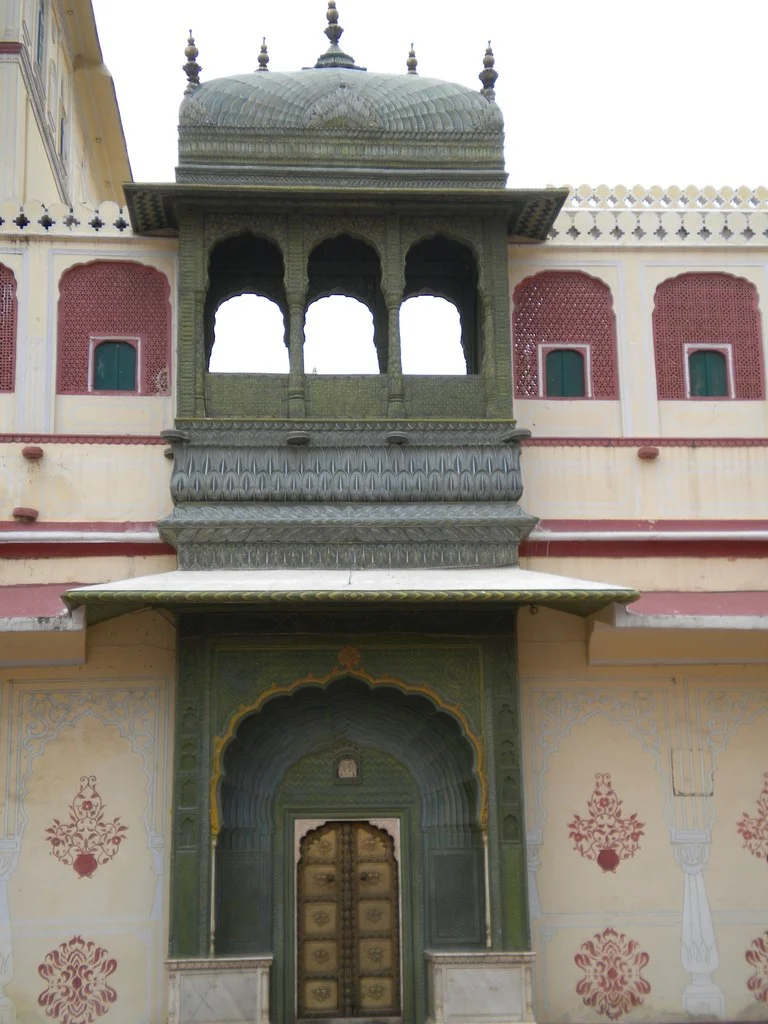
| Green or Leheriya Gate | Green decoration with wave-like patterns | Ganesha |
| Rose Gate | Repeated rose motifs | Devi |
The Heritage Lab describes the deity connections and the figures above the entrances. Use these as a starting point, then compare them with the labels and interpretation available during your visit. [5]
Peacock Gate and the details beyond the portrait
The peacocks make this doorway easy to recognise. In photographs, their forms gather around the arch and create an elaborate frame. Look first at the broad arrangement, then at how smaller painted elements fill the spaces around the birds.
For a more satisfying visit, try taking three different pictures: the whole doorway within its wall, a closer view of the peacock decoration, and one portrait. Each records something different. A portrait alone can leave out the very details that made you want to visit.
If people are waiting, decide your position and camera settings before taking your turn. Ask your companion to step in, take a short set of photographs, and move aside. You can return to study the decoration from a respectful distance without keeping the entrance occupied.
Lotus Gate and how repeated patterns change the effect
At the Lotus Gate, shift your attention from individual birds to repeating flowers. Notice how a motif is repeated across a surface and how the border frames the opening. You do not need to identify a painting technique to recognise the planning involved.
This is a useful place to slow down after the more recognisable Peacock Gate. Compare what your eye notices first at each doorway. Is it a central figure, a strong colour, the outline of the arch, or the repetition of a flower?
For children who like drawing, suggest remembering one simple shape to sketch later. Trying to reproduce an entire decorated entrance on the spot can turn an enjoyable observation into a frustrating task. One petal or border pattern gives them a more manageable connection with what they have seen.
Green Gate and its wave-like decoration
The Green Gate, also called the Leheriya Gate, provides a clear visual change. Its green palette and repeated curved forms offer an easy comparison with the flower and bird decoration elsewhere in the courtyard.
Look above the entrance as well as around it. Visitors concentrating on a portrait position can miss the figure that helps explain the doorway’s religious association. A guide can be particularly useful here if your group wants to understand the imagery rather than simply identify the colours.
A simple observation game works well: ask everyone to choose one detail they would use to recognise this gate in a photograph with the rest of the image hidden. Compare their answers after looking at the other entrances. Adults often notice just as many different things as children do.
Rose Gate and a useful final comparison
The Rose Gate rewards a closer look at floral repetition. Rather than treating it as the final item on a checklist, compare its decoration with the Lotus Gate. Both use flowers, but the shape, arrangement and overall visual effect give each a different identity.
Ask which doorway feels most detailed from far away and which becomes more interesting as you approach. There is no correct answer. This sort of comparison helps a group spend time looking at the building itself instead of moving directly from one photograph to the next.
Finish your circuit by looking back across the courtyard. You should now be able to distinguish the four entrances by their decoration, even if you cannot recall every name. That is a more useful memory than a rushed sequence of nearly identical portraits.
Do the City Palace Jaipur gates really represent four seasons?
Many guides describe the Peacock, Lotus, Green and Rose gates as representing autumn, summer, spring and winter. However, the museum’s brochure explicitly questions that familiar explanation. It notes the six-season Indian calendar and suggests that dedication to the deities above the doors is more likely. [3]
The careful conclusion is that the four-season story is a popular interpretation, rather than an uncontested historical fact. You can recognise the story without presenting it as proven. The visible motifs and deity associations give you firmer things to look for.
If a guide explains the seasonal reading, ask whether it comes from museum interpretation, a historical reference or an oral tradition. A good conversation about evidence can add interest to the visit, especially for older children. There is no need to turn a difference in interpretation into an argument.
Ridhi Sidhi Pol timings entry fees and how to reach it
Use the current museum schedule
For Ridhi Sidhi Pol timings, plan around City Palace Museum: 9:30 am to 6:30 pm, with last tickets sold at 6:00 pm. The museum lists daily opening, with closure on Dhulandi, the second day of Holi. Check the current visitor page before setting out. [4][6]
Treat the final ticket-sale time as a deadline, not a recommended arrival. Entering late leaves little room for queues, finding the courtyard, looking at displays or taking a break. For a relaxed family visit, aim to begin much earlier in the day.
Older blogs may display different closing times. When sources disagree, give priority to the museum’s current operational notice over an undated listing, an old review or a brochure printed for an earlier period.
What is the Ridhi Sidhi Pol entry fee?
The official admission page does not list a separate Ridhi Sidhi Pol ticket. Budget for the City Palace Museum visit, whose listed inclusions cover courtyards and galleries, and confirm access to Pritam Niwas Chowk when purchasing. [6]
These published rates were checked on 28 October 2026:
| Admission option | Indian national or resident | International resident |
| Museum adult | ₹400 | ₹1,200 |
| Museum youth concession | ₹200 | ₹600 |
| Composite adult | ₹500 | ₹1,700 |
| Chandra Mahal Royal Tour adult | ₹4,000 | ₹5,000 |
The youth category is labelled for students or children below 12. Carry supporting identification where relevant and confirm eligibility at purchase. The Royal Tour is sold at the ticket counter. Rates and access can change. [6]
Which ticket makes sense for your visit?
Start by identifying the spaces you actually want to see. If your main interest is the decorated courtyard and a selection of museum displays, discuss the regular museum ticket at the counter. Do not assume you need the most expensive tour because you have seen a photograph of an elaborate doorway.
The palace’s composite option adds Jaigarh and the Royal Cenotaphs. The Royal Tour covers selected Chandra Mahal interiors, with a personal guide and refreshments. These are different purchases with different purposes. [6]
Before choosing a composite ticket, consider whether those additional stops fit your available days, transport arrangements and children’s energy. Ask about validity and access conditions. A slightly cheaper combined admission has little value if the itinerary becomes too rushed to use it.
For the Royal Tour, identify the particular rooms you want to see and confirm they are accessible that day. Ask about the duration and walking involved before paying. Families with very young children may prefer a shorter general visit; travellers especially interested in interiors may make a different choice.
A realistic family budget
Using the museum rates above, two Indian adults and two children qualifying for the youth concession would pay ₹1,200 in admission: ₹400 + ₹400 + ₹200 + ₹200. This is an illustrative calculation, not a family-package offer.
Keep transport, any guiding service, meals and optional purchases outside that figure. If your group includes students, overseas residents or children around an age threshold, resolve the category before treating the calculation as your final budget.
Do not assume a child travels free throughout the palace because a separate amenity has an age-based exemption. Admission and add-on services can have different rules. Ask a specific question about the museum ticket rather than relying on a general statement that a place is suitable for children.
Check closures before promising a particular experience
As checked on 28 October 2026, the museum website lists the Mubarak Mahal Textile Gallery as temporarily closed for restoration from 27 March 2026. It also states that Museum at Night is temporarily closed. [6]
This matters if someone in your group is especially interested in textiles or expects an evening visit. A tour description or old photograph may still show an experience that is temporarily unavailable. Read the operational notes as well as the ticket cards, and confirm again before your date.
Getting to the correct entrance
The museum identifies Gate 1 near the Jantar Mantar ticket counter and Gate 2 at Jaleb Chowk. Tickets are available at both. Its visitor page identifies Badi Chaupar as the nearest metro station and places parking at Gate 2. [4][6]
When arranging a cab or auto-rickshaw, specify City Palace Museum and the public entrance you intend to use. An internal palace gateway is not a useful vehicle drop-off instruction. Keep the entrance information available on your phone, especially if a map search suggests several similarly named places.
If you arrive by metro, plan the final approach separately. Look at the walking route, crossings and weather before assuming the whole group will be comfortable walking it. For grandparents, tired children or a stroller, a short onward ride may be a sensible choice.
Avoid treating an online airport-to-palace journey time as a promise. Check live routing when you travel, and leave a buffer before a train, flight or booked tour. The consequence of a tight connection matters more than whether an estimated drive looks short on a map.
Choosing a comfortable time of year and day
For planning purposes, the cooler part of Jaipur’s year is generally easier for a walking-heavy outing. October to March is a common sightseeing window, but October afternoons and sunny winter days can still call for a hat, water and breaks. Look at the forecast for your actual date. [7]
Starting near opening gives you more flexibility to shorten or extend the visit. It does not guarantee an empty courtyard. Tour groups, school visits and other visitors may have exactly the same idea.
During hot weather, reduce the number of outdoor stops and protect the meal break. In rain, check conditions before adding an open-air attraction nearby. A museum complex containing galleries and courtyards should not be treated as a fully indoor weather-proof outing.
How to visit with children mobility needs and a camera
How much time should you allow?
As a planning allowance, set aside 20 to 40 minutes for the gateway and decorated courtyard, and roughly two to three hours for a selective City Palace Museum visit. These are suggested budgets, not official tour durations. Add time if you want detailed guiding or frequently stop for photographs.
With a toddler, a shorter visit may be more enjoyable than completing every gallery. With older children, the same courtyard can support a longer conversation about imagery and design. Start with one shared priority so the group does not spend the first hour deciding what everyone came to see.
You can also set a simple exit condition: after the courtyard, two chosen displays and a rest, reassess. Continuing becomes a choice based on how the group feels, rather than an obligation created by the ticket price.
Give each age group something manageable to do
For children aged three to five, try a colour-and-shape search. Ask them to find a bird, a flower and something green. Keep the task brief and let them describe what they see in their own words.
For six- to eight-year-olds, compare two entrances. Which repeats an animal shape? Which repeats a flower? Can they spot a border that appears to continue around the opening? Avoid turning the activity into a test of names.
For children aged nine to twelve, introduce the difference between an observation and an explanation. A peacock is visible in the decoration; the intended symbolism requires interpretation. The disputed seasonal story offers a useful example of why sources matter.
Teenagers may prefer choosing a photography theme, such as symmetry, a single colour or the relationship between a doorway and its surrounding wall. Let them make a few deliberate images instead of asking them to pose repeatedly.
For babies and children under three, plan around comfort rather than an educational outcome. A parent can still enjoy the architecture during a brief look while another adult manages a rest. There is no need for every family member to experience each display in the same way.
Strollers wheelchairs and family facilities
The museum lists wheelchair access at major entrances, accessible restrooms, wheelchairs and ramps where possible. It also lists a nursing room and paid golf-cart hire, subject to availability. [6]
Those facilities are helpful, but they do not establish a step-free route through every doorway or room. Ask staff about the route to Pritam Niwas Chowk, thresholds, temporary diversions and the nearest suitable restroom. For an essential mobility requirement, contact the museum before travel rather than discovering the limitation after arrival.
If you are choosing between a stroller and a carrier, think about the child’s usual preferences, the weather and the amount of carrying you can comfortably manage. Keep the bag light enough that you can adapt if a section of the route is awkward.
For someone who tires easily, ask where the group can pause before beginning the circuit. Do not make the whole visit depend on a cart being immediately available. A short, clearly agreed route can be more practical than a long itinerary with uncertain assistance.
Taking photographs without taking over the courtyard
Prepare before stepping into a popular portrait position. Clean the lens, decide whether you want the full doorway or a closer frame, and ask your companion to be ready. Take a short set, check that you have a usable image, then leave space for others.
Keep children away from painted surfaces, carvings and door fittings. Explain that pointing is welcome and touching is unnecessary. Avoid leaning against the decoration or placing bags where they might scrape it.
For photographs of guards, guides or other visitors, ask permission. If a stranger appears prominently in your frame, changing your angle is often easier than waiting for them to move. Leave pathways usable while you photograph.
If you plan professional photography, a commercial shoot or specialist equipment, ask the museum about permission and charges in advance. For ordinary visitor photography, follow the signs and staff instructions in each space. Advice about an outdoor courtyard does not automatically apply inside a gallery.
A few small preparations make the outing easier
Wear shoes you can walk and stand in comfortably. Take a charged phone, any identification needed for concessions and the booking details if you have purchased admission in advance. Check what you are permitted to carry before packing a large bag.
Discuss the visit with children in concrete terms: there will be walking, decorated doors, some museum displays and a break afterwards. That gives them a clearer expectation than promising a vague royal adventure.
If the group includes several adults, agree who is supervising young children when others take photographs. The busiest moment is often when everyone is looking at a screen. A simple handover prevents confusion without making the outing feel heavily organised.
Build a manageable half-day around Ridhi Sidhi Pol
A suggested morning with room to change plans
Use the following as a flexible sequence rather than a booked schedule:
| Part of the outing | Suggested allowance | What to do |
| Arrival and admission | 15 to 30 minutes | Find the public entrance, confirm access and choose your ticket |
| City Palace Museum | 2 to 3 hours | Include the gateway, courtyard and a selection of displays |
| Meal or proper rest | 45 to 60 minutes | Sit down and reassess the group’s energy |
| Optional nearby stop | 30 to 60 minutes | Choose one additional interest, allowing for its entry process |
These allowances are recommendations. They do not include your journey from the hotel, and a busy admission queue can change the order of the day. If lunch slips much later than planned, keep the break and remove the optional stop.
For a shorter family morning, finish after the palace and a meal. For adults interested in art and architecture, use the optional block for more time in the museum instead. A half-day does not have to contain several different attractions to feel complete.
Jantar Mantar for an interest in science
Jantar Mantar is a natural nearby possibility. Rajasthan Tourism places it next to City Palace, and UNESCO describes it as an early eighteenth-century astronomical observation site with monumental fixed instruments. [8][9]
Choose it if someone in your group is curious about measuring time or observing the sky. A short explanation of one instrument is likely to be more memorable than a rapid circuit of structures whose purpose remains unclear.
Consider the conditions before adding it after a long palace visit. If the group has already had enough walking or sun, keep it for another part of your Jaipur stay. Check its own current admission information rather than assuming the palace ticket covers a neighbouring monument.
Hawa Mahal for a different architectural view
Hawa Mahal is another Old City attraction to consider. Rajasthan Tourism distinguishes enjoying its famous exterior from visiting inside the building. Decide which experience you want before allocating time. [8]
A brief exterior look and an interior visit create different demands on a family. If the aim is simply to recognise the facade and take a photograph, do not build the rest of the afternoon around a longer visit your group did not ask for.
Check the walking route and crossings between stops, especially with young children. Nearby attractions still require movement through a working city. If you choose a cafe or restaurant for a break, check access, seating and the menu rather than choosing solely for a photographed view.
Markets and farther-away forts need separate decisions
A short browse in an Old City market can be enjoyable when the group still has energy. Agree a purpose, whether that is looking at textiles, choosing a small souvenir or simply seeing the streets. An open-ended shopping walk can become tiring after a museum morning.
Keep Amer, Jaigarh and Nahargarh as transport-based additions to your wider itinerary. They should not be treated as the next doors along the palace courtyard circuit. If a ticket includes another site, you still need to plan the journey, access and time to visit it.
When comparing heritage attractions in Jaipur, think about variety. After a detailed palace visit, your family may enjoy a meal, a craft activity or rest more than another large monument. Leave some choice for the day itself.
Make the decision before adding the next stop
Ask three practical questions after your palace visit: has everyone eaten, is the weather comfortable for the next activity, and does anyone actually want to do it? If one answer is no, adjust the plan.
This is especially useful when parents have different sightseeing priorities. Agreeing one main attraction and one optional addition keeps a single preference from turning into an exhausting day for everyone else. You can return to a saved list of places to visit in Jaipur with family during the rest of your stay.
Frequently asked questions about Ridhi Sidhi Pol Jaipur
Where is Ridhi Sidhi Pol in Jaipur?
Ridhi Sidhi Pol is inside Jaipur’s City Palace complex, associated with the approach to Pritam Niwas Chowk. Arrange your journey to City Palace Museum, enter through a public museum entrance and use the visitor map or staff guidance to find the courtyard. [1][2]
Is Ridhi Sidhi Pol the same as the Peacock Gate?
The names are often mixed together online. Ridhi Sidhi Pol refers to the internal gateway associated with the approach to the courtyard; Peacock Gate is one of its four decorated doorways. Ask to see both the gateway and Pritam Niwas Chowk if you are unsure which photograph you have saved. [1][2]
What are the visiting hours for Ridhi Sidhi Pol?
Plan around City Palace Museum’s current hours of 9:30 am to 6:30 pm. The museum lists closure on Dhulandi. Arrive with enough time to buy admission, find the courtyard and enjoy the visit rather than aiming for the end of the day. Recheck the schedule before travelling. [4]
Can I buy a ticket only for Ridhi Sidhi Pol?
The museum’s official admission page does not publish a separate ticket for this gateway. Plan for museum admission and confirm courtyard access when purchasing. If a seller describes a special gate-only visit, clarify the inclusions and who provides entry before paying. [6]
Is Ridhi Sidhi Pol suitable for a visit with children?
It can be a good choice for a short, visually engaging part of a family museum visit. Birds, flowers and patterns offer easy things to notice together. Keep the activity suited to your child’s age, allow breaks and shorten the route when needed. The aim is an enjoyable visit, not completing every display.
Plan your City Palace visit around what interests your family
Ridhi Sidhi Pol is best understood as part of the City Palace experience: an internal gateway leading towards a courtyard whose decorated doors deserve a careful look. Use current museum information for admission, allow time to compare the entrances, and keep the popular seasonal explanation in perspective.
Before leaving, check the official visitor page, choose the displays your group most wants to see and decide which nearby stop is optional. For help joining the day together, read our Jaipur with kids guide and build a plan around your children’s interests, meal times and energy.