

Gudibande Fort: Trek, Timings, Entry Fee and Distance from Bangalore
Gudibande Fort is the kind of Bangalore day trip that looks simple on a map but raises several questions once you start planning. How far is it really—90 km or 100 km? Is the climb easy enough for children? Is there an entry fee? Can you arrive for sunrise? And why do different travel pages describe the trek as anywhere from 3 km to 6 km?
The short answer is that Gudibande is a rewarding, beginner-friendly hill-fort outing when you go early, carry your own water and treat the uneven stone steps with respect. The fort stands above Gudibande town in Karnataka’s Chikkaballapur district, roughly 92–100 km from central Bangalore by the usual NH44 route. Most independent visitors need 30–60 minutes to climb, then another 60–90 minutes to explore and descend. Access is generally reported as free, but no current official page publishes a guaranteed fee or gate schedule, so small local changes are possible.
This guide brings the scattered information into one place and flags what is confirmed, what is commonly reported and what should be checked again on the day of travel.
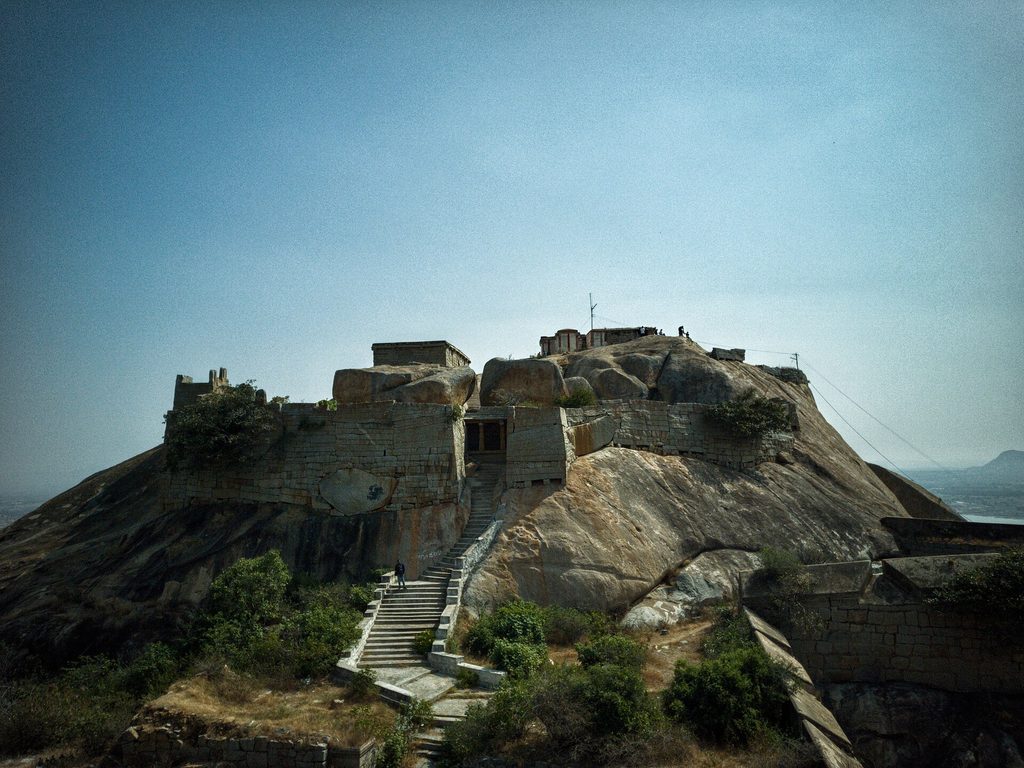
Gudibande Fort quick facts
| Trip detail | Practical answer |
|---|---|
| Location | Gudibande town, Chikkaballapur district, Karnataka |
| Also shown as | Gudibanda; Surasadmagiri Hill–Gudibanda on the district website |
| Distance from Bangalore | About 92–100 km from central/north-central Bengaluru; more from the southern and eastern suburbs |
| Usual driving time | About 2–2.5 hours one way; allow more for city traffic and breaks |
| Main road route | Bengaluru → NH44 → Devanahalli → Chikkaballapur side → Varlakonda/Gudibande turn → Gudibande town |
| Fort-only trek distance | Roughly 3 km round trip is a sensible planning figure; published routes range from about 3–6 km |
| Trek difficulty | Easy to moderate for an active beginner; uneven steps, open rock, heat and limited railings add difficulty |
| Ascent time | Usually 30–60 minutes; families and frequent photo stops may take 60–90 minutes |
| Total time at the fort | Allow 2–3 hours for climbing, exploring, resting and descending |
| Entry fee | Generally reported as free; carry small cash because there is no current official tariff online |
| Visitor timings | No formal hours are published on the official tourism pages; visit in daylight and aim for roughly 6:00 am–6:00 pm as a safety window, not an official gate time |
| Best season | October to February; March can still work with a very early start |
| Best time of day | Early morning after first light |
| Family suitability | Best for active school-age children who follow instructions; not stroller- or wheelchair-accessible |
| Facilities | Basic parking near the base; no dependable food, drinking water or toilets on the climb or summit |
| Ideal trip length | Half day for the fort alone; full day with Bhairasagara Lake or Lepakshi |
Important verification note: Karnataka Tourism and the Chikkaballapur district website describe Gudibande and its history, but neither currently publishes an official entry fee or opening hours. “Free entry” and “open all day” come mainly from recent visitor guides. Confirm locally if a fixed fee, temporary closure or access restriction would affect your trip.
Why Gudibande Fort is worth the drive from Bangalore
Gudibande is not a manicured viewpoint with a ticket counter, paved promenade and café at the top. Its appeal is precisely the opposite. The climb passes weathered gateways, sections of defensive wall, boulders and rock-cut water structures before opening onto broad views of Gudibande town and the surrounding dry-granite landscape. On a clear day, Bhairasagara Lake is one of the most recognisable features below.
For travellers comparing offbeat places near Bangalore, the fort combines a manageable trek, a historical site and a countryside drive. You can leave before breakfast, spend an unhurried morning on the hill, stop by the lake and return before evening traffic becomes severe.
The Karnataka Tourism Gudibande page calls it an easy-to-moderate hike that can be done by a family. That description is broadly fair, but it needs context. The route is technically straightforward and does not normally require ropes or climbing equipment. Yet it includes irregular old steps, smooth rock, steep-looking sections, strong sun and unprotected edges. “Family-doable” should therefore mean an alert family wearing suitable shoes—not a pushchair outing or a casual climb in slippery sandals.
Gudibande Fort history: what is documented and what is local tradition
The safest historical summary is that Gudibande Fort is a 17th-century hill fort associated with the local ruler or chieftain Byre Gowda. Karnataka Tourism confirms that attribution, while the Chikkaballapur district administration identifies the site as Surasadmagiri Hill–Gudibanda and says Byregowda constructed a fort on the hill.
Many travel accounts describe Byre Gowda as a “Robin Hood” figure who helped poorer residents. This local memory has appeared in established media, including a Deccan Herald feature, but the detailed historical record is limited. Present it as a popular local account, not a completely documented biography.
The fort is often described as a smaller counterpart to Madhugiri Fort. Its defences use the natural granite hill, with successive walls, gateways and passages creating multiple levels. Karnataka Tourism also highlights a network of escape routes and 19 rock ponds linked for rainwater collection, with a stated combined capacity of up to three lakh litres. Whether every visible depression formed part of one continuous system is difficult for a casual visitor to judge, but the water-management idea is central to understanding the site. On an exposed hill where carrying water upward would have been difficult, capturing monsoon runoff was a practical defensive necessity.
At or near the summit is a Shiva shrine commonly called Sri Rameshwara Temple in travel accounts. Local tradition connects the shrine with Rama and Sage Vishwamitra, and some pages call it one of 108 Jyotirlingas. Treat that as a regional religious belief rather than confusing it with India’s widely recognised list of 12 Jyotirlinga temples. Dress respectfully, avoid touching carvings or ritual objects and remember that a heritage ruin can still be an active sacred space.
The alternate spelling Gudibanda Fort appears on maps, government pages and travel sites. It refers to the same destination; “Gudibande Fort” is the more useful form for this article because it matches the dominant travel search wording.
Gudibande Fort trek: distance, difficulty, time and trail experience
How long is the Gudibande Fort trek?
Use about 3 km round trip for the fort-only outing from the usual base area as a practical planning estimate, but do not treat it as a surveyed official distance. A community-recorded Wikiloc route measures approximately 1.95 miles, or 3.1 km, with about 214 metres of ascent. Other trekking and booking pages advertise 4, 5 or 6 km.
Not everyone starts recording from the same place. One visitor may park beside the first steps; an organised group may add a village approach, longer loop or another activity. A package distance may therefore describe the full programme rather than the shortest fort path.
If distance is important because you are travelling with a child, older adult or first-time trekker, plan by time and terrain as well as kilometres. Budget up to 60–90 minutes for a gentle ascent, at least 30 minutes at the upper levels and 45–60 minutes to descend slowly. That buffer is more useful than racing to match a 30-minute online estimate.
Gudibande Fort trek difficulty
The trek is easy to moderate, with no routine need for technical climbing skills. Much of the ascent follows stone steps and an obvious uphill line through the fort. The main challenges are not distance but exposure and footing:
- Ancient steps vary in height and width.
- Smooth granite can become slippery after rain.
- The hill has little shade, so heat raises the effort quickly.
- Some edges and ruin sections lack barriers.
- The descent puts more strain on knees and ankles than the ascent.
- Loose gravel and worn stone require attention even on dry days.
An active beginner who can comfortably climb several flights of stairs and walk for two hours with breaks should generally manage. Someone with a recent knee or ankle injury, uncontrolled vertigo, significant balance difficulty or heat sensitivity should reconsider or seek medical advice appropriate to their condition. This article is travel planning, not a fitness clearance.
How many steps are there at Gudibande Fort?
There is no reliable official step count. Published pages variously mention about 400, 500 or 1,000 steps. The disagreement probably comes from different starting points and from deciding whether broken rock-cut sections count as individual steps. The useful takeaway is that the route contains several hundred uneven steps, not that one disputed number is exact.
What the climb feels like
The lower section begins close to Gudibande town and gains height through exposed rock and stonework. As the settlement falls away behind you, the route passes the remains of gates and defensive walls. Pause at these levels rather than treating the fort as a single summit target; the changing view and water structures are much of the experience.
Higher up, the path becomes more rugged in appearance, although it remains a walking route for most visitors. Wind can be strong near the top. The summit area rewards a slow circuit, with fort remains, the Shiva shrine, boulder formations and wide views across the plateau. Bhairasagara Lake is easier to appreciate from above than from the roadside.
The fort uses the natural granite hill as part of its defence. Photo: solarisgirl/Wikimedia Commons, CC BY-SA 2.0.
Do not enter narrow cavities, unstable rooms or “escape routes” for a photograph. They may contain loose stone, animals or a difficult exit. Stay on the obvious path, especially with children.
Realistic trek-time planning
| Traveller profile | Ascent | Explore/rest | Descent | Total at fort |
|---|---|---|---|---|
| Fit adult moving steadily | 30–45 min | 30–45 min | 25–40 min | 1.5–2 hr |
| Beginner or photo-focused visitor | 45–60 min | 45–60 min | 35–50 min | 2–2.5 hr |
| Family with school-age children | 60–90 min | 45–60 min | 45–60 min | 2.5–3.5 hr |
These are planning ranges, not promises. Heat, rain, crowds, footwear and the exact parking point can change them considerably.
Gudibande Fort timings, entry fee and best time to visit
What are the Gudibande Fort timings?
No formal opening and closing hours are currently published on the Karnataka Tourism or Chikkaballapur district pages. Several independent guides say the fort has no fixed timing or is accessible throughout the day. That should not be read as an invitation to climb at any hour.
For an independent visit, use daylight as your operating window. Roughly 6:00 am to 6:00 pm is a sensible year-round planning shorthand, adjusted for the actual sunrise and sunset on your travel date. It is a safety recommendation, not an official gate schedule. Start the descent with generous light remaining; the stones are harder to read at dusk and the trail is not designed as an illuminated night attraction.
Commercial listings promote a Gudibande Fort sunrise trek, sometimes beginning well before dawn. Those outings may include a trek leader, group transport and local arrangements. A first-time independent family should not copy a package schedule blindly. If sunrise is essential, confirm access locally, go with an experienced organiser and carry a proper headlamp—never rely only on a phone torch.
Is there a Gudibande Fort entry fee?
Most recent independent guides report free entry. There is no current ticket tariff on the official tourism pages. A few local or commercial listings mention a small charge, generally in the ₹5–₹20 range, which may reflect a temporary local collection, parking or a past arrangement rather than a statewide monument ticket.
The responsible answer is: expect access to be free, but carry small cash and accept that a nominal local fee may be introduced or collected. A trek-operator package price is not the Gudibande Fort entry fee; it usually covers transport, a guide, meals or additional stops.
Parking near the base is usually described as free and informal. Do not assume it is a guarded car park. Lock the vehicle, leave valuables out of sight and park without blocking homes, shops or the narrow approach lane.
Best time to visit Gudibande Fort
October to February offers the most comfortable combination of lower temperatures and clearer morning views. March can also be pleasant if you start soon after daylight. From April into May, the exposed granite becomes hot quickly; avoid a late-morning or afternoon ascent.
The monsoon can turn the landscape green and dramatic, but wet stone changes an easy route into a much more cautious one. Skip the climb during heavy rain, thunderstorms or immediately after intense showers. Lightning, slippery rock and water flowing across steps are more important than completing an itinerary.
Whatever the month, check the IMD Bengaluru weather and warnings before leaving and compare them with a forecast for Gudibande or Chikkaballapur in your maps/weather app. Conditions 100 km north of your home can differ from what you see outside your Bangalore window.
Gudibande Fort distance from Bangalore and how to reach it
How far is Gudibande Fort from Bangalore?
Gudibande Fort is approximately 92–100 km from central Bangalore by road. The most commonly reported drive takes 2–2.5 hours each way, although an early start from north Bengaluru can be faster and a weekend departure through city traffic can take longer.
“Distance from Bangalore” is not one fixed number because Bengaluru is geographically large. A traveller starting near Hebbal is already on the useful side of the city; someone leaving Electronic City must cross or bypass much more of it. Depending on your neighbourhood and route, the door-to-door distance can be closer to 90 km or well above 115 km. Use live navigation the night before and again at departure.
Best road route from Bangalore
The straightforward self-drive route is:
Bengaluru → Hebbal/Airport Road → NH44 → Devanahalli → Chikkaballapur direction → turn near Varlakonda toward Gudibande → Gudibande town → fort base
NH44 handles most of the journey. The final approach leaves the highway for quieter roads through the countryside. Navigation apps may offer small variations, so save the fort location offline and look for the Gudibande turn rather than depending on constant mobile data. The last lane toward the base can be easy to miss among town streets.
Allow a breakfast or washroom stop on the highway or around Chikkaballapur. Facilities are much less predictable once you reach the fort. Top up fuel before leaving the main highway if the gauge is low.
Driving tip for a Gudibande Fort Bangalore road trip: A 5:30–6:00 am departure reduces urban traffic, puts the climb in cooler weather and creates a buffer for breakfast. Starting from south Bengaluru may justify leaving 30–45 minutes earlier.
By bus and local transport
Public transport is possible, though the final connection and return timing can be uncertain. Search the official KSRTC website for Gudibande services or connections via Chikkaballapur. From Chikkaballapur, continue by local bus, taxi or auto.
Do not plan the return around the last possible connection. Confirm the final bus from Gudibande before starting the trek and keep enough cash for local transport. An auto arranged for a one-way drop may not wait at the base unless that is agreed in advance.
By train
Train travel is not the simplest one-day option. Chikkaballapur is the practical rail connection, but Gudibande still requires an onward road transfer; check both schedules before choosing it.
Parking and finding the trek start
Visitors generally park cars and two-wheelers near the base of the hill in Gudibande town. Expect an open local parking area rather than a formal multi-level facility with marked bays. Ask a shopkeeper or resident where vehicles are currently being left, park considerately and photograph the location pin before climbing.
If maps direct you into a lane that is too narrow or unsuitable for your vehicle, do not force the route. Stop in a safe wider area and ask locally. A few extra minutes on foot are better than obstructing a residential street.
A practical Gudibande Fort one-day trip itinerary
The fort works best as an early morning outing. The following schedule is deliberately spacious; it allows for Bangalore traffic, a relaxed family climb and a nearby lake stop without turning the day into a race.
Option 1: Fort and Bhairasagara Lake family day
5:30 am — Leave Bangalore
Depart earlier if you live in south or east Bengaluru. Carry breakfast for children who cannot wait, even if you plan to stop on the highway.
7:00 am — Breakfast and restroom break
Choose a clean, established stop before leaving the highway. This is also the moment to buy extra water, not after reaching the first steps.
8:00 am — Reach Gudibande and park
Apply sunscreen, check shoes and remind children to stay together and away from edges.
8:15 am — Start the Gudibande Fort trek
Climb at the pace of the slowest person. Short pauses at gateways and water structures make the history visible and prevent children from treating the summit as the only reward.
9:15–9:45 am — Explore the upper fort
Enjoy the view and have a light snack. Keep food sealed if monkeys are present and never feed wildlife.
10:15–10:45 am — Begin the descent
Descend before the rock heats up. Smaller steps and a slightly sideways stance may feel steadier on irregular sections, but children should hold an adult’s hand wherever the drop or surface demands it.
11:15 am — Visit Bhairasagara Lake
The lake is only a short drive from the fort area and works as a scenic pause. Enjoy it from a safe, stable bank. There are no guarantees of lifeguards, fencing or safe swimming conditions.
12:00–12:30 pm — Lunch or begin the return
Choose a known restaurant on the route rather than waiting for the family to become exhausted and hungry. A direct return should bring you back to much of Bangalore by mid-afternoon, traffic permitting.
Option 2: Gudibande Fort and Lepakshi full day
Lepakshi is commonly listed about 24–30 km from Gudibande, depending on the chosen roads. It makes a strong second stop for families interested in architecture and stories, but only if everyone still has energy after the climb. Leave Gudibande by late morning, eat before or soon after reaching Lepakshi, and give the temple complex at least 90 minutes. Check current temple access and photography rules separately.
Avoid adding three or four distant attractions merely because a blog calls them “nearby.” Nandi Hills and Bhoga Nandeeshwara Temple belong to the broader north-Bengaluru travel region, but they are not quick next-door add-ons to Gudibande. A shorter itinerary usually produces a better family day than a checklist completed through a windscreen.
Gudibande Fort with kids: suitability, safety and facilities
Is Gudibande Fort safe for children?
Gudibande Fort can be a good family trip for active school-age children who can follow safety instructions, but it is not childproof. There are uneven steps, exposed rock, limited railings, strong sun and old structures. Adults must supervise continuously, particularly at upper viewpoints and during the descent.
Age alone does not decide readiness. A careful seven-year-old accustomed to walks may cope better than an older child who runs ahead or tires quickly. As a conservative guide, many families will find the trek more practical from around age eight, but that is not an official restriction. Parents remain the best judges of their child’s balance, stamina and willingness to listen.
Toddlers create a different challenge. A stroller cannot use the trail, while carrying a child on irregular stone changes the adult’s balance. If the youngest family member cannot walk safely, choose another outing or have one adult remain below.
Turn the fort into a history-and-nature activity
Children engage more when the walk has small missions. Before the climb, ask them to look for:
- a gateway that would have slowed an approaching enemy;
- channels or rock hollows that could collect rain;
- a safe viewpoint from which the town becomes visible;
- differences between natural boulders and placed fort stones;
- Bhairasagara Lake from the upper levels;
- signs that the site is both a historical ruin and a living place of worship.
This turns the outing into more than “climb, photograph, descend.” It also supports the search intent behind historical places near Bangalore for kids without inventing games that encourage children to wander away from the path.
Facilities parents should plan around
Toilets: Do not depend on a clean public toilet at the fort base or summit. Use a reliable facility during the highway breakfast stop and ask in Gudibande town before starting.
Water and food: There are no dependable stalls on the climb or at the top. Carry at least one litre of water per person in cool weather and more in hotter conditions, plus compact snacks. Avoid heavy meals immediately before climbing.
Shade: The route is largely exposed. Hats, sunscreen and an early start matter more here than on a wooded trail.
Seating: Do not expect benches. Rest only on stable, safe ground away from edges and temple access points.
First aid: Carry plasters, antiseptic wipes, any prescribed medicine and an elastic support if your family normally uses one. The best first-aid strategy is still preventing slips and heat exhaustion.
Mobile signal: Coverage can vary. Download the map, share your plan with someone at home and do not depend on the phone as your only torch or navigation system.
What to carry for the trek
- Walking or trekking shoes with a grippy sole
- Refillable water bottles; extra water in warm weather
- ORS or an electrolyte sachet
- Hat, sunglasses and sunscreen
- Light, breathable clothing
- Small snack such as fruit, nuts or an energy bar
- Compact first-aid kit and personal medicines
- Fully charged phone and power bank
- Rain shell during unsettled weather
- Bag for carrying every piece of waste back down
- Small cash for local transport, refreshments or any nominal collection
Keep the backpack light. Large picnic containers, speakers and unnecessary gear make the climb less comfortable and can disturb other visitors.
Responsible behaviour at a fragile fort
Do not write on walls, move stones, climb fragile masonry or leave offerings and packaging outside designated places. Avoid loud music. Ask before photographing worshippers. If you picnic near the lake, collect food scraps as well as plastic; biodegradable litter can still attract animals and alter the site.
Things to do and places to visit near Gudibande Fort
1. Explore the fort’s gateways and defensive levels
Do not hurry through the lower remains. The sequence of walls, narrow passages and turns helps explain how the hill itself became part of the defence. Photograph from the established path and avoid standing on unstable parapets for a dramatic frame.
2. Look for the rainwater-harvesting system
The interconnected rock ponds are the fort’s most distinctive engineering story. Their condition and water level change by season. Observe them from stable ground and do not enter a pond or channel; algae, silt and polished stone can be deceptively slippery.
3. Visit the summit shrine respectfully
The Shiva shrine gives the upper fort continuing religious meaning. Opening of the inner area may depend on local practice rather than a tourist schedule. Remove footwear where requested and keep the space clear for worshippers.
4. Photograph the Gudibande landscape
Morning side-light brings out the texture of the boulders and walls. A wide view from the upper levels can include the town, fields and Bhairasagara Lake. Drones should not be flown without checking all current aviation, local and site restrictions; being able to launch one technically does not establish permission.
View from the top of Gudibande Fort. Photo: solarisgirl/Wikimedia Commons, CC BY-SA 2.0.
5. Stop at Bhairasagara Lake Gudibande
Bhairasagara, also written Byrasagara in some sources, lies close to the town and is visible from the fort. It is a natural pairing for a Gudibande Fort one-day trip. The waterbody can be photogenic in calm morning light and may attract birds, but conditions around the bank are not standardised for tourism. Supervise children, keep back from soft or steep edges and do not assume the water is suitable for swimming.
6. Add Vatadahosahalli Lake only if time allows
Travel accounts describe Vatadahosahalli Lake beyond Gudibande as a quiet birding and landscape stop. It is less structured than a formal attraction, so daylight, road condition and local access matter. Use live navigation, avoid isolated detours late in the day and leave immediately if a route crosses private land or appears unsuitable.
7. Continue to Lepakshi for a heritage-focused full day
Lepakshi’s Veerabhadra Temple, murals, sculptures, hanging-pillar story and large Nandi make it the most compelling major add-on for many history-loving families. It is in Andhra Pradesh, so check the route, current timings and temple etiquette before travel. Pairing Gudibande’s military-water engineering with Lepakshi’s temple art creates a stronger educational theme than collecting unrelated viewpoints.
Frequently asked questions about Gudibande Fort
How difficult is the Gudibande Fort trek?
Gudibande Fort is an easy-to-moderate trek for most active beginners. The route is short and largely follows stone steps, but the steps are uneven, the hill is exposed to sun, and some sections have limited railings. Good shoes, an early start and a slow descent make a significant difference.
What is the Gudibande Fort trek distance and time?
Plan for roughly 3 km round trip on a fort-only route, although published tracks and organised itineraries range from about 3–6 km. Most adults take 30–60 minutes to climb. Allow 2–3 hours for the complete visit, including rests, exploration and descent; families may need up to 3.5 hours.
What is the entry fee for Gudibande Fort?
Entry is generally reported as free, and the official tourism pages do not currently publish a ticket price. Carry small cash because a nominal local charge or parking collection can change without appearing online. Do not confuse an organiser’s trek-package cost with the fort entry fee.
Can children visit Gudibande Fort?
Yes, active school-age children who follow instructions can usually enjoy Gudibande Fort with close adult supervision. It is not suitable for strollers, and parents should be cautious around uneven steps, slippery rock and unfenced edges. Start early, carry water and turn back if a child is tired or uncomfortable.
Is Gudibande Fort open for a sunrise trek?
Sunrise treks are sold by commercial organisers, but the official tourism pages do not publish a formal pre-dawn access policy or visitor timing. Independent first-time visitors should begin after there is usable daylight. For a true sunrise climb, confirm current access and go with an experienced group that provides local guidance and proper lighting.
Conclusion: is Gudibande Fort worth visiting?
Gudibande Fort is worth the weekend trip when you want a short historical trek, open countryside and a quieter alternative to Bangalore’s most crowded hill destinations. Plan on a 92–100 km drive from central Bengaluru, an easy-to-moderate climb, generally free access and two to three hours at the fort. Go early, carry water, wear shoes with grip and treat published fee, timing and distance figures as planning ranges rather than permanent rules.
For a simple family day, combine the fort with Bhairasagara Lake and an early lunch. For a fuller heritage circuit, add Lepakshi without overloading the itinerary. Before leaving, check the weather, live road conditions and any local access update—and use MagickWorld’s guides to compare more beginner treks and one-day family trips from Bangalore.


