

City Palace Jaipur: Tickets, Timings, Entry Fee and What to See Inside
One search for City Palace Jaipur can leave you with three different closing times, several ticket prices and photos of rooms you may not be able to enter on a standard ticket. That is an awkward way to plan a day in the Pink City, particularly if you are travelling with children or trying to fit Hawa Mahal and Jantar Mantar into the same morning.
The answer starts with a simple distinction: City Palace is both a museum and a living royal complex. Its public courtyards and galleries are part of the regular museum visit. Selected rooms of Chandra Mahal, where the Jaipur royal family continues to live in private areas, are offered through a separate Royal Tour. A palace-issued composite ticket adds Jaigarh and the Royal Cenotaphs, while another Jaipur monument pass is an entirely different product.
This guide sets out the current admission categories, opening hours, entrances, major sights and a realistic route through the palace. It also explains where to pause, when a family should skip an expensive upgrade, and how to combine the visit with nearby attractions. The figures and temporary closures below were checked against the City Palace Museum’s official visitor information, rather than copied from older ticket listings.
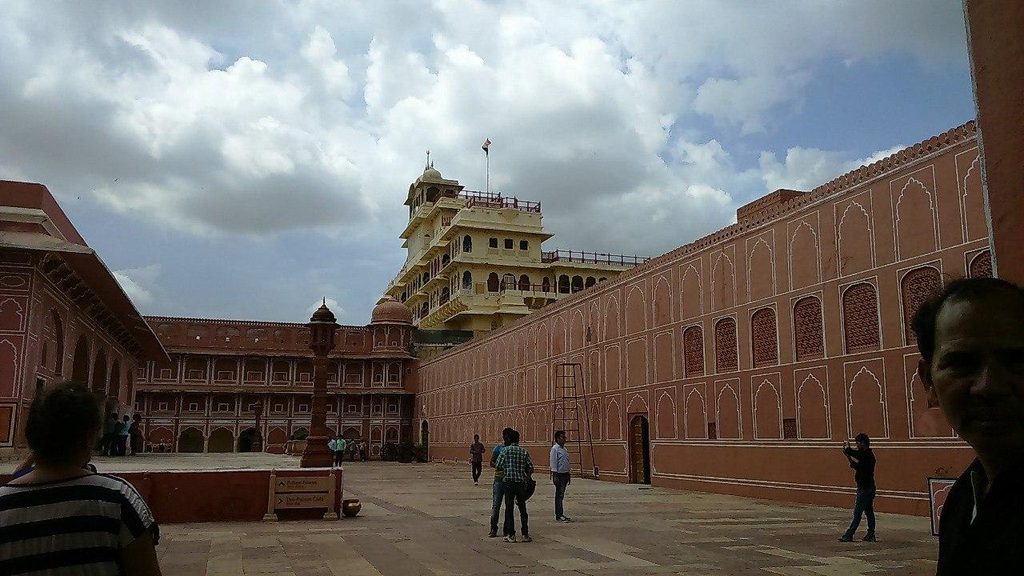
City Palace Jaipur ticket price, entry fee and booking
The regular City Palace Museum ticket currently costs ₹400 for an Indian adult or resident. The youth concession is ₹200 for a student or child below 12; the adult concession is ₹200 for a senior citizen or defence visitor. That ticket covers the museum’s courtyards and galleries. It does not give you unrestricted access to the residential rooms of Chandra Mahal. The official visitor page is the best place to recheck the amount before setting out.
For an Indian family of two adults and one eight-year-old, the currently listed museum entry adds up to ₹1,000. That is a useful planning example, rather than an additional family package. Bring any documentation required for a concession and confirm a child’s or student’s category at the ticket counter. The official site separately mentions a concession for visitors with disabilities; staff can explain eligibility and documentation.
Which City Palace ticket should you buy?
- Museum admission: ₹400 Indian adult; ₹200 youth concession; ₹200 senior citizen or defence concession. It includes public courtyards and galleries. This suits a first visit focused on architecture, museum collections and the main palace atmosphere.
- City Palace composite: ₹500 Indian adult; ₹300 youth concession; ₹300 senior citizen or defence concession. It adds Jaigarh and the Royal Cenotaphs to the palace courtyards and galleries. It is useful when those sites are genuinely on your route.
- Chandra Mahal Royal Tour: ₹4,000 Indian adult or ₹2,000 youth concession on the current Indian-resident listing. It includes the courtyards and galleries, a personal guide, refreshments and selected rooms listed by the palace as Sri Niwas, Chhavi Niwas, Shobha Niwas and Pritam Niwas. The palace says Royal Tour tickets are sold only at the ticket counter.
- Jaipur Centre for Art: The palace lists a separate ₹100 adult or youth Indian-resident admission for this rotating contemporary-art space. The art centre’s visitor page says a City Palace Museum ticket is also required to enter the complex; it currently advertises free gallery admission on Tuesdays and Thursdays. Check its live terms and exhibition before planning the visit.
The official page also displays a Museum at Night ticket, but explicitly says Museum at Night is temporarily closed. Do not buy travel around an evening show advertised by an older guide. If the museum reopens that experience, confirm the schedule and ticket type on its live visitor page.
For international visitors, the palace has a separate International Resident selector. Because its live amounts are not all exposed in the public text version of the page, use that selector or ask at the ticket desk for the exact ticket you need. Quoting an old foreigner entry fee as though it were current would be misleading. The same applies if you are comparing third-party booking pages: check the ticket name and what access it actually buys.
The two different “composite tickets”
This distinction can save both money and disappointment. The City Palace composite is sold by the palace and, according to its own listing, covers City Palace, Jaigarh and the Royal Cenotaphs. It is not the Rajasthan government monument composite used for state-managed Jaipur attractions such as Hawa Mahal or Jantar Mantar. A traveller holding a government monument ticket should still expect to purchase City Palace admission separately.
Suppose you have one day in Jaipur and plan to walk only around Hawa Mahal, Jantar Mantar and City Palace. The regular palace museum ticket is the simpler choice. If Jaigarh and the Royal Cenotaphs are also firm stops, compare the palace composite with buying admission separately. The extra ₹100 for an Indian adult looks attractive, but the sites are not all next door to the palace; transport and time matter more than the face value of the ticket. Confirm any usage period and access conditions at the counter before relying on the composite for a later day.
Is the Royal Tour worth the higher price?
It can be, if richly decorated palace interiors and a guided account of the royal residence are the reason for your visit. The difference is substantial: for the same two adults and eight-year-old, currently listed Indian-resident Royal Tour tickets would total ₹10,000, against ₹1,000 for regular museum admission. A family with a child who mainly wants to spot gateways, courtyards and carriages may enjoy the less costly visit more.
The museum’s list of Royal Tour rooms is more reliable than photos labelled simply “inside City Palace.” Do not assume that a blue room, mirror-work chamber or an image of a private apartment appears on the regular route. Some other guides still use older names such as Royal Grandeur or Royal Splendour and older prices. Ask the palace desk for the current Chandra Mahal Royal Tour, its route that day and the total for your group. A personal guide and refreshments are listed as part of the Royal Tour; ordinary museum guides are available separately for an additional fee.
Where can you buy tickets?
The museum says visitors can purchase tickets at Gate 1 near the Jantar Mantar ticket counter and Gate 2 at Jaleb Chowk. Its visitor page specifically says Royal Tour tickets are available at the counter only. Start at the official visit and ticket information page, then make the purchase through the option the museum currently provides for your chosen ticket. If a reseller promises a special room or skip-the-line benefit, compare that promise with the museum’s own inclusion list first.
City Palace Jaipur timings and the best time to visit
The City Palace Museum tour is listed from 9:30 a.m. to 6:30 p.m., with the last tickets sold by 6:00 p.m. The Royal Tour is also listed from 9:30 a.m. to 6:30 p.m. The museum describes itself as open seven days a week and closed on Dhulandi, the second day of Holi. A special event or restoration can still affect individual spaces, so a quick check of the official page is sensible before a long journey.
This is one place where search results can be especially confusing. You may find 5:00 p.m. or 5:30 p.m. closing times, as well as claims of a nightly show. The palace’s current hours and closure notice take priority over those older articles. The museum currently says that Mubarak Mahal’s Textile Gallery has been temporarily closed for restoration since 27 March 2026. The exterior of Mubarak Mahal remains an architectural point of interest, but do not promise your children they will see its textile display until the museum confirms it has reopened.
How long does a City Palace visit take?
Allow about two hours for a comfortable museum visit, or closer to three if you like to read displays, sit for a break and take photographs where permitted. A focused walk through selected courtyards can be shorter. A Royal Tour adds its own guided route, so ask the counter for that day’s duration before promising another timed activity immediately afterward. These are planning estimates, not a fixed museum rule.
Arriving at 9:30 or 10:00 a.m. gives you a better chance to see the open courtyards before the strongest heat. From October through March, Jaipur’s outdoor sightseeing is generally more comfortable; mornings still help in busy travel periods. In April through June, plan shaded breaks and keep the more exposed old-city walking for earlier in the day. During rain, stone surfaces and crowded lanes may slow a group with young children. There is no need to race the museum: a measured pace usually makes the exhibits more memorable.
If you reach the counter at 5:45 p.m., the fact that last tickets are sold at 6:00 does not make a full visit practical. Think of the ticket-sale cutoff as the latest possible admission, not a recommended arrival time. For a family, entering at least two hours before closing is a more useful rule of thumb.
A simple half-day schedule
For a first visit in the old city, start at the palace at opening and spend roughly two hours inside. Take a drink or snack break, then visit nearby Jantar Mantar if your group is interested in the giant astronomical instruments. Leave Hawa Mahal for a separate stop or a short walk and photograph, depending on the children’s energy. Reverse the sequence if you specifically want to photograph Hawa Mahal’s street-facing facade earlier in the morning; the palace’s later closing time gives you some flexibility.
City Palace Jaipur history and architecture: why it matters
Jaipur was founded by Maharaja Sawai Jai Singh II in 1727, and City Palace grew as the political, ceremonial and residential centre of the new city. Its earliest buildings took shape in the following years; later rulers extended and adapted the complex. Rajasthan Tourism describes the palace as an ensemble influenced by both Rajput and Mughal design, with additions made by successors rather than one building finished at one moment. The museum’s own history similarly describes a complex built from the mid-18th century onward, with later changes continuing into the 20th century.
That layered history explains why a walk here does not look like a tour through a single style or a single period. A courtyard opens to an audience pavilion; a reception building leads toward a museum gallery; beyond lies a seven-level palace with private living spaces. Decorative arches, stone screens, painted surfaces, domed forms and broad courtyards each served a purpose as well as making an impression. Instead of trying to memorise a list of architectural terms, notice how each threshold changes the scale, shade and sense of privacy.
The Rajasthan Tourism description of City Palace explains the royal residence and Mubarak Mahal, while the City Palace Museum’s own introduction describes a place used for administration, ritual, entertainment and patronage of art forms. The public museum was established in 1959. That date describes the museum, not the age of the palace itself.
Is City Palace a UNESCO World Heritage Site?
Be precise with this popular question. Jaipur’s walled city is a UNESCO World Heritage property, and Jantar Mantar has its own UNESCO inscription. City Palace is a major landmark within the city’s historic fabric, but it is misleading to present the palace as a separately inscribed World Heritage property. UNESCO’s Jaipur City entry names City Palace among the walled city’s important monuments; its Jantar Mantar entry explains why the nearby observatory has a distinct listing.
That distinction makes a walk between the palace and observatory more interesting. Sawai Jai Singh II was interested in both the governance of a new capital and astronomical observation. A family can see one side of that story in the palace’s ceremonial spaces and the other in Jantar Mantar’s instruments, without needing an elaborate history lesson.
Reading the buildings as you walk
Ask yourself what a space was for. Mubarak Mahal’s reception role gives a clue to its open, decorative appearance. A courtly audience space was designed for gatherings and display. Chandra Mahal’s separate ticket and private sections remind visitors that parts of the palace are still used as a home. The large courtyards are also practical answers to circulation, gatherings and Jaipur’s climate.
For children, try a simpler question at each stop: “Would you welcome a guest here, meet a crowd here, display a treasured object here or live here?” This turns architectural vocabulary into a small game. It also helps explain why some doors are open to a museum visitor and others are not. The palace is preserved, but it is not an empty film set.
Things to see inside City Palace Jaipur
The most useful route depends on which galleries are open and which ticket you have bought. Use the museum’s illustrated palace brochure and map to orient yourself at the gate, and ask staff if any part of the map has changed. The museum currently identifies spaces including Pritam Niwas Courtyard, Sarvato Bhadra, Sabha Niwas, Sileh Khana, a painting and photography gallery, Rath Khana and Mubarak Mahal. The list below explains what makes each stop worthwhile, without assuming that every gallery or private room is open on your date.
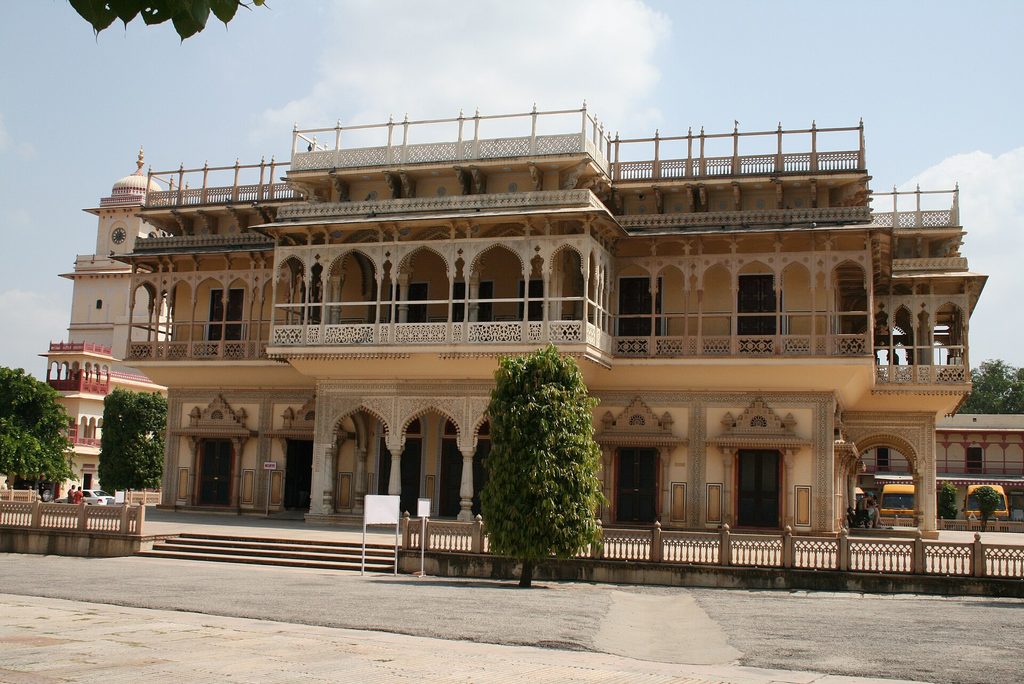
Mubarak Mahal: start with the exterior
Mubarak Mahal was designed as a reception building. Its arches, balconies and fine detailing make it an easy first stop: step back enough to see the whole facade before moving close to the carvings. This is a good place to notice how the palace mixes formal symmetry with small decorative choices.
Rajasthan Tourism describes a collection of royal garments and textiles associated with the building. At the time of this article, the palace says its Textile Gallery in Mubarak Mahal is temporarily closed for restoration. View the building as architecture and check the official notice before planning around the clothes, shawls or other textile displays. This is particularly important for families whose children have been promised a costume museum.
Sarvato Bhadra and the great silver vessels
Sarvato Bhadra is one of the places where visitors see how ceremony shaped the palace. Many older guides use the name Diwan-i-Khas when discussing this area and the large silver vessels known as gangajalis. If the names on a guidebook and a museum sign differ, follow the signs and ask staff which pavilion or display they mean. There is more value in observing the space carefully than in winning a naming argument.
Stand back to understand how the open structure relates to the courtyard, then move nearer to any displayed objects as permitted. With children, ask what job such an unusually large vessel might have served and what it suggests about the scale of a royal journey. Avoid presenting a dramatic anecdote as fact unless it appears in the museum interpretation or your guide can support it. These vessels are memorable enough without extra legend.
Sabha Niwas and the museum galleries
Sabha Niwas is an audience space and a museum highlight. Look for the arrangement of the room as well as the objects: the shape of a hall tells you something about who gathered there and how formal occasions were staged. The palace also identifies a Sileh Khana Gallery, a Painting and Photography Gallery and Rath Khana. Depending on access and rotation, these spaces let visitors move from courtly weapons to images and vehicles connected with the royal household.
A useful museum technique is to choose one object in each gallery and read its label properly. Why was it made? Who might have used it? Is there a repair, pattern or material a photograph would miss? Spending a minute with three objects often teaches more than walking quickly past thirty. The palace’s collections overview is a useful companion for learning the current gallery names, but the open galleries and their displays should be confirmed when you arrive.
Rath Khana is a particularly approachable stop for young visitors because a carriage is easier to picture in use than an unfamiliar court title. Older children may prefer the detail of armour, painted scenes or early photography. If your family has mixed ages, let each person choose one favourite object to explain at the end. It keeps the visit shared without forcing everyone to enjoy the same room for the same length of time.
Pritam Niwas Chowk and the Peacock Gate
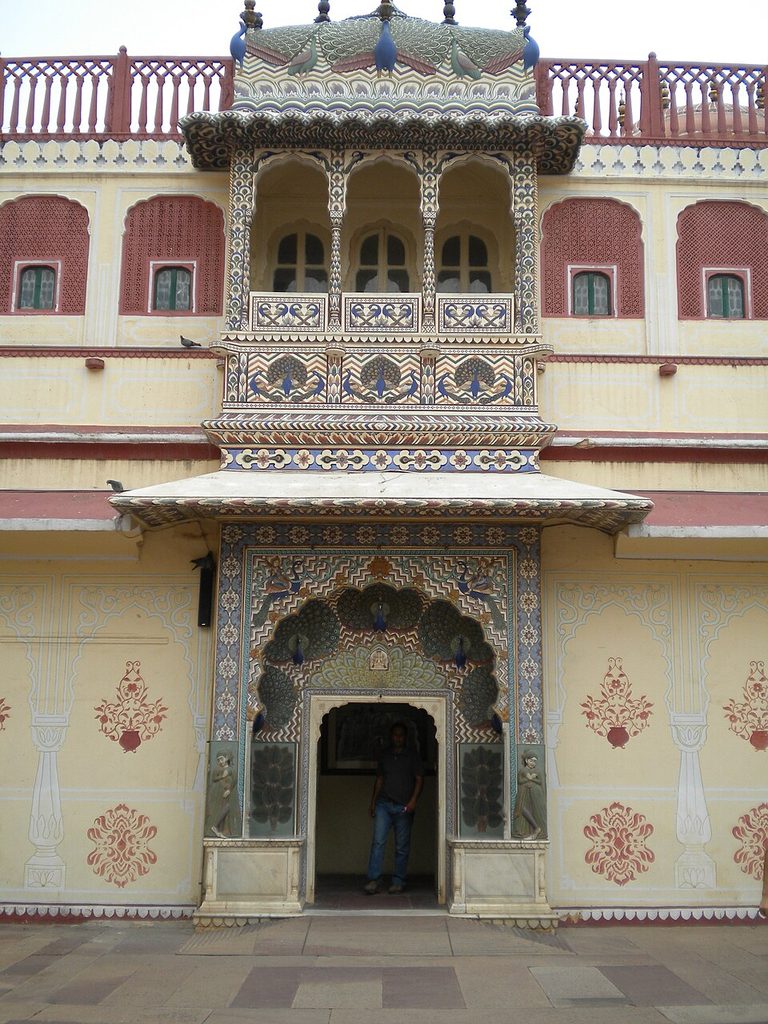
The painted gateways around Pritam Niwas Chowk are among City Palace Jaipur’s most recognisable images. The Peacock Gate is the detail many visitors have seen before arriving. Photograph the whole doorway if permitted, then look at the smaller repeating shapes and colours. The other gateways reward the same slow attention; together, they make the courtyard more than one photo backdrop.
Ticket descriptions on the palace website use broad terms such as “courtyards,” while its Royal Tour inclusion list also names Pritam Niwas. Because access routes can change, ask at the ticket counter whether the courtyard and the particular gate you want to see are included in your chosen ticket on that day. That question is more useful than relying on a photograph from an undated article. Respect any queue, barrier or no-photography notice, especially in a space connected to the residential part of the complex.
Chandra Mahal: what the Royal Tour adds
Chandra Mahal is the seven-level palace that remains associated with the Jaipur royal family’s residence. The standard museum visit gives you the palace context and public collections; the separate Royal Tour offers guided access to selected Chandra Mahal spaces. The palace currently lists Sri Niwas, Chhavi Niwas, Shobha Niwas and Pritam Niwas among its inclusions, alongside a personal guide and refreshments. It does not advertise a free walk through every residential floor.
This is the point to ask yourself what you actually want from the day. If you are drawn to decorated interiors and prefer a guide who can connect one room to another, the tour has a clear purpose. If you mainly want the public courtyards and a feel for Jaipur’s history, museum admission already gives you a worthwhile visit. For families, check the route and expected time at the counter; a premium price does not automatically make a longer, more formal tour right for a small child.
The Jaipur Centre for Art and a pause for food
The palace’s Jaipur Centre for Art offers changing contemporary exhibitions, with a separately listed admission category. It can be a rewarding contrast after historic galleries if an exhibition interests your group. Check the programme before arrival; a rotating art space is different from a permanent display, so a description written months earlier may no longer fit.
The museum also lists dining options, including The Gallery Cafe for smaller bites and Baradari for a fuller meal, on its food and drinks page. Menus, seating and hours can change. Treat a cafe stop as a useful break, especially with children, but leave enough time for the galleries you most want to see before you sit down. Food choices inside the complex do not remove the need to carry drinking water during a hot Jaipur day.
How to reach City Palace Jaipur and plan a family visit
City Palace sits within Jaipur’s walled old city, close to Jantar Mantar and the route toward Hawa Mahal. The museum lists Gate 1 near the Jantar Mantar ticket counter and Gate 2 at Jaleb Chowk as visitor entrances. Give your driver the gate you need rather than only the name “City Palace”; the old-city lanes and restricted turns can make the final approach slower than the map suggests.
Metro, auto, taxi and parking
The museum identifies Badi Chaupar on the Pink Line as the nearest metro station. From the station, continue on foot if your group is comfortable in busy streets or take a short local ride. An auto-rickshaw or taxi can bring you close to the entrance, but traffic around the bazaars may be slow. If you drive, the palace says parking is available only at Gate 2 near Jaleb Chowk. Check access and parking space on the day rather than assuming you can leave a car beside Gate 1.
For a visitor coming from Jaipur Junction or the airport, a taxi or auto with a clear destination such as “City Palace Gate 2, Jaleb Chowk” is easier to negotiate than an unsupported fixed travel-time estimate. Road conditions vary with the time of day, festivals and work in the old city. If you are already sightseeing in the Pink City, walking between nearby monuments can be more efficient than calling another car for every short stretch.
The museum lists wheelchair access at major entrances, accessible restrooms, wheelchairs subject to availability and ramps wherever possible. It also lists a nursing room and a golf cart hire option at ₹150 per person, with no golf-cart ticket required for children below five. Those facilities are useful to know about, but historic buildings can still have uneven surfaces or spaces that are harder to reach. If a particular room is essential for someone in your group, call or ask staff about that route before paying for an upgrade.
City Palace Jaipur with kids: choose a manageable route
City Palace can work well for children when the day is built around looking and asking questions instead of covering every label. For roughly ages three to five, choose two or three visual stops and take a break before attention runs out. Ages six to nine may enjoy a gateway hunt, a carriage and the scale of the silver vessels. Older children can compare a painted court scene with the rooms and objects around them, or connect the palace to Jaipur’s nearby observatory.
Try a five-object challenge: find a carved doorway, a painted detail, something used to travel, something used in a ceremony and one object nobody in the family can immediately explain. Keep the challenge flexible; it is a way to look more closely, not a worksheet that has to be completed. If photography is permitted in a courtyard, ask a child to photograph a pattern rather than posing in front of every gate. That small assignment often changes what they notice.
For a toddler, plan for shade, a toilet stop and a snack break. A carrier may be easier than a stroller in crowded approaches or on uneven parts of a heritage site; ask staff which accessible route is available once inside. For a child who dislikes museums, agree on a short palace visit followed by an outdoor or hands-on activity elsewhere in Jaipur. A successful 75-minute visit is better than a tired three-hour march.
Photography and respectful access
Photography rules may differ between courtyards, galleries and Royal Tour rooms. Follow displayed signs and the instructions of staff. Ask before using a tripod, flash, video equipment or images for commercial work; do not rely on a historic camera-fee figure from a blog. A phone snapshot allowed in one courtyard is not a general permission to photograph collections or private residential spaces.
A practical route with Jantar Mantar and Hawa Mahal
The three sites are in the same old-city area, but they involve separate admissions and different opening arrangements. For a history-focused morning, begin at City Palace, walk to Jantar Mantar and use its instruments as the second chapter of Sawai Jai Singh II’s story. Finish with a view of Hawa Mahal or go inside if your group still has time. If you prefer the best light on Hawa Mahal’s facade, start there and head to the palace afterward. Keep a buffer for queues, street crossings, refreshments and the time it takes to orient yourself at each entrance.
Jantar Mantar makes the strongest learning pair with the palace. At the palace, children see how a court used space, art and ceremony; at the observatory, they can see monumental instruments made to study the sky. UNESCO has a clear introduction to Jantar Mantar that parents can read beforehand. Hawa Mahal adds another perspective on Jaipur’s old city, but trying to explore all three interiors in a rush can leave very little time to understand any one of them.
Jaigarh is farther from this compact walking route. If you have purchased the palace composite, plan transport and time for it and the Royal Cenotaphs separately. Ask at the palace ticket counter about the composite’s validity and access conditions. Do not mistake “included” for “a comfortable walk away.” An unhurried two-day Jaipur visit can be better value than packing every listed attraction into one afternoon.
Frequently asked questions about City Palace Jaipur
What is the City Palace Jaipur entry fee in 2026?
The official listing checked on 28 September 2026 shows ₹400 for an Indian adult museum ticket, ₹200 for the listed youth concession and ₹200 for a senior citizen or defence concession. The Indian adult palace composite is ₹500, and the Chandra Mahal Royal Tour is ₹4,000. International categories have a separate selector. Check the official ticket page again before visiting, as admission can change.
Can you enter Chandra Mahal with a normal City Palace ticket?
The regular museum ticket includes courtyards and galleries; it is not a ticket to all the private rooms in Chandra Mahal. The separate Royal Tour currently lists guided access to selected named spaces and is sold at the ticket counter. Ask staff about a particular room if it is your main reason for visiting.
Is photography allowed inside City Palace Jaipur?
Photography may be allowed in some public areas and restricted in others. Follow the signs at each gallery or courtyard and ask staff about cameras, flash, video or commercial use. A photograph you have seen online does not establish that its location is accessible or photographable with your ticket today.
Can we visit City Palace, Jantar Mantar and Hawa Mahal in one day?
Yes, the three attractions are close enough to combine in an old-city day. Allow roughly two hours or more for the palace, then choose how deeply to explore the other two according to their current hours and your group’s energy. Each attraction has its own admission rules; the City Palace composite is not a universal ticket for all three.
Is City Palace Jaipur worth visiting with children?
Yes, especially if you keep the route short and make it visual. Courtyards, decorative gates, carriages and large historic objects give children concrete things to notice. Check current gallery access before promising a specific display, and consider the expensive Royal Tour only if its guided palace rooms genuinely suit your children’s interests and patience.
The visit in one sentence: choose the museum ticket for the public courtyards and collections, the palace composite if you will use its extra sites, or the Royal Tour if selected Chandra Mahal interiors are the point of your trip. Check the live museum page for hours and gallery access, then build your Jaipur day around the time your group will actually enjoy spending there. For the next step, read a Jaipur family itinerary or a Jantar Mantar guide before fixing your route.


