
Sheesh Mahal Jaipur: History, Timings, Tickets & Visitor Guide
You can search for “Sheesh Mahal Jaipur,” follow a map pin, and still end up at the wrong mirror palace. The historic hall most travellers mean is inside Amer Fort, also called Amber Fort or Amer Palace, on the hills north of Jaipur. There is another attraction named Sheesh Mahal at the Jaipur Wax Museum inside Nahargarh Fort. They are different places, with different admission arrangements. Rajasthan Tourism’s Amer Palace guide identifies the fort’s Sheesh Mahal; its Jaipur Wax Museum listing identifies the other one.
Once you have the right place, a few questions matter more than the usual “must-see” descriptions. Is there a separate mirror-hall ticket? When does the palace actually close? Can you walk into the decorated chamber, or do you view it from outside? And how do you find it within a fort of gates, stairways, and courtyards? This guide answers those questions, explains what you are looking at, and gives you a realistic plan for getting there from Jaipur.
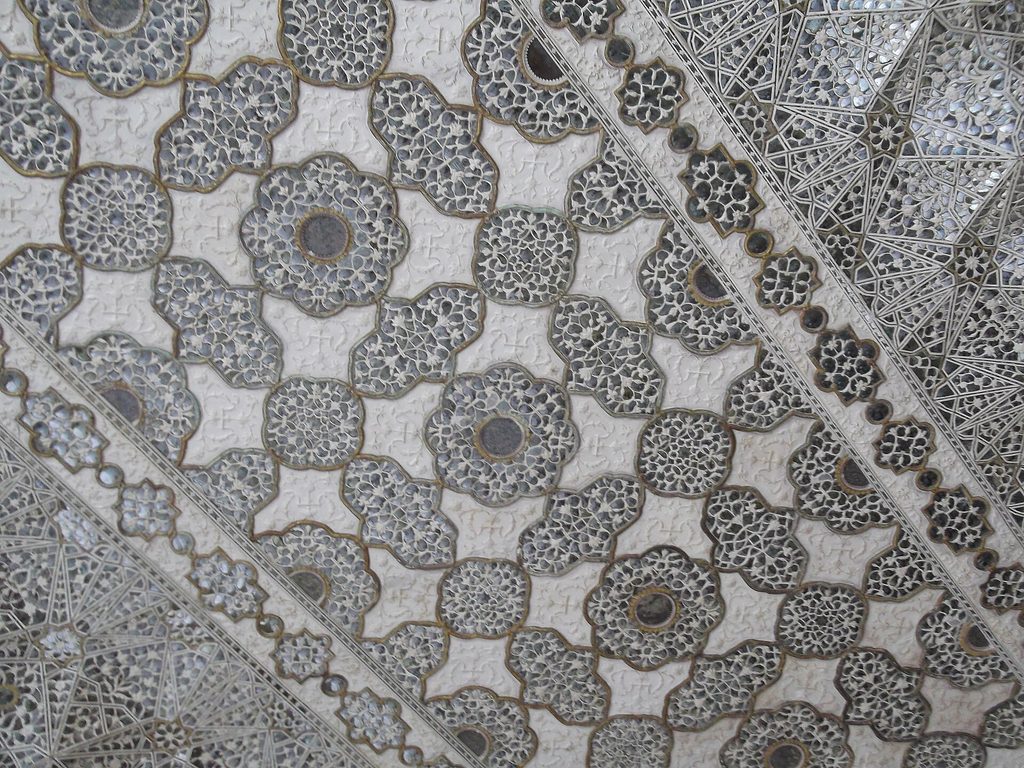
Image: Yercaud-elango, Wikimedia Commons, CC BY 4.0. No changes indicated. This photograph shows the Amer Fort mirror palace, not the Nahargarh attraction.
Where is Sheesh Mahal Jaipur, and which mirror palace do you want?
Sheesh Mahal at Amer Fort is a decorated hall in the fort-palace’s private palace area, reached during a visit to Amer Palace roughly 11 km from central Jaipur. It is commonly associated with Jai Mandir and the third courtyard beyond Ganesh Pol. Rajasthan Tourism places the Sheesh Mahal among the fort’s main sights and describes the larger complex as four courtyard sections. Source: Rajasthan Tourism.
For directions, enter Amer Fort, Amber Fort, or Amer Palace as the destination. “Sheesh Mahal Jaipur” by itself is a less useful search because the name also appears at Nahargarh. Amer and Amber are two spellings used for the same fort and settlement; you do not need to choose between two different historic palaces. If you are booking transport, tell the driver “Amer Fort palace entrance” and agree on the pickup point for the return trip.
Amer Fort versus the Jaipur Wax Museum at Nahargarh
At Amer, Sheesh Mahal is part of a centuries-old royal palace complex. You see its mirror decoration while exploring the fort’s gates, public audience hall, garden, and private quarters. At Nahargarh, the Jaipur Wax Museum advertises its own Sheesh Mahal as part of the museum experience. The wax museum’s ticket and 10 am onward hours sometimes appear in search results for the Amer hall; those details belong to Nahargarh, not the monument discussed here. See the official wax museum entry if that is the place you intend to visit.
One quick test settles most confusion: if a page mentions wax figures, a wax-museum combo, or Nahargarh Fort, it is describing the other attraction. If it mentions Ganesh Pol, Jaleb Chowk, Jai Mandir, or the courtyards of Amer, it is describing this guide’s destination. A photo of a room full of reflective surfaces is not enough to identify the venue.
The short answer before you plan the day
| Question | Practical answer |
|---|---|
| Location | Inside Amer Fort/Amber Palace at Amer, near Jaipur; find the private palace area beyond Ganesh Pol. |
| Separate Sheesh Mahal ticket? | Normally no. Buy admission for Amer Palace; the mirror-hall area is one of its sights, subject to any on-site conservation barriers. |
| Daytime hours | Rajasthan Tourism’s Jaipur listing gives 8:00 am–5:30 pm for Amer Palace. Another government tourism site lists 9:00 am–6:00 pm; verify the day’s operating schedule before travelling. |
| Ticket budget | A late-2025 report of the January 2026 revision gives ₹200 for Indian adults and ₹1,000 for foreign adults at Amer. Treat these as reported planning figures until the official live checkout confirms your category and total. |
| Time to allow | Around 2–3 hours inside the palace for a first visit, plus transport, queuing, and the uphill approach. |
| Best slot | An early daytime visit generally means cooler stone courtyards and more time before closing. |
The hours come from Rajasthan Tourism’s Jaipur page and Incredible India’s Amer Fort page. The reported fee change is covered by NDTV Rajasthan. This table is a starting point for a trip, not a promise that every gallery or room will be open on your date.
Sheesh Mahal Jaipur timings, tickets and access in 2026
The question “What time does Sheesh Mahal open?” sounds simple, but you will find different answers online. Sheesh Mahal is a part of Amer Palace, so plan around the palace’s daytime admission, not a separate mirror-room timetable. Rajasthan Tourism’s destination list shows 8:00 am to 5:30 pm for Amer Palace. Incredible India, another government tourism resource, shows 9:00 am to 6:00 pm. Neither page explains the discrepancy. If a precise opening minute matters to your itinerary, check the live state ticketing system or ask the palace counter before relying on a printed schedule. Rajasthan Tourism hours · Incredible India hours.
This also changes how to think about an “early” visit. Arriving around the earlier published opening time may help if the gates open then; it does not guarantee entry before 9 am on a day when a later schedule is in force. If you have a train to catch or only a narrow morning window, build in flexibility. Allow time from the ticket point to the mirror hall rather than turning up just before the listed closing hour.
Is there a separate Sheesh Mahal Jaipur entry fee?
You ordinarily visit Sheesh Mahal on an Amer Palace admission ticket; there is no separate standard ticket just for the historic mirror hall. The ticket gives access to the visitor route through the fort-palace. It should not be read as a guarantee that visitors may step into every delicate room. Staff can cordon off sections for conservation, crowd control, or maintenance. Third-party ticket guides also describe the Sheesh Mahal as included in the Amer admission, though their quoted prices vary widely. Rajasthan Tourism: Amer Palace · TravelTriangle: ticket arrangement, with outdated price estimates.
For Sheesh Mahal Jaipur ticket price searches, start with the Amer Palace category, not a supposed “Sheesh Mahal” rate. Following the announced January 2026 increase, Rajasthan news reporting quoted ₹200 for Indian adult visitors and ₹1,000 for foreign adult visitors for Amer Fort. Many guides that still say ₹100/₹500, or even ₹25/₹200, reflect older schedules. I could not independently confirm the current checkout screen because the Rajasthan online ticket portal was unavailable during this editorial check. Verify the actual amount, child/student eligibility, and any concessions on the official portal or at the ticket counter before payment. Fee revision reporting.
If you plan to see several Jaipur monuments, ask whether a government composite ticket suits the exact sites on your itinerary, what it costs on your visit date, and how long it remains valid. Do not assume a combined state-monument ticket covers the privately operated Jaipur Wax Museum or every museum in Jaipur. A two-stop day at Amer and Jaigarh may have different economics from a three-day circuit of state-run monuments. The only useful comparison is the live total for your actual visitor categories and sites.
Where to buy and what the ticket does not include
Rajasthan Tourism’s Amer Palace page links an official e-ticketing portal. Select Amer Palace/Amber Palace if it is listed, check the date and ticket category, and save the confirmation where you can retrieve it without mobile data. The portal failed to load for this article’s 26 September 2026 check, so its current checkout rules, payment options, and prices could not be verified here. If it remains unavailable when you plan your visit, use the authorised on-site counter and keep the receipt. Official Rajasthan Tourism palace page.
An entrance ticket is separate from your ride from Jaipur, a vehicle up to the parking area, a guide, food, and any evening sound-and-light programme. Published tour prices sometimes combine some of these services; compare like with like. Before you pay a person offering “VIP” access to the mirror room, ask them to name the officially sold ticket and show where the extra privilege is described. A guide can add historical context, but no private guide should promise entry to an area that conservation staff have closed.
Bring the ID needed for any concession you claim and check the checkout screen for its exact wording. Student, age, and nationality categories can change; there is no reason to quote an unverifiable discount as a universal rule. If you arrive with a ticket screenshot from an agency, confirm that it is for Amer Palace on your date, rather than a Jaipur Wax Museum package at Nahargarh. This single check prevents one of the most common booking mistakes.
Can you enter the Sheesh Mahal chamber?
You can visit the Sheesh Mahal area within Amer Palace, but access to the most fragile mirror-covered surfaces may be limited to a view from a doorway or courtyard. An older first-hand travel account describes the room as viewable from the doorway rather than entered, and more recent guides describe changing barriers and visitor flow. Treat the railing and on-site staff direction as the current rule. Do not buy a trip on the promise that you will walk freely through the mirrored interior. Condé Nast Traveler’s visit account · Rajasthan Tourism palace overview.
You will still see a remarkable amount from the permitted viewing point. Pause and look at one small section of the arch, then across the ceiling and surrounding panels; the detail is easier to appreciate that way than through a hurried wide-angle photo. Keep hands, bags, tripods, and phone flash away from historic surfaces. Follow the current photo signs; permissions can differ between the courtyard and protected rooms. The frequently retold “one candle lights the entire room” story is best treated as an illustration of many small reflections, not a demonstration visitors are entitled to perform.
The history behind the Sheesh Mahal at Amer Fort
Who built Sheesh Mahal in Jaipur? The most careful answer separates the building of Amer Fort as a whole from the later development of its mirror-decorated private palace. The fort-palace expanded over several reigns. India’s Ministry of Tourism says Raja Man Singh I commissioned Amer Fort in 1592. UNESCO identifies the buildings and gardens added under Mirza Raja Jai Singh I as characteristic of its 17th-century Rajput–Mughal court style. Different popular guides attach Sheesh Mahal itself to Man Singh I, Jai Singh I, or a later completion in 1727; those claims should not be presented as an independently settled, single-date construction record. Incredible India · UNESCO Hill Forts of Rajasthan evaluation.
Jai Singh I is not the same ruler as Sawai Jai Singh II, who founded Jaipur city in 1727. The similarity of their names helps explain why online dates slide from the 1600s to 1727. A reader looking for a short attribution can say: “Sheesh Mahal belongs to Amer’s palace complex, begun under Man Singh I and significantly developed in the 17th century under Mirza Raja Jai Singh I; sources disagree over an exact completion date for the mirror hall.” That is more defensible than treating Jaipur city’s foundation year as proof of when each reflective tile was installed.
From a fort to a royal residence
Amer was a centre of Kachwaha rule before Jaipur became the capital. The palace was both an administrative seat and a residential complex, which helps make sense of its progression from military-looking entrance spaces to richly decorated private areas. The first large courtyard, Jaleb Chowk, could receive people and processions. Diwan-e-Aam was associated with public audiences. Ganesh Pol marked a move towards the palace’s more private courts, where the mirrored Jai Mandir and Sukh Niwas stood across a garden. Rajasthan Tourism describes this sequence and the sandstone and white marble used across the complex. Rajasthan Tourism.
It is tempting to turn every named hall into a fixed scene from a royal story: a queen requesting indoor stars, a ruler lighting a single candle, or courtiers meeting in exactly the room a guide indicates. Those tales can make a visit memorable, but the popular versions rarely give a contemporary source. Enjoy them as local storytelling unless a guide can point you to a dated inscription or a reliable historical reference. The material in front of you needs no embellished origin tale: the mirror inlay, carved surfaces, garden arrangement, and change in scale between courtyards already tell you that this was an elite space.
Why Amer’s UNESCO status matters
Amer is one component of the Hill Forts of Rajasthan, a serial UNESCO World Heritage property inscribed in 2013. That status applies to the wider fort and its heritage landscape, not to a separate UNESCO listing for Sheesh Mahal alone. UNESCO draws particular attention to Amer’s 17th-century mixture of Rajput and Mughal court design and the way its gardens were fitted into a hill-fort setting. UNESCO World Heritage listing · ICOMOS evaluation hosted by UNESCO.
This broader view changes a visitor’s experience. On your way up, look back towards Maota Lake and the hills; then compare the wide first courtyard with the tighter scale of the private palace. At the mirror hall, the tiny pieces of glass make more sense beside the ordered garden and decorated gateway. Amer is a sequence of spaces, not a single photo stop. If time is short, that is a reason to walk the main route with attention rather than race through the whole fort looking only for its most photographed chamber.
Image: Chainwit., Wikimedia Commons, CC BY 4.0. No changes indicated. Ganesh Pol is a landmark on the way to the private palace area.
What makes the mirror work and architecture special?
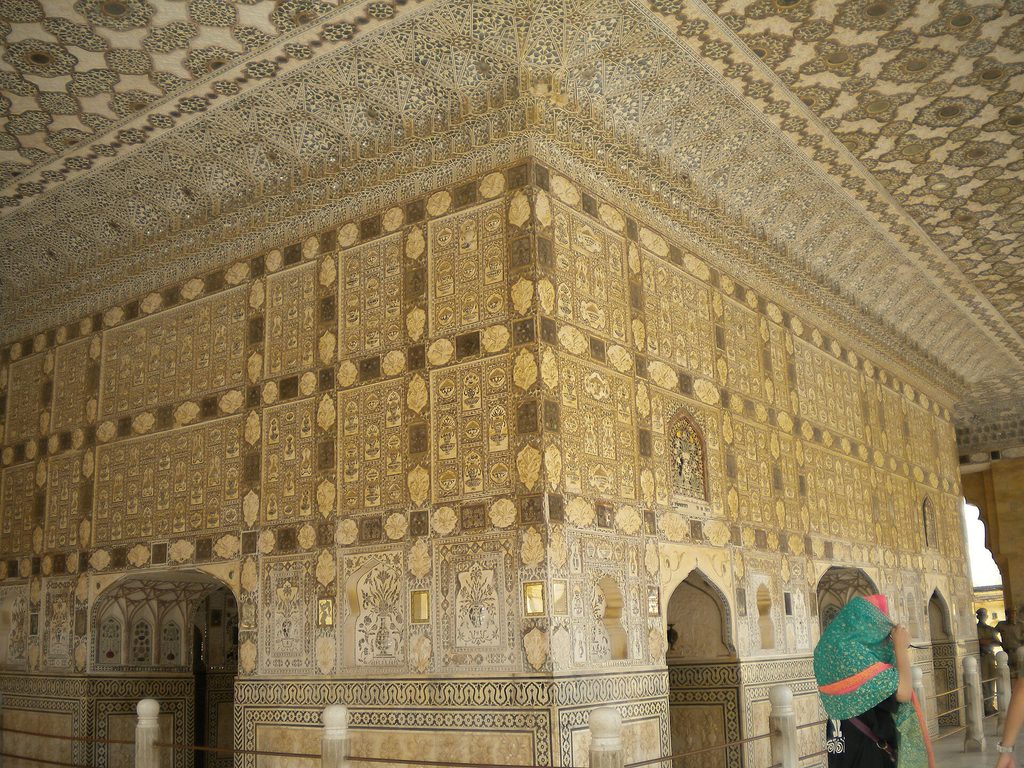
Why is Sheesh Mahal famous? Its walls, arches, and ceilings carry many small reflective pieces arranged with ornamental painting and other decorative work. Instead of one large mirror giving a single image, the small pieces scatter points of reflected light across a richly patterned surface. Looking from a few steps back, the whole room appears to shimmer; looking closer from the permitted boundary, you see individual flowers, curves, and repeated designs. India’s official tourism description calls the hall the “palace of mirrors” and places it among Amer’s chief attractions. Incredible India.
You do not need a torch trick to see why this worked. Try standing still as your eyes adjust, then follow a narrow strip of daylight along the decorative panels. Notice how the pattern changes around an arch or a column rather than repeating like printed wallpaper. A photograph often flattens this effect. A slow look reveals the effort involved in setting many small pieces into a surface that still reads as one coherent design.
How to read the room without needing an architecture degree
Start at the threshold. The change from the garden’s open air to a decorated chamber is part of the design. Then look upward: the ceiling is not just a cover but a surface meant to catch light above a visitor’s normal line of sight. Next, examine the edges of the panels. Mirror pieces are framed by painted and carved ornament, which gives the sparkle a clear shape. Finally, look across the garden to Sukh Niwas. Amer’s private area balances different kinds of comfort and display instead of piling every luxury into the same room.
Sheesh Mahal is often labelled Jai Mandir or associated with a hall of private audience in guide descriptions. Terms used by guides for neighboring halls can overlap, and modern signage may simplify a complex history of rooms. If you are trying to match a historical label to an exact doorway, trust the on-site interpretation and the physical route over a travel site’s blanket map pin. The essential location is consistent: the mirror-decorated palace area beyond Ganesh Pol, within the inner courts of Amer.
The mirror work also sits within an architectural language that includes carved stone, niches, painted surfaces, screened openings, and a formal garden. UNESCO’s description of Amer emphasises the meeting of Rajput and Mughal court traditions, rather than assigning every detail neatly to one culture. That is a useful corrective when a caption calls the entire hall “pure Mughal” or “pure Rajput.” This palace was developed by a court with its own political history, craftspeople, and changing tastes. UNESCO evaluation.
What about Belgian mirrors and the candle story?
Many pages say all of Amer’s mirrors were imported from Belgium or Persia. Others describe a queen who wanted to sleep beneath the stars and a chamber that could be lit by one flame. These are widely repeated claims, but the official tourism and UNESCO sources used here do not establish the origin of every piece of glass or document the queen story. Avoid treating them as verified facts when describing the site. What you can observe is the reflective inlay itself and the way a small light source might be repeated across many pieces. That is a substantial piece of craftsmanship without an exact import ledger or a staged candle test.
Respecting access limits is also part of understanding the work. The mirror surfaces are not a hands-on exhibit. A finger on a historic panel, a bag against a carved edge, or a group crowding a barrier can cause more harm than a visitor expects. If someone offers to cross a rope for a special photo, decline. You can leave with better photographs by finding an unobstructed permitted angle and waiting for a small gap in the crowd than by pressing into the decorated wall.
How to reach Sheesh Mahal and make the most of the visit
First travel to Amer Fort, then follow the palace visitor route towards Ganesh Pol and the mirror hall. Amer is roughly 11 km from the Jaipur city centre. Rajasthan Tourism says buses serving Amber Palace leave from Ajmeri Gate and MI Road and take about 40 minutes; a taxi, auto-rickshaw, or hired car can take you closer to the fort approach. Journey times will vary with traffic and the point at which your vehicle drops you. Rajasthan Tourism directions.
If you are coming from the Pink City’s old streets, an easy plan is to leave early, take the road past the Jal Mahal viewpoint, and head straight to Amer. Do not treat the Jal Mahal stop as part of your Amer ticket: it is a separate roadside viewpoint on the route. A driver may offer a fixed tour price that includes several photo stops or shops. Agree in advance on the drop-off, waiting time, extra parking or hill-transfer charges, and where the return pickup will be. A ride that looks cheap one way can be less convenient if no vehicle is waiting after your visit.
A simple route from the entrance to the mirrored hall
Most first-time visitors can navigate with a short mental route: Suraj Pol → Jaleb Chowk → Diwan-e-Aam area → Ganesh Pol → private courtyard → Sheesh Mahal/Jai Mandir. Rajasthan Tourism notes that arrivals by car may use the Chand Pol side, so your first gate can differ without changing the destination. Ask an official staff member or guide for the Sheesh Mahal route if a passage is closed or you enter from another side. Rajasthan Tourism palace layout.
Walk at a pace that lets you notice the change in purpose from space to space. Jaleb Chowk is broad and public. The public audience area is more architectural and shaded. Ganesh Pol is a decorated threshold into the more secluded part of the palace. Beyond it, the garden puts the mirror hall into context. If you only have 90 minutes inside, prioritise that sequence and leave a little time to step back and look at the façade instead of trying to see every passage.
For a fuller visit, allow two to three hours inside Amer Palace, and add travel and the uphill approach separately. Photographers, families with young children, people who like reading interpretation, and anyone moving slowly on steps may want longer. A realistic half-day from central Jaipur might be: travel to Amer; visit the fort-palace; take a short break; then decide whether to continue to nearby Jaigarh or return via the Jal Mahal viewpoint. Trying to fit Amer, Jaigarh, Nahargarh, the wax museum, City Palace, and Hawa Mahal into one relaxed morning is unlikely to work.
Here is one way to use that time without turning the visit into a stopwatch exercise. Spend the first stretch getting up to Jaleb Chowk, sorting out the ticket, and finding the main visitor route. Give the public hall and Ganesh Pol enough time for a proper look; both help explain the shift from the administrative fort to the private residence. Keep your longest pause for the garden and Sheesh Mahal. After that, walk into the remaining palace areas that are open and return by the marked exit. If you have a timed pickup, tell your driver which exit you will use rather than assuming that you will emerge exactly where the car left you.
Travelling with children changes the rhythm. A child who has had twenty minutes in a vehicle followed by an uphill climb may need a water break before any history lesson will land. Show them the difference between the huge first courtyard and the small repeated mirrors later on; it gives them two concrete things to look for. If you are travelling with an older relative, save energy for the palace interior by using the vehicle approach that the site allows that day. Do not mistake the short distance from Jaipur on a map for a short, level walk once you reach the fort.
Best time to visit Sheesh Mahal Jaipur
For most travellers, an early daytime slot is the easiest choice: the open stone courtyards feel more manageable before the hottest part of the day, and you have room in the schedule if the ticket line or transport takes longer than expected. October through the cooler part of the year usually makes the outdoor walking more comfortable; Jaipur’s summer heat calls for more water and more pauses. Rain can make stone surfaces slippery, so slow down on ramps and steps after a shower.
Late afternoon can give attractive light on the fort exterior, but it leaves less margin to reach the inner palace before its visitor route closes. Check the current closing time and any last-entry rule instead of assuming that a ticket purchased near closing gives a full-length visit. Daylight also makes it easier to find fine detail in the mirror work without a flashlight. The sound-and-light show is a separate evening event with its own arrangements; a seat at that show should not be taken as access to the Sheesh Mahal interior after daytime hours.
If someone in your party has limited mobility, plan before committing to the climb. Amer involves a hill approach, uneven stone, thresholds, and stairs between its courtyards. Driving towards a higher entrance may reduce the initial climb, but it does not turn the entire historic palace into a step-free route. Ask the ticket office about that day’s accessible route and which areas it actually reaches. It is better to choose a manageable portion of Amer and enjoy it than to promise a complete circuit that a companion cannot comfortably make.
Practical details that prevent a rushed visit
Wear shoes with grip and carry water, especially if you intend to walk up from the lower approach. Keep your ticket and ID available until you are through the relevant checks. If you hire a guide, agree on the total price, duration, language, and route before starting; ask for their official identification if they present themselves as an authorised guide. A good explanation should help you distinguish the first courtyard, public hall, Ganesh Pol, and mirror palace rather than hurry you straight to a photo spot.
Photography rules deserve a quick glance at the entrance and again near protected rooms. Do not assume a phone and a professional shoot are treated the same way. Keep the flash off near delicate interiors, and do not use a tripod or lighting equipment without checking the posted policy. Avoid stepping over barriers for a clear image. The easiest picture of the entire complex is often taken from below, with the palace above Maota Lake; the most meaningful close view of Sheesh Mahal is often a detail shot from its permitted boundary.
Nearby places make more sense when you group them geographically. Jaigarh Fort is on the ridge above Amer and adds a military viewpoint; Panna Meena ka Kund lies in the Amer area and may suit a separate short stop if access permits; Jal Mahal is along the road back toward Jaipur. Nahargarh Fort is a different outing, and its wax museum’s Sheesh Mahal requires its own planning. Check each site’s own hours and admissions before building a multi-stop schedule. India’s tourism portal lists Jaigarh and Panna Meena ka Kund as nearby attractions; Rajasthan Tourism has the Amer Palace overview.
Frequently asked questions about Sheesh Mahal Jaipur
Is Sheesh Mahal inside Amer Fort?
Yes. The historic Sheesh Mahal discussed here is within Amer Fort/Amber Palace, around 11 km from central Jaipur. Follow the palace route towards Ganesh Pol and Jai Mandir. The Jaipur Wax Museum also has an attraction with the same name at Nahargarh, so check your map pin and ticket venue before leaving.
What is the Sheesh Mahal Jaipur entry fee?
There is generally no separate standard admission for the Amer mirror hall; buy an Amer Palace ticket. A reported January 2026 rate change put Amer admission at ₹200 for Indian adults and ₹1,000 for foreign adults, but confirm the live amount and your visitor category at the official portal or counter. Do not use the Nahargarh wax museum’s ticket price as the Amer rate.
What are Sheesh Mahal Jaipur timings?
Use Amer Palace’s daytime visiting hours. Rajasthan Tourism lists 8:00 am–5:30 pm; Incredible India lists 9:00 am–6:00 pm. Because these official travel pages disagree, check the day-of-visit schedule with the ticket office or live booking portal. Evening sound-and-light show times do not establish entry hours for the mirror room.
Can you go inside Sheesh Mahal at Amer Fort?
You can reach and view the Sheesh Mahal area with Amer Palace admission, but entry into the most delicate mirrored chamber may be restricted. You may need to admire it from a doorway or courtyard. The barriers and staff instructions in place on the day decide how close visitors can get; do not count on unrestricted access to the room.
How much time should I spend at Amer Fort for Sheesh Mahal?
Allow about two to three hours in the fort-palace if you want to see Sheesh Mahal in context with Jaleb Chowk, Diwan-e-Aam, Ganesh Pol, and the garden. Add time for the drive from Jaipur, the uphill approach, and ticketing. If your time is short, follow the main palace route and leave Jaigarh or Nahargarh for another visit.
Plan your Amer visit with the right information
Sheesh Mahal is worth seeing for the mirror work, but the route to it explains why the hall belongs where it does: a sequence of public courts gives way to a private, carefully decorated palace. Go to Amer Fort, buy the Amer Palace ticket, allow enough time to reach its inner courts, and follow current barriers around the historic surfaces. Check the official hours and live price again shortly before you travel, because published government travel pages and older guides do not always agree.
If you are shaping a longer Jaipur day, read a related Amer Fort walking route or Jaipur monuments itinerary before adding Jaigarh, Jal Mahal, or Nahargarh. It will help you choose a comfortable pace and keep the two different “Sheesh Mahal” attractions straight.


