
Delhi to Jim Corbett: Distance, Routes, Costs & Family Travel Guide (2026)
The easiest mistake when planning Delhi to Jim Corbett is booking a lovely resort, seeing “five hours” on a travel page, and assuming the safari gate will be just outside reception. Your hotel, Ramnagar town and the entrance on your safari permit can be three different destinations.
For an initial estimate, allow roughly 240–260 km from Delhi to Ramnagar, then calculate the remaining journey to your accommodation. Five to six hours is a commonly published driving estimate; six to eight hours with family breaks and the resort transfer is a more useful planning allowance, with longer journeys possible. These are ranges, not a prediction for every Delhi address. Ramnagar route overview.
This guide explains which route to compare, how trains and buses fit into the plan, what to include in your budget, and how to arrange a family weekend around the safari you can actually book.
Information checked on 12 September 2026. Transport fares, road diversions and park arrangements can change; date-specific bookings take priority over general planning estimates.
1. Delhi to Jim Corbett distance: choose the right destination first
The Delhi to Jim Corbett distance by road is approximately 240–260 km when Ramnagar is the reference point. Your final distance depends on where you start in Delhi NCR and whether you are heading to a resort, safari gate or forest rest house.
That distinction explains why otherwise useful guides give different answers. A quoted distance to Ramnagar cannot describe every property marketed as a “Jim Corbett resort.” Nor does reaching the park boundary mean you have reached accommodation inside the reserve.
Ramnagar, your resort and your safari gate
Think of the journey in three parts:
| Journey | Destination to enter | What it helps you calculate |
|---|---|---|
| Delhi to the Corbett area | Ramnagar, Uttarakhand, or your confirmed resort | The main road journey or public transport connection |
| Arrival transfer | Your property’s reception entrance | The actual arrival time, taxi drop and check-in plan |
| Safari transfer | The reporting point on your permit or confirmed pickup instructions | When you need to leave the hotel for the safari |
The Delhi to Ramnagar distance is therefore a useful baseline. The Delhi to Jim Corbett National Park distance becomes meaningful only after you choose an entrance or accommodation address.
Save the property’s map pin and ask whether it points to reception, a highway signboard or a back entrance. For a late arrival, a simple landmark description can be more useful than another screenshot of the map.
Which gate matches your booking?
The reserve lists different entrances for different tourism zones. Use this as an orientation table, then follow the exact reporting instructions issued for your visit. Official Corbett safari zones.
| Zone | Listed entrance | Planning implication |
|---|---|---|
| Bijrani | Amdanda, also spelt Aamdanda | Check the drive from your hotel to this gate |
| Jhirna | Dhela | Confirm the booked zone even though the gate name is shared |
| Dhela | Dhela | Match the permit, pickup and entrance |
| Dhikala | Dhangari, also written Dhangarhi | Distinguish the gate from the forest accommodation beyond it |
| Durgadevi | Durgadevi | Calculate this transfer separately from arrival in Ramnagar |
| Sonanadi | Vatanvasa | Check the appropriate approach instead of automatically routing through Ramnagar |
| Pakhro | Pakhro | Verify its separate approach and reporting arrangements |
For Garjiya bookings, use the gate stated on the current permit: official pages use differing gate descriptions. Asking for written pickup details is sensible whenever a place has multiple names.
How your Delhi starting point changes the trip
An East Delhi departure and an airport pickup are different journeys. Someone leaving Dwarka or Gurugram still has to cross or bypass part of NCR before joining the onward corridor. A Noida address also needs its own calculation; “Noida” covers a substantial area.
Compare the full route from your actual address. If relatives are joining from another part of NCR, agree on a practical meeting point before departure. Multiple doorstep pickups can consume the time saved by starting early.
The most useful answer to “What is the Jim Corbett distance from Delhi?” is therefore a range followed by a map check. Once your resort is selected, replace that range with the distance between your two exact addresses.
2. Best route from Delhi to Jim Corbett, driving time and road conditions
The main route to compare for a Ramnagar-based trip is Delhi → Ghaziabad/Hapur corridor → Gajraula → Moradabad bypass → Kashipur → Ramnagar → your resort. NH9 forms the principal Delhi–Moradabad corridor; onward navigation depends on the route and destination you select. Delhi–Corbett road-route overview.
Treat the town names as orientation points. They are not instructions to enter every town centre. Keep the live route to your actual destination open and follow road signs at junctions.
Is this always the fastest route?
For most travellers heading towards Ramnagar, it is the sensible starting comparison. However, the best route from Delhi to Jim Corbett on your travel date depends on your NCR exit, traffic, closures and the property’s location.
Before leaving, compare the main route with any alternative suggested by live navigation. Ask what the alternative changes: does it avoid an incident, use a better bypass, or simply cut through smaller roads?
A route that saves a few kilometres may add junctions, village traffic and uncertainty. With children, predictable stops and a straightforward approach can matter more than the shortest displayed distance.
Be cautious with old route descriptions that present NH24 and NH9 as completely separate choices without explaining the actual roads. Compare the map alignment and junctions, rather than choosing a route solely by a highway number copied into a blog.
Delhi to Jim Corbett travel time: driving versus arriving
Many route pages quote a Delhi to Jim Corbett driving time of five to six hours. For planning, separate that estimate from the time your family needs to reach a room and settle in.
| Part of the journey | How to budget time |
|---|---|
| Road travel | Start with the live estimate from your exact address |
| Breakfast and toilet stops | Add the breaks your passengers actually need |
| Last approach to the property | Include it if your first search ended at Ramnagar |
| Parking and check-in | Allow time before making another commitment |
| Delays | Keep a buffer for traffic, weather and diversions |
For example, a map showing five hours and forty minutes, plus a forty-minute breakfast and a twenty-minute comfort stop, already becomes six hours and forty minutes. An additional resort approach takes it further. This is an illustration of elapsed time, not a route measurement.
For a Delhi to Jim Corbett road trip with kids, block roughly six to eight hours initially, then adjust to the live route. On difficult travel days, even that allowance may be insufficient.
When should you leave Delhi?
In clear conditions, an early departure can help you avoid part of the city rush and reach your property with the afternoon available. Around 6 am can be a practical target if the driver has slept properly and visibility is good.
Winter fog changes that calculation. A later departure in better visibility may be the better choice. Check the India Meteorological Department’s forecasts and warnings for the route and destination before deciding.
If driving after a full working day would leave the driver tired, consider a morning start or an additional night. The schedule should allow the person driving to arrive with enough energy for the return journey too.
Delhi to Jim Corbett road conditions: what to check
Road condition is a changing observation, not a permanent property of the route. A recent traveller’s report can help, but confirm the date, the direction travelled and the exact section described.
Check four things before departure: significant delays around your NCR exit, the selected Moradabad–Kashipur connection, traffic near Ramnagar, and the last approach to your hotel. Ask the property specifically about the last few kilometres after heavy rain.
For travellers worried about hill driving, distinguish the Ramnagar approach from a property farther along the surrounding hill roads. Ask the hotel about gradients, narrow stretches and the recommended arrival route. The word “Corbett” on a booking page does not describe the entire drive.
Food, fuel and comfort stops
Gajraula is a commonly used food-stop area on the route. Select a stop for its location, recent feedback, parking and toilets, then confirm opening hours if travelling early. No restaurant name can guarantee today’s cleanliness. Route and stop overview.
Keep water, a change of clothes and essential items inside the cabin. Have meals while parked comfortably, and choose stops with a safe entry and exit rather than stopping on the highway shoulder.
For an electric vehicle, confirm the connector, charging speed, access hours and recent operating status of both the planned charger and a backup. If the hotel advertises charging, ask whether it is a dedicated charger or a socket, and whether advance reservation is needed.
3. How to reach Jim Corbett from Delhi by car, train or bus
Choose transport by comparing the whole journey: reaching the departure point, travelling to Ramnagar, transferring to your hotel and getting around after arrival.
| Option | Main advantage | Extra arrangement to include |
|---|---|---|
| Own car | Flexible stops and local movement | Fuel, tolls, parking and a rested driver |
| Hired taxi | Direct pickup and resort drop | Written fare inclusions and return arrangements |
| Train to Ramnagar | Avoids driving the main road journey | Confirmed seats, station pickup and room access |
| Bus | Can be economical for fewer passengers | Exact boarding point, drop location and onward taxi |
Delhi to Jim Corbett by car or taxi
A car suits families carrying luggage, a stroller or supplies, especially when those items would otherwise need moving through several transfers. A hired taxi offers similar flexibility if everyone would prefer to travel as a passenger.
Choose the vehicle around passengers and luggage. Ask how much boot space remains with every required seat in use. Confirm working seat belts and an appropriate child restraint arrangement before booking; a larger vehicle does not automatically solve seating needs.
For a one-way taxi, arrange the return separately. For a taxi staying throughout the trip, check daily kilometre minimums, driver accommodation requirements and local-use limits.
Your outstation car gets you to accommodation and permitted public destinations. Tourist safaris inside the reserve use authorised vehicles; they are a separate arrangement. Official safari guidance.
Delhi to Jim Corbett by train
For a Ramnagar-based stay, search for Ramnagar, station code RMR. Check the station code printed on your actual booking: DLI is Old Delhi, while NDLS is New Delhi. A website’s “Delhi” heading is not enough to identify your departure station.
Search results commonly show Sampark Kranti and the Ranikhet/Corbett Link services. Listings can mix main-train names, linked services and nearby destinations, so verify the train number, boarding station and destination on your ticket. Use IRCTC train search for booking and National Train Enquiry System for current railway enquiries.
As an orientation, Delhi–Ramnagar listings reviewed for this guide showed journeys around five to six hours and fares across classes of roughly ₹115–₹725. These are listing snapshots, not a confirmed timetable or fare for your dates. Allow additional time for station access and the hotel transfer. Delhi–Ramnagar train listings.
An overnight train may reach Ramnagar well before normal hotel check-in. Confirm whether early access is available and chargeable. A family waiting with bags until afternoon has not necessarily gained a restful holiday morning.
If your preferred Delhi to Ramnagar train is unavailable, compare another travel date against a different railway destination. A ticket to Kathgodam ends at a different station; price and time the onward road transfer before choosing it.
Delhi to Jim Corbett by bus
Search both Ramnagar and Jim Corbett, then inspect the actual drop point. The reviewed redBus page included locations labelled Ramnagar, a bypass and Kashipur under the broader Corbett destination. These produce different hotel transfers. Its displayed journey times also varied by service. Delhi–Corbett bus listings.
Compare current state services through the Uttarakhand Transport Corporation booking portal. Confirm the departure terminal on your ticket instead of assuming every bus leaves from the same Delhi ISBT.
Check the arrival hour, seat type, luggage allowance, planned rest stops and cancellation terms. For an early arrival, reserve the hotel transfer before you leave Delhi.
The bus page reviewed displayed fares from approximately ₹450 to above ₹3,000, depending on the service. That wide spread makes the exact seat and travel date important. Compare the checkout price with any required taxi transfer rather than treating the lowest headline fare as your entire travel budget. Current bus fare listings.
Does flying make sense?
Compare the complete flight itinerary, including airport reporting and the onward taxi, against the direct road journey. For travellers already in Delhi, a short flight does not automatically create a shorter door-to-door trip. If flying from another city, evaluate the connection around your confirmed accommodation and available flights.
4. Delhi to Jim Corbett trip cost: fuel, tolls, taxis and safari
Separate your budget into transport, accommodation, meals, safari and local extras. This makes a low package price easier to evaluate and prevents you from counting an included meal or transfer twice.
The examples below are planning tools. Hotel and meal amounts are assumed spending choices, while the safari figures are identified separately as published official rates checked during research.
Calculate your own fuel cost
Use this formula:
Fuel cost = total kilometres ÷ your car’s expected mileage × fuel price per litre.
For an illustrative 600 km return trip including local driving, mileage of 14 km/l and an assumed fuel price of ₹100/litre, the fuel cost is about ₹4,286. At 11 km/l, the same journey costs about ₹5,455.
The fuel price is deliberately a round assumption, not a claim about today’s pump rate. Replace all three inputs with your own route, realistic mileage with passengers and air-conditioning, and the price where you refuel.
Delhi to Jim Corbett toll charges
There is no single toll total that applies to every Delhi NCR departure and every Corbett property. Charges depend on the roads used, vehicle category, current tariffs and any applicable pass arrangements.
Before travelling, identify the plazas on your selected route and check their current rates through the IHMCL National Highway fee-plaza directory and linked official resources. An old blog receipt is useful historical context, not a current quotation.
For the sample budget below, ₹1,200 is simply a provisional return-trip toll reserve. A verified total for your exact route was not established for this guide; replace that reserve before finalising the budget. It is not a published tariff or a promised upper limit.
Keep FASTag active and funded. If you hold a pass, check eligibility for the specific plazas. For a taxi, ask whether tolls are included or payable against actual transactions, and avoid adding them again if already included.
Delhi to Jim Corbett taxi fare
Published offers reviewed for this guide ranged from a basic sedan headline around ₹3,300 to quotes around ₹5,000; larger vehicle quotes reached roughly ₹6,000–₹7,000. Providers used different inclusions, so these figures are not like-for-like guaranteed totals. Triveni’s route offer, Uttarakhand Cab’s published estimates.
For a usable quotation, provide the pickup address, resort pin, date, passenger count, children’s ages and luggage. Ask for the payable total, included kilometres, excess-kilometre charge, driver allowance, taxes, tolls, waiting and cancellation terms.
A multi-day hire may charge a minimum distance for every day. As a worked example, 250 km per day × three days × ₹11/km = ₹8,250, before allowances and extras. Those are published example terms from one operator; your quotation may differ. SRT Cabs’ fare and minimum-distance terms.
Understand the complete safari price
The official pricing table separates the permit, vehicle and guide. For an Indian-national day-safari booking, the listed components reviewed were:
| Example zone | Permit | Vehicle | Guide | Component total |
|---|---|---|---|---|
| Bijrani | ₹3,380 | ₹2,700 | ₹1,000 | ₹7,080 |
| Dhela or Jhirna | ₹3,380 | ₹3,000 | ₹1,000 | ₹7,380 |
These are per-booking vehicle examples, not a per-person quotation. Check the final amount, nationality rules and any hotel pickup or agency charge before payment. Official Corbett pricing.
A worked two-night family budget
This example assumes two Indian adults and one child, one room, their own car, and one Dhela/Jhirna safari booking. It is an illustrative spending plan, not an available MagickWorld package.
| Expense | Assumption | Amount |
|---|---|---|
| Fuel | 600 km, 14 km/l, ₹100/litre | ₹4,286 |
| Tolls | Provisional return reserve | ₹1,200 |
| Stay | Two nights at an assumed ₹6,000 final nightly total, including child occupancy and breakfast | ₹12,000 |
| Other meals and snacks | Chosen family allowance | ₹4,000 |
| One safari | Published Dhela/Jhirna components above | ₹7,380 |
| Parking and minor extras | Chosen allowance | ₹1,000 |
| Subtotal | Before contingency | ₹29,866 |
| Contingency | Approximately 10% | ₹2,987 |
| Planned total | Rounded | About ₹32,900 |
Replace the room assumption with a written total that includes your child’s age, bedding, meal plan and taxes. If safari pickup costs extra, add it. A second safari, premium room or private transfers will change the total substantially.
For a train or bus trip, compare all passengers’ return tickets plus station transfers and local taxis against driving. Public transport can be economical, but the cheapest individual ticket does not always produce the lowest family total.
5. Best time to travel and how to book the right Corbett safari
Choose your dates around both the weather and the experience you want. A quiet resort break and a trip built around a particular safari zone need different booking decisions.
Seasonal planning without assuming every zone is open
The official Dhikala page lists its usual visitor season as 15 November to 15 June. The reserve’s pricing table lists Bijrani day visits from 15 October to 30 June, and Jhirna/Dhela throughout the year. These are published operating patterns; actual access remains subject to current notices and conditions. Dhikala visitor information, zone calendar and pricing.
| Travel period | What to build into your plan |
|---|---|
| November to February | Warm layers for early outings and flexibility for fog on the road |
| March to April | Water, shade and a quieter middle of the day |
| May to June | Heat-conscious scheduling and confirmation of seasonal closing dates |
| Monsoon and reopening period | Flexible bookings, road updates and confirmation of the exact operating zone |
An open hotel does not mean every safari is operating. Conversely, a seasonal closure in one zone does not describe the entire Corbett region. For a safari-focused trip, establish permit availability before committing to accommodation with restrictive cancellation terms.
Book in an order that protects the plan
Start with your preferred travel dates and a backup date. Look at available safari zones and shifts, shortlist accommodation with a manageable gate transfer, then coordinate transport and room bookings.
When the safari is the main reason for travelling, secure it before treating the itinerary as fixed. If permits are not yet released, understand the hotel’s cancellation deadline and set a reminder to check the release notice.
The official booking process asks for visitor details, identification and the selected zone and shift. It also explains the separate guide and vehicle arrangements. Verify every name and detail before paying, and retain the confirmed ticket with its readable QR code. Official booking instructions.
Booking windows can be amended through notices. Use the official Corbett Tiger Reserve website as your starting point, including when a resort or agent assists with the arrangements. Ask to see the issued permit rather than relying only on a message that the safari is “confirmed.”
Dhikala needs a different plan
A private resort room near Corbett is separate from a forest rest house reservation. Dhikala accommodation lies beyond its entrance, and the forest journey is part of the visit. Check the permitted arrival window, vehicle arrangements, meals and baggage requirements before leaving Delhi. Official forest rest house information.
Dhikala does not offer ordinary day-jeep permits; the official options include canter visits or a qualifying night stay. A canter is a shared safari vehicle with a fixed schedule. Choose it with the duration and your passengers’ comfort in mind. Official Dhikala booking options.
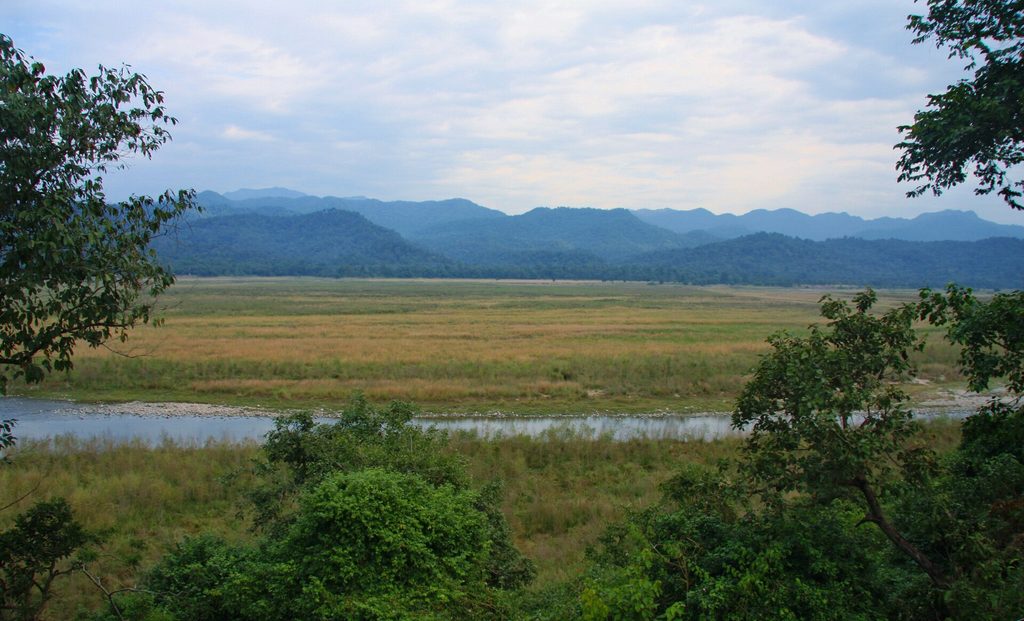
View from the Dhikala Forest Lodge area towards the Ramganga landscape, November 2009. Photo: Ashok.delhi17, Wikimedia Commons, CC BY-SA 4.0. Original photograph; no edits.
Rules that affect what you bring and how you travel
Carry the identification required for your booking and keep the permit accessible. Confirm how every child must be recorded and included in the vehicle capacity; never assume children can be added beyond the permitted passenger limit.
The reserve’s current notice prohibits mobile-phone use within tourism zones of the core habitat. Ask about the applicable carrying or storage procedure, and take a permitted standalone camera if photographs matter to you. Plan children’s safari activities without depending on a phone. Current official notices.
Follow the guide’s instructions on remaining in the vehicle, viewing distance and permitted stops. Keep voices low, take your waste back and do not feed wildlife. The reserve identifies itself as a zero-plastic zone; check what you may carry before entry. Official visitor instructions.
Most importantly, book the forest experience without making a tiger sighting the condition for a successful day. No itinerary can arrange when a wild animal appears.
6. A Delhi to Jim Corbett family trip that leaves time to enjoy the stay
For a first visit with children, two nights and three days gives you a useful balance: one arrival day, one full day at the destination, and a return day. This is an itinerary recommendation, not a minimum required by the park.
One night can work for a short break, but it places the drive, check-in, safari and departure close together. Decide whether your family wants that pace before booking.
Choose the hotel around the whole family’s day
A pool photograph answers only one question. Before choosing a stay, ask how everyone will sleep, what the child can eat, and what remains available when the family is tired or the weather changes.
Get specific about the extra bed or cot, room location, stairs, balcony access, meal times and supervised activities. If the listing says “kids’ activities,” ask which activities run on your dates, what ages they suit and whether they cost extra.
Ask for the transfer time to your booked safari gate. Imagine two otherwise similar hotels: one needs an additional cross-town trip before a morning safari, while the other has an easier approach. That difference affects wake-up time, breakfast and the amount of time spent sitting in a vehicle.
For grandparents or anyone with limited mobility, request clear information about room access and getting into the safari vehicle. Photographs of the actual steps and bathroom layout can settle questions that “comfortable for families” leaves unanswered.
Day 1: travel, settle in and leave the afternoon flexible
Leave Delhi according to visibility, the driver’s rest and your household routine. Plan a breakfast stop and enough room for another break without turning either into a race against a safari deadline.
Aim to arrive around your confirmed check-in time. Have lunch, unpack and let everyone settle. A short activity at the property, reading together or a quiet early evening can be enough after the drive.
Avoid making a prepaid arrival-day safari depend on the optimistic driving estimate. If an afternoon safari is essential, arrive the previous evening or build the entire journey around a generous reporting buffer.
Before dinner, confirm the next day’s pickup point, departure time, clothing and breakfast arrangements. Put identification and permits together so the morning does not begin with a search through suitcases.
Day 2: one main experience, followed by time to recover
Plan around your confirmed morning or afternoon safari. If it is a morning visit, ask whether breakfast is served afterwards and what can be arranged before departure. Follow the guide’s instructions about food inside the reserve.
Explain the outing to children beforehand: there will be stretches of waiting, the vehicle may be bumpy, and everyone needs to listen to the guide. Invite them to notice a bird call, a tree shape or an animal track rather than setting a tiger-only mission.
Afterwards, leave space for a meal and rest. A second safari can suit an interested older child or an enthusiastic group, but it is an additional choice, not a requirement for completing Corbett.
If you would like another outing, ask about current access to a local museum or interpretation centre. The official Dhangarhi Interpretation Centre page describes its wildlife exhibits but also carries a “Starting Soon” label, so confirm operation before promising a visit.
Day 3: return with a comfortable margin
Have breakfast, check the route and leave time for checkout. Decide whether a short local stop fits before starting the return, rather than adding several places once everyone is already in the car.
Keep the Delhi arrival estimate flexible. If someone has a flight, train or important commitment that evening, work backwards with a substantial buffer or return a day earlier.
An early safari followed by the entire drive home can create a long day for the driver. Share driving only with someone rested and comfortable with the vehicle, or choose a quieter departure morning.
What to pack, and what to leave unplanned
Keep the road bag small and accessible: drinking water, essential medicines already used by the family, a spare outfit, wipes, tissues, a light layer and a familiar quiet activity. Store larger bags so they do not obstruct seats or access.
Pack safari clothing for the season, closed footwear and binoculars if available. Ask what the vehicle provides and what you may carry, particularly for babies or children with specific needs.
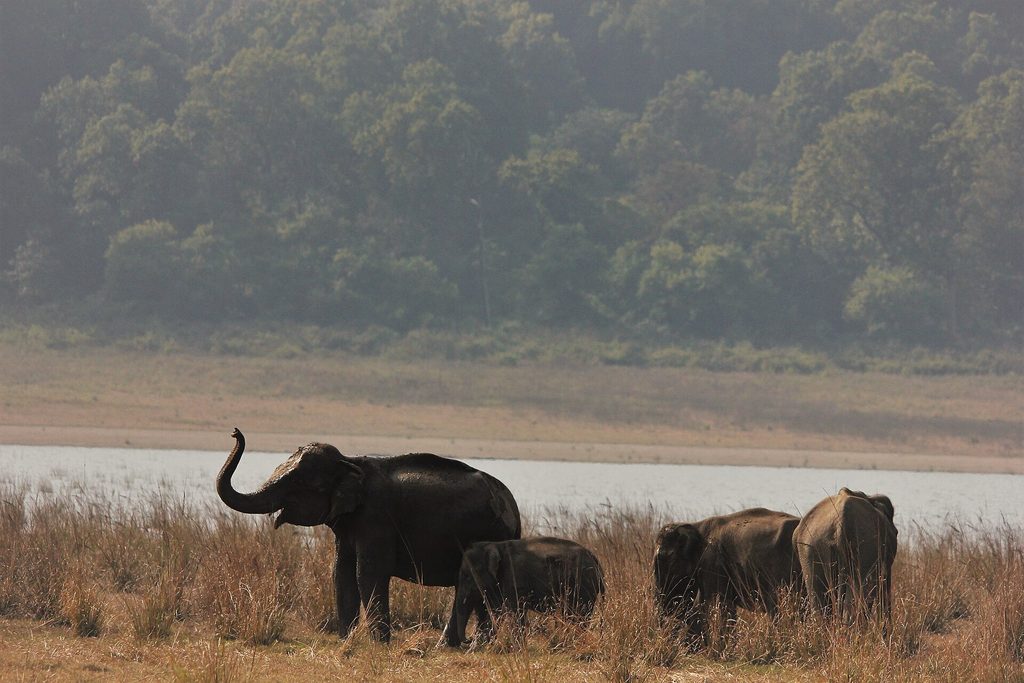
Leave some time without an activity attached to it. A family can return with a memorable story about elephants, a new bird or an evening game even when the safari does not produce the hoped-for tiger photograph.
7. Frequently asked questions about Delhi to Jim Corbett
How far is Jim Corbett from Delhi by road?
Use roughly 240–260 km to Ramnagar as an initial reference. Your exact Delhi starting point, resort and safari gate change the final distance. Enter the accommodation’s reception pin before calculating the complete road journey.
How many hours does Delhi to Jim Corbett take by car?
Five to six hours is a common driving estimate. For a family trip, allow around six to eight hours initially for breaks and the resort approach, then adjust to live navigation. Heavy traffic, fog or rain can make it longer.
Which railway station should I book for Jim Corbett?
For a Ramnagar-based stay, search for Ramnagar, code RMR. Check the exact Delhi boarding station and destination on your ticket. Arrange the onward hotel transfer, especially if your train arrives before dawn.
Can I drive my own car inside Jim Corbett National Park?
You can drive to your resort and permitted public destinations. Tourist safaris inside the reserve require authorised safari vehicles and the relevant permit. Your Delhi taxi booking does not provide safari entry. Official safari rules.
Are two days enough for a Delhi to Jim Corbett trip?
Two days with one night can accommodate a brief stay and a safari if timings align, but the two road journeys take a large share of the break. Two nights and three days usually gives families more room to rest and enjoy the destination.
A good Delhi to Jim Corbett trip begins with three clear decisions: your actual destination, transport that suits the passengers, and a confirmed plan for the safari. Calculate the full route, compare complete costs and leave enough time to enjoy the stay between activities.


