Amer Fort Jaipur Timings and Ticket Price 2026: History, Distance & Complete Guide
Planning Amer Fort should be simple: know when the gates open, what the ticket really costs, how long the journey takes and which parts deserve your time. Yet a quick search produces several different answers. Some pages still show the pre-2026 entry fee, while others mix daytime palace hours with evening event timings.
This Amer Fort Jaipur travel guide separates the current planning facts from the historical background. You will find the verified Amer Fort Jaipur timings, Amer Fort ticket price for 2026, official online booking steps, seasonal light-and-sound show schedule, practical distances from Jaipur Junction and the airport, a sensible route through the palace, and advice for visiting Amer Fort with kids and older family members.
Quick answer: The official Rajasthan booking portal currently lists Amber Fort timings as 7:00 AM to 8:00 PM. For a proper daytime visit, allow 2.5 to 3 hours and arrive close to opening rather than treating 8:00 PM as a safe sightseeing arrival time.
Amer Fort Jaipur timings and ticket price 2026
Amer Fort opening time and closing time
Amer Fort is open daily from 7:00 AM to 8:00 PM according to the Rajasthan Government’s Online Booking Management System (OBMS). The portal also lists Dhulandi, the colour-playing day of Holi, as a holiday. Temple access, security checks, ticket counters and individual rooms can follow shorter operating windows, so the fort’s closing time should not be confused with the last comfortable time to begin a full visit.
A good planning rule is to enter by 4:30 PM at the latest if you want a two-to-three-hour visit in daylight. For cooler weather, quieter courtyards and better photographs, 7:00-9:00 AM is the strongest time band. If you searched for Amer Fort Jaipur online timings, rely on the official OBMS listing rather than cached snippets that still show 8:00 AM-5:30 PM or 7:00 AM-9:00 PM.
| Visitor detail | Current planning answer |
| Amer Fort opening time | 7:00 AM |
| Amer Fort closing time | 8:00 PM |
| Open days | Daily; OBMS lists Dhulandi/Holi as a holiday |
| Best arrival | 7:00-9:00 AM |
| Recommended entry for full visit | By 4:30 PM; earlier is better |
| Standard visit duration | 2.5-3 hours |
Source: Rajasthan Government OBMS – Amber Fort
Amer Fort entry fee 2026
Rajasthan revised monument prices from 1 January 2026. The practical rates below combine the announced revision with current 2026 visitor and package listings. Because the official page has surfaced inconsistent cached rate blocks, confirm the final category and amount on the payment screen before paying.
Amer Fort ticket price 2026 (individual palace entry)
| Visitor category | Entry fee | What to carry |
| Indian adult | ₹200 | Government photo ID if requested |
| Indian student | ₹100 | Current institutional student ID |
| Foreign adult | ₹1,000 | Passport/accepted photo ID |
| Foreign student | ₹500 | Passport plus current student ID |
| Child up to 7 | Commonly listed as free | Age proof; confirm at booking |
Verification: 2026 Rajasthan fee revision report and official booking portal
The palace entry ticket does not automatically include the evening light-and-sound show, transport up the hill, a guide, parking or nearby attractions. Carry a current institutional ID if you are buying a student ticket. Children up to seven are commonly listed as free, but confirm the age rule during booking because child categories can change.
Is the Jaipur composite ticket worth buying?
The official OBMS portal sells two different multi-attraction products, and many articles confuse them. The Jaipur Package is valid for two days and covers ten listed Jaipur sites. It costs ₹550 for an Indian citizen, ₹180 for an Indian student, ₹1,700 for a foreign citizen and ₹800 for a foreign student. The Rajasthan Package is valid for ten days across 42 listed places and costs ₹1,300, ₹600, ₹5,500 and ₹2,800 respectively for the same four categories.
Buy the individual Amer Fort ticket if this is your only state-run monument. Consider the Jaipur Package if you will visit several included places such as Amer Fort, Hawa Mahal, Jantar Mantar, Nahargarh Fort and Albert Hall over two days. The Rajasthan Package makes sense only for a monument-heavy multi-city trip. Always open the live inclusion list before purchase; private attractions such as City Palace and Jaigarh may have separate management and tickets.
Amer Fort online ticket booking and light show timings
How to book Amer Fort tickets online
Use the Rajasthan Government OBMS portal for Amer Fort online ticket booking. Search for the site under its official listing name, Amber Fort. The booking path is straightforward when the portal is working:
Open the official OBMS Amber Fort page and choose Book Now.
Sign in with a mobile number or email address and complete the one-time-password check.
Select your visit date and enter each visitor under the correct Indian, foreign or student category.
Review the date, visitor count and ticket type before completing the captcha and payment.
Download the QR ticket and save an offline screenshot. Mobile data can be unreliable around a crowded entrance.
If the portal repeatedly fails, use the official counter in the Jaleb Chowk area rather than paying an unverified person outside. Online booking reduces time at the counter, but it does not create a special skip-the-security line.
Amer Fort light and sound show timings
The sound-and-light presentation takes place on the Maota Lake-facing side of the Amber Fort and Palace Complex. It is a separate evening experience, not access to all palace rooms after dark. The current BookMyShow listing shows a 55-minute programme in English and Hindi with a base price of ₹250; taxes or booking charges may appear at checkout.
Common seasonal schedule – always confirm the selected date
| Season | English show | Hindi show |
| October-February | 6:30 PM | 7:30 PM |
| March-April | 7:00 PM | 8:00 PM |
| May-September | 7:30 PM | 8:30 PM |
For 25 August 2026, the commonly published seasonal schedule points to 7:30 PM for English and 8:30 PM for Hindi. However, event times can move because of daylight, weather, maintenance or production changes. Select your exact date on the live booking page before arranging a driver. Reach 20-30 minutes early, especially with children or during the October-March tourist season.
Family note: The show is mostly narration, music and illumination rather than a modern projection-mapping spectacle. It can be engaging for history-loving school-age children, but 55 minutes of seated narration may feel long for toddlers.
Amer Fort location, distance from Jaipur and how to reach
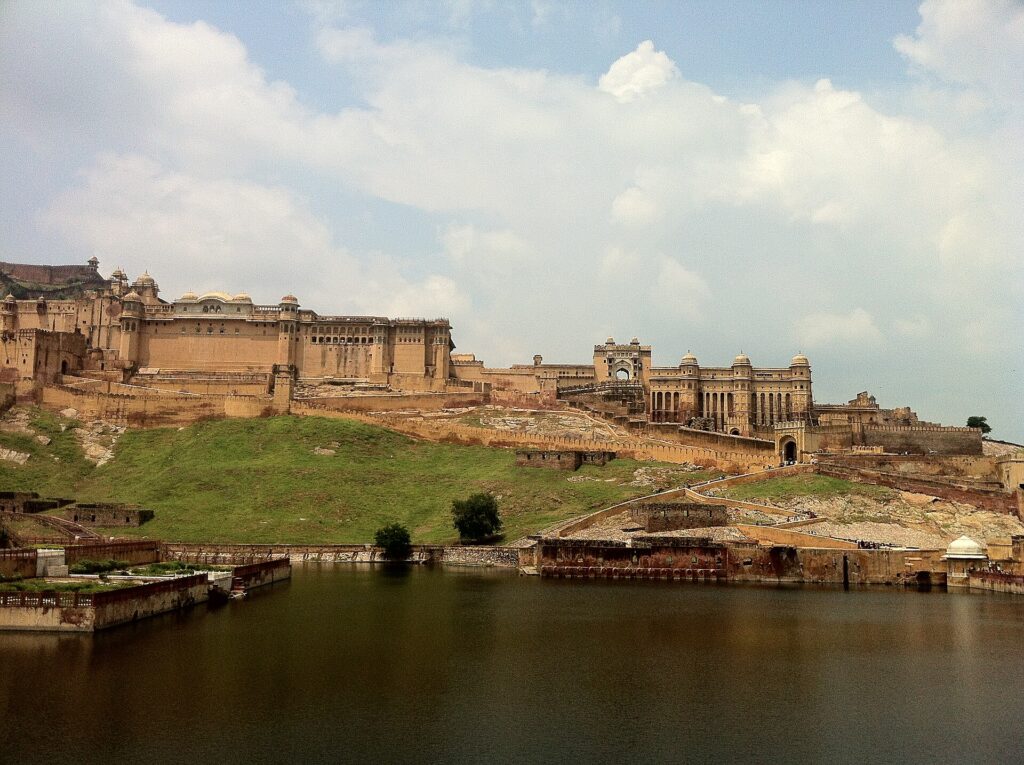
Amer Fort is in Devisinghpura, Amer, north-east of Jaipur’s historic core. Rajasthan Tourism places Amber Palace about 11 km from the main city. Distance changes noticeably with your starting point, so a single ‘Jaipur to Amer Fort distance’ figure is not enough for practical planning.
Approximate road distances to Amer Fort
| Starting point | Road distance | Practical time allowance |
| Jaipur main city | About 11 km | 30-45 minutes |
| Hawa Mahal / old city | About 8 km | 25-40 minutes |
| Jaipur Junction railway station | About 12-13 km | 30-50 minutes |
| Jaipur International Airport | About 20 km | 45-75 minutes |
Route references: Jaipur Junction • Jaipur Airport
These are approximate road distances, not straight-line measurements. Jaipur traffic, one-way controls on Amer Road, weekend crowds and tourist-season diversions can add substantial time. A 12 km journey from the station may take 30 minutes early in the day and closer to an hour at a busy period. From Jaipur International Airport, budget 45-75 minutes even though the road distance is about 20 km.
Best transport options
Cab or hired car: the simplest option for a family, older travellers or anyone combining Amer Fort with Jaigarh, Panna Meena ka Kund and Jal Mahal. Agree on waiting time and the return plan before the driver leaves.
Auto-rickshaw: workable from the old city, but settle the fare, waiting time and whether the ride is one-way or return before boarding.
City bus: Rajasthan Tourism says buses leave from Ajmeri Gate and MI Road and take roughly 40 minutes. Services also operate through the old-city corridor; ask for the Amber Fort stop because route numbers and frequencies can change.
Metro plus road transport: Jaipur Metro does not run to Amer. Take the metro toward the old city, then connect by bus, auto or cab.
Walking, jeep or vehicle to the upper gate: the uphill path is scenic but steep and cobbled. A return jeep is often quoted around ₹500 for up to six people, subject to current official rates. Access controls can change on crowded days.
Elephant-ride operations and fares have changed repeatedly, and animal-welfare concerns remain active. Do not make a fixed itinerary around a ride. Walking or taking authorised road transport is more predictable and avoids the ethical concern.
Accessibility reality: A vehicle can reduce the uphill climb, but the palace still contains uneven stone, slopes, thresholds and many steps. A full-size stroller is awkward; a baby carrier is usually easier. Visitors with limited mobility should prioritise the main courtyards and allow extra time.
Amer Fort history, architecture and facts worth knowing
A concise history of Amer Fort
Amer was an established settlement before the palace visible today. The present royal complex is generally dated from 1592, when Raja Man Singh I of the Kachwaha dynasty commissioned major construction. His successors expanded it over roughly 150 years. Mirza Raja Jai Singh I was especially important in shaping the seventeenth-century palace and garden ensemble.
In 1727, Sawai Jai Singh II founded Jaipur on the plains and moved the capital away from Amer. The palace did not lose its cultural importance, but its role changed from the active centre of court to a historic royal complex. In 2013, Amer became one component of UNESCO’s serial World Heritage property, the Hill Forts of Rajasthan, alongside five other forts. It is more accurate to call Amer part of that UNESCO property than to describe it as an unrelated stand-alone inscription.
Stories about the site’s earliest rulers and the origin of the names Amer and Amber vary across local tradition and later retellings. For a trustworthy visitor guide, it is better to distinguish those traditions from the well-documented late-sixteenth- to early-eighteenth-century Kachwaha palace.
Why Amer Fort architecture feels different
Amer is defensive on the outside and refined on the inside. Its ramparts, gates and hill position control movement through a strategic pass, while the palace introduces visitors gradually from public space to private royal space. UNESCO identifies Amber Palace as an important seventeenth-century expression of a shared Rajput-Mughal court style. The blend is visible in the chhatris, jalis and religious imagery associated with Rajput traditions, alongside symmetrical gardens, floral ornament, cusped arches and spatial ideas associated with Mughal court design.
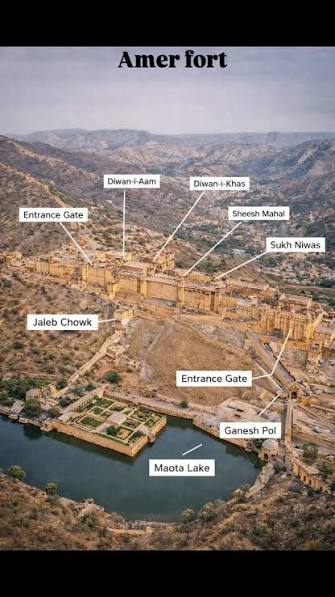
The palace is organised around four principal courtyards. That sequence is not just decorative; it tells you who could go where:
Jaleb Chowk: the arrival and military assembly court, entered through Suraj Pol when approaching on foot or Chand Pol from the vehicle side.
Diwan-i-Aam: the public audience zone where the ruler heard petitions and appeared before subjects.
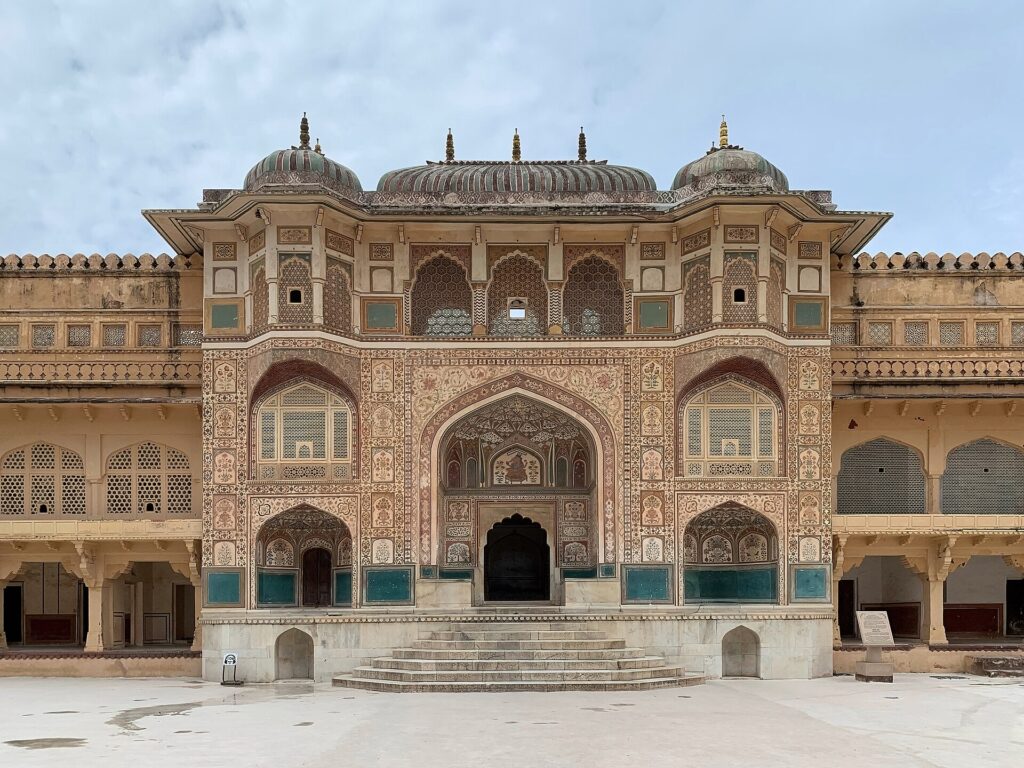
Ganesh Pol, Jai Mandir and Sukh Niwas: the transition into private royal space, with painted gateways, mirror work, gardens and an ingenious water-assisted cooling system.
Man Singh Palace and the zenana: the older residential area, arranged around a more intimate courtyard for the royal household.
What not to miss inside Amber Palace Jaipur
Ganesh Pol: pause before walking through it. The painted floral surfaces, Ganesha image and latticed upper level make it one of the best places to read the Rajput-Mughal visual mix.
Sheesh Mahal or Jai Mandir: tiny mirror and coloured-glass elements were designed to multiply limited light. View from the permitted area and do not touch the historic surfaces.
Sukh Niwas: look for the channel that helped cool moving air with water, a practical design response to Jaipur’s climate.
Diwan-i-Aam: stand back to see the rhythm of columns and imagine the carefully staged relationship between ruler and public.
Maota Lake views: the lake and Kesar Kyari garden explain why water, defence and landscape are central to the palace rather than mere background scenery.
Amer-Jaigarh connection: a restored route reflects the defensive relationship between the palace below and the stronger fortification above. Check access conditions before attempting the climb.
AMER FORT FACTS Amer and Amber are two names for the same place. The site is both a fortified complex and a royal palace. Construction of the visible Kachwaha palace began in 1592; the capital moved to Jaipur in 1727; and Amer joined the UNESCO-listed Hill Forts of Rajasthan in 2013. The palace’s four-courtyard sequence moves from public arrival to private royal residence.
Best time to visit Amer Fort and realistic visit duration
Best season and time of day
October to March is the easiest season for Amer Fort because Jaipur’s daytime weather is generally cooler and drier. It is also the busiest period. Weekends, public holidays and the winter wedding-photo season can fill the most photogenic courtyards quickly. Arriving at opening gives you the best balance of softer light, manageable temperatures and space to look closely.
October-March: best overall; bring a light layer for early winter mornings and expect peak crowds after about 9:30 AM.
April-June: visit at opening, carry water and avoid turning the open courtyards into a midday endurance test.
July-September: the Aravalli hills can look greener, but humidity, rain and slippery stone demand more care.
Late afternoon is attractive for warmer light, but it gives you less margin if queues or traffic delay arrival. A sunset-oriented visit also does not guarantee that every interior will remain open until the complex’s published closing time.
How long does an Amer Fort visit take?
Allow 2.5 to 3 hours for a satisfying first visit. A rushed highlights loop can be done in about 90 minutes, while photographers, architecture enthusiasts and families taking breaks may need 3.5 to 4 hours. Add travel time separately. The light-and-sound show adds about 55 minutes plus waiting time and may require a long gap after a morning visit.
Choose a visit length that matches your group
| Visit style | Time inside | What it covers |
| Quick highlights | 90 minutes | Jaleb Chowk, Ganesh Pol, Sheesh Mahal, one viewpoint |
| Balanced first visit | 2.5-3 hours | All four court zones with pauses and context |
| Family / photography pace | 3.5-4 hours | Breaks, detail, temple queue and slower movement |
| Light show | +55 minutes | Plus 20-30 minutes for arrival and seating |
A practical three-hour route
0:00-0:30 – Reach the upper entrance, complete ticket checks and orient yourself in Jaleb Chowk.
0:30-1:00 – Visit Shila Devi Temple if open, then study Diwan-i-Aam and the views from the public court.
1:00-1:50 – Pass through Ganesh Pol to the garden, Sheesh Mahal/Jai Mandir and Sukh Niwas.
1:50-2:30 – Continue to Man Singh Palace and the zenana courtyard rather than turning back after Sheesh Mahal.
2:30-3:00 – Use the final half-hour for Maota Lake viewpoints, water, restrooms and a calm exit.
Amer Fort for kids and families, plus nearby places
How to make the fort work for children
Amer Fort can be an excellent family history visit when adults turn the architecture into a story rather than a long sequence of rooms. Give children a simple mission: find the Sun Gate and Moon Gate, spot an elephant motif, compare public and private courtyards, count mirror reflections without touching them, and work out how water cooled Sukh Niwas.
With babies or toddlers: use a carrier, take authorised road transport uphill and plan a shorter 90-120-minute loop with a water break.
With ages 5-8: focus on gates, mirror work, the lake and the cooling channel. Four memorable ideas beat forty dates.
With ages 9-12+: ask why a ruler needed separate audience halls, why the palace moved from public to private space and how the hill supported defence.
With grandparents: avoid midday, minimise the initial climb, agree on a meeting point and do not rush the uneven stairways.
Carry a refillable water bottle, hat, sunscreen and shoes with grip. Keep children close on steep stairs and elevated edges. Paid restrooms are available inside according to current visitor information; carry small change and basic hygiene supplies. If visiting Shila Devi Temple, be prepared to remove footwear and follow the temple’s own rules.
Personal photography is commonly allowed in much of the complex, but flash, tripods, drones and commercial shoots may face restrictions or require permission. Follow the signs and staff instructions on the day rather than relying on an old blog post.
Places to visit near Amer Fort
| Place | Approx. distance | Allow | Best for |
| Panna Meena ka Kund | About 1 km | 30-45 min | Geometry, water history, photos |
| Jagat Shiromani Temple | 0.5-1 km | 20-30 min | Stone carving and a quieter stop |
| Anokhi Museum | About 1 km | 60-90 min | Block printing; check Monday closure |
| Jaigarh Fort | About 7 km by road | 1.5-2 hrs | Military history and high views |
| Jal Mahal viewpoint | About 4-5 km | 20-30 min | Easy family photo stop |
| Hawa Mahal | About 8 km | 45-75 min | Old-city architecture |
For a relaxed family morning, pair Amer Fort with Panna Meena ka Kund and a short Jal Mahal photo stop. Add Jaigarh only if everyone is comfortable with more walking and another substantial fort. Trying to force Amer, Jaigarh, Nahargarh, Hawa Mahal, City Palace and Jantar Mantar into one day usually produces more driving and queueing than discovery.
Frequently asked questions
What are the Amer Fort Jaipur timings?
The official Rajasthan OBMS portal lists Amber Fort as open from 7:00 AM to 8:00 PM. It lists Dhulandi/Holi as a holiday. Individual rooms, the temple, counters and evening events can follow different schedules, so arrive early for a complete daytime visit.
What is the Amer Fort ticket price in 2026?
The 2026 individual entry fee is ₹200 for an Indian adult and ₹1,000 for a foreign adult. Student rates commonly listed for 2026 are ₹100 for Indian students and ₹500 for foreign students with valid ID. Check the official payment screen before purchase.
How far is Amer Fort from Jaipur railway station and airport?
Amer Fort is about 12-13 km by road from Jaipur Junction and about 20 km by road from Jaipur International Airport. Allow roughly 30-45 minutes from the station and 45-75 minutes from the airport, depending on traffic.
Are Amer Fort and Amber Fort the same place?
Yes. Amer Fort, Amber Fort, Amer Palace and Amber Palace refer to the same hilltop palace-fort complex in Amer, Jaipur. ‘Amer’ is the locally used form; ‘Amber’ is common in English-language tourism and on the official booking listing.
How much time is enough for Amer Fort with children?
Plan 2.5 to 3.5 hours with school-age children, including a water break. With toddlers, a focused 90-120-minute visit is usually more enjoyable. Add the 55-minute evening show only if the child is comfortable with a later, narration-led programme.
Conclusion: plan around the morning, not the closing time
Amer Fort rewards an early, unhurried visit. Use 7:00 AM-8:00 PM as the official operating window, but enter near opening; budget ₹200 per Indian adult or ₹1,000 per foreign adult for the 2026 individual ticket; allow about three hours; and remember that the light show is a separate, seasonally timed event.
Book through the Rajasthan Government portal, save the QR ticket offline and check the live show listing the day before travel. Then choose one or two nearby stops rather than overloading the day. For the next step, build the fort into a realistic Jaipur family itinerary or explore MagickWorld’s guides to child-friendly activities and stays in Jaipur.