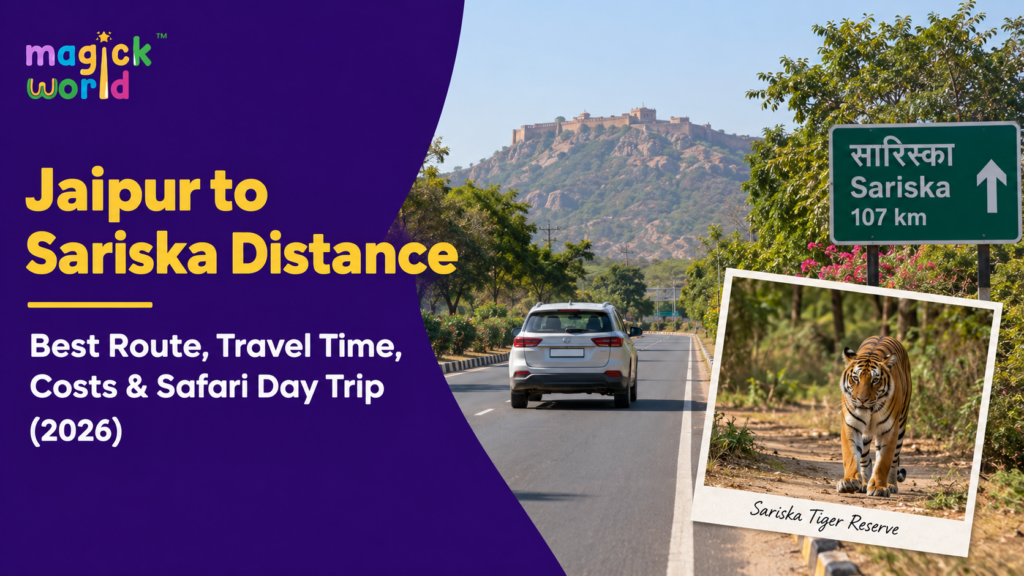
Jaipur to Sariska Distance: Best Route, Travel Time, Costs & Safari Day Trip (2026)
Here is the useful answer: the Jaipur to Sariska distance by road is usually about 110–120 km to Sariska’s main gate, and most travellers should allow 2.5–3 hours without a long stop. The exact number changes with your Jaipur pickup point, the gate printed on your safari booking and the route suggested by live navigation.
This guide explains those differences before covering the best route from Jaipur to Sariska, road conditions, car and bike travel, bus and train options, estimated taxi fares, fuel and toll costs, safari planning, family travel and a realistic one-day itinerary.
Jaipur to Sariska distance and travel time at a glance
What is the distance from Jaipur to Sariska? For practical planning, use 110–120 km one way and 2.5–3 hours by car for a journey from central Jaipur to Sariska Main Gate. Rajasthan Tourism publishes a city-to-reserve reference distance of 107 km, but a door-to-gate route commonly becomes longer once the precise pickup and entry point are added.
| Journey | Practical road-distance range | Sensible travel-time allowance | What changes the figure? |
|---|---|---|---|
| Central Jaipur to Sariska Main/Sadar Gate | 110–120 km | 2.5–3 hours | Pickup locality, Jaipur traffic and the final gate pin |
| Jaipur Railway Station to Sariska Main Gate | About 115–125 km | 2.75–3.25 hours | City traffic and route selected out of Jaipur |
| Jaipur Airport to Sariska | About 120–130 km | 3–3.5 hours | The airport is south of the city, so urban crossing adds time |
| Jaipur to Tehla Gate | Roughly 100–120 km | 2.5–3.25 hours | Route via Jamwa Ramgarh/Ajabgarh and rural-road conditions |
| Jaipur to Sariska and back | Usually 220–250 km | 5–6.5 hours of driving | Gate, hotel detours, meal stops and return route |
These are planning ranges, not map promises. Enter the exact gate named on your permit, not merely “Sariska National Park,” into navigation. Sariska Main Gate—also called Sadar or Sariska Gate in some listings—and Tehla Gate serve different tourism zones. Choosing the wrong pin can cost far more time than a 10 km difference in the original estimate.
Why Jaipur-to-Sariska distance figures disagree online
Four problems explain most of the conflicting answers:
- “Jaipur” is not one point. A pickup in Kukas or Amer is closer to the northern route than Jaipur Airport, Jagatpura or Mansarovar.
- “Sariska” is not one point. A resort in Tehla, Sariska Main Gate, the reserve’s mapped centre and Alwar city are different destinations.
- Road and straight-line distances get mixed. A flight-distance figure is useless for a road trip through the Aravallis.
- Transport sites sometimes label Rajgarh or Alwar as Sariska. There is no railway station at the safari gate. Every rail journey needs a road transfer.
The phrases Jaipur to Sariska National Park distance, Jaipur to Sariska Wildlife Sanctuary distance and Jaipur to Sariska Tiger Reserve distance are often used for the same trip in general travel searches. For driving, the protected-area name matters less than the entry gate on the booking.
The Rajasthan Tourism wildlife page is a sound reference for the official 107 km headline distance. Use live maps for your actual door-to-gate total.
Best route from Jaipur to Sariska Tiger Reserve
For a safari from the main gate, the most straightforward Jaipur to Sariska route is normally:
Jaipur → NH 48 towards Shahpura → Shahpura turn → Viratnagar/Bairat side → Thanagazi → Sariska Main Gate via NH 248A
Allow about 110–120 km and 2.5–3 hours. The first portion is faster highway driving; after the Shahpura turn, the road becomes a two-lane corridor through settlements and the Aravalli landscape. It is the best route for most first-time visitors whose permit says Sariska or Sadar Gate.
Route 1: Via Shahpura and Thanagazi—best for the main gate
This is usually the best balance of distance, road quality and simplicity. NH 48 gets you out of Jaipur, while NH 248A connects the Shahpura side with Thanagazi and the reserve.
Do not build the schedule around the fastest map estimate. Town traffic, cattle, local buses, speed breakers, roadwork and the last slower section can easily add 20–40 minutes. A family travelling on a winter weekend should budget three hours even if navigation initially shows less.
Choose this route when:
- your safari boarding point is Sariska Main Gate or Sadar Gate;
- you are making a direct Jaipur to Sariska self-drive trip;
- you want the simplest route for a sedan or regular hatchback; or
- you are returning to Jaipur immediately after an afternoon safari.
Route 2: Via Jamwa Ramgarh, Pratapgarh, Ajabgarh and Tehla—use for Tehla Gate
If the booking says Tehla, navigate directly to Tehla Gate instead of driving to Sariska Main Gate. A common southern approach runs from Jaipur towards Jamwa Ramgarh, Andhi, Pratapgarh, Ajabgarh and Tehla. It can be similar in distance—or shorter from parts of east and south Jaipur—but includes more rural two-lane driving.
This is also the logical side for travellers combining Tehla with Bhangarh or an Ajabgarh-area stay. Mobile coverage, fuel choices and late-night roadside services can thin out on rural stretches, so download the route and refuel before the final section.
Important: Main Gate and Tehla Gate may appear close on a map of the reserve, but public-road travel between them can be a substantial detour. A route through protected forest is not automatically open to private through-traffic. Let the permit—not a hotel advertisement—decide the gate.
Jaipur to Sariska via Alwar—is it the best option?
No, not for a direct safari. Jaipur to Sariska via Alwar city is usually a deliberate detour, because the main gate lies south-west of Alwar. Depending on the exact roads and stops, the journey can rise to roughly 160–190 km and four hours or more.
The Alwar route makes sense if Alwar is part of the plan: perhaps you are staying there, meeting a train passenger, visiting the City Palace and museum, or adding Siliserh Lake. It does not make sense merely because a generic route page calls Alwar the gateway to Sariska.
Jaipur to Sariska road conditions and safety
The public approach is suitable for an ordinary car; a 4×4 is not required. Expect a mix of multi-lane highway, two-lane road, village sections and slower curves near the hills. Conditions after heavy monsoon rain can change quickly, and temporary works may create dust or broken edges.
The Jaipur-to-Sariska road is generally manageable in daylight, but “safe” depends on driving decisions. Avoid high speed through settlements, leave space around buses and tractors, watch for unmarked speed breakers and animals, and use low beam in fog. A pre-dawn safari departure demands more caution than the same road at 9 a.m.
NH 48 has introduced barrier-free toll collection on parts of the Jaipur–Delhi corridor. No physical stop does not necessarily mean no charge: keep the vehicle’s FASTag active and funded. The government’s 2026 Daulatpura toll-system announcement explains how the newer multi-lane free-flow system works.
How to reach Sariska from Jaipur by car, taxi, bus or train
For most visitors, Jaipur to Sariska by car is the simplest option because the trip is gate-specific and safari reporting times are fixed. Public transport can cost less, but the last mile needs planning.
Jaipur to Sariska by car or self-drive
A car gives you control over departure time, meal stops and the return after safari. A hatchback or sedan is adequate for the public road to either gate. Private cars do not replace the authorised safari vehicle inside the tourism zone; park where directed and board the gypsy or canter assigned through the permit system.
Before leaving:
- save the gate pin offline and take a screenshot of the booking;
- carry the original photo ID used for every passenger on the permit;
- check tyre pressure, spare wheel and FASTag balance;
- keep drinking water, but follow rules about food and waste inside the reserve;
- refuel before the rural final stretch; and
- call the hotel or authorised booking contact if its map pin differs from the permit gate.
A Jaipur to Sariska family trip is comfortable by car, but do not underestimate a long day: five to six hours of road travel plus a safari can mean 11–13 hours away from the hotel.
Jaipur to Sariska distance by bike
The Jaipur to Sariska distance by bike is broadly the same as by car—normally 110–120 km to the main gate. A bike can be enjoyable in mild weather, but it is a transport choice for the public highway only. Motorcycles are not a substitute for an authorised safari vehicle.
Wear a certified helmet, avoid riding the rural section after dark, carry puncture essentials and add a warm layer for a winter dawn return. In May and June, heat exposure can make a same-day ride tiring even before the safari begins. For two riders, the fuel saving is real; the trade-off is fatigue, dust and limited luggage protection.
Jaipur to Sariska taxi fare and cab price
As a September 2026 market check, online cab listings commonly showed about ₹2,500–₹3,600 for a one-way sedan, while advertised round-trip or full-day sedan prices often began around ₹3,700–₹5,500. SUVs and larger vehicles generally cost more. Treat these as shopping ranges, not regulated fares.
When comparing a Jaipur to Sariska cab price, ask for the final amount in writing. A cheap headline may exclude:
- toll and parking charges;
- driver allowance or night allowance;
- waiting beyond a fixed number of hours;
- a minimum-kilometre rule for a round trip;
- airport pickup fees;
- extra kilometres to Tehla, Alwar, Bhangarh or a remote resort; and
- the forest permit, guide and safari vehicle.
For a one-day trip, a round-trip taxi with waiting is usually more practical than arranging a return cab at the gate. Compare the quote with a recognised aggregator and a registered local operator, check recent reviews, and confirm that the driver understands your reporting gate and time.
Jaipur to Sariska by bus
Buses are available towards Thanagazi and Alwar, but there is not always a convenient, reservable bus that drops a safari visitor at the correct gate at the correct time. That is why a single permanent “Jaipur to Sariska bus timing” is misleading.
The useful bus plan is:
- Search Jaipur → Thanagazi first for a main-gate trip.
- If that timing does not work, search Jaipur → Alwar and price the longer onward taxi.
- Confirm the final connection locally before booking a non-refundable safari.
- Keep at least 60–90 minutes of buffer beyond the scheduled bus arrival.
Check the RSRTC live booking portal for the actual travel date. Its schedules and booking window change, and some local services may not appear like a typical intercity coach. Bus plus local transport suits a flexible overnight trip better than a tightly timed same-day safari.
Jaipur to Sariska by train
There is no direct train to the tiger-reserve gate. The most practical Jaipur to Sariska train journey is generally Jaipur Junction (JP) to Alwar Junction (AWR), followed by a road transfer of about 36–37 km to Sariska Main Gate. Faster trains can cover Jaipur–Alwar in under two hours, while other services take longer.
Rajgarh (RHG) is another possible railhead, particularly for Tehla-side stays, but fewer suitable halts and a less predictable last-mile connection can cancel the time saved. Alwar is usually easier for first-time visitors because taxis and accommodation are more readily arranged.
Use IRCTC for booking and NTES for live running information. Search JP → AWR or JP → RHG, then obtain a separate gate-specific taxi quote. Do not book from a page claiming dozens of “Jaipur to Sariska trains” without checking which station its word “Sariska” actually represents.
Jaipur to Sariska trip cost: taxi, fuel, tolls and safari
A credible Jaipur to Sariska trip cost separates road transport from the forest experience. Safari fees are not included in ordinary cab fare, and a tour package may exclude them too.
Jaipur to Sariska fuel cost
Use this formula rather than copying an old blog:
Fuel cost = total kilometres ÷ real-world mileage × current fuel price
For example, assume a 230 km round trip. At the Jaipur petrol price shown on 4 September 2026—about ₹112.69 per litre—the estimates are:
| Vehicle example | Assumed real-world mileage | Approximate fuel used | Estimated round-trip fuel cost |
|---|---|---|---|
| Petrol sedan | 15 km/l | 15.3 litres | About ₹1,725 |
| Petrol SUV | 12 km/l | 19.2 litres | About ₹2,160 |
| Motorcycle | 40 km/l | 5.8 litres | About ₹650 |
Your car, air-conditioning use, detours and traffic will change the result. Check the day’s price through IndianOil’s fuel-price service and replace the example rate if publishing this guide later.
Jaipur to Sariska toll charges
The toll depends on the starting locality, chosen approach and current FASTag tariff. For budgeting, allow roughly ₹150–₹250 one way for a private car on the main NH 48 approach, or around ₹300–₹500 for the return drive, then verify the route shown by live navigation. Tehla-side routing may produce a different total.
With barrier-free tolling now operating on parts of NH 48, review the FASTag deduction after the trip rather than assuming that an open lane was free. Cab quotes should say explicitly whether toll is included.
Practical budget examples
The following ranges exclude accommodation and use live safari charges as a separate line because permits vary by nationality, vehicle, seat type, zone and booking date.
| Trip style | Road transport estimate | Food and small extras | Add separately |
|---|---|---|---|
| Self-drive petrol sedan, two adults | ₹2,025–₹2,300 including estimated fuel and toll | ₹800–₹1,500 | Safari permit/vehicle/guide |
| Full-day sedan with driver | ₹3,700–₹5,500 | ₹800–₹1,500 | Safari, plus exclusions in quote |
| Bus or train plus last-mile transfer | Highly connection-dependent; compare per-person total before booking | ₹500–₹1,000 per person | Safari and possible overnight stay |
| Bike day trip | About ₹800–₹1,100 for fuel, toll/parking and basics | ₹500–₹1,000 | Authorised safari seat/vehicle |
For a Jaipur to Sariska tour package, ask for a line-by-line inclusion list. “Safari trip” sometimes means only a Jaipur car transfer, while “entry included” may still exclude the gypsy, guide, portal charge or foreign-visitor fee. The official Sariska booking page is the right place to compare what the forest booking actually includes.
Jaipur to Sariska one-day trip and safari planning
Yes, Sariska can be visited from Jaipur in one day—but only if the safari is booked first and the road plan is built backwards from its reporting time.
The reserve generally operates morning and afternoon tourism shifts whose exact times move with the season. The official portal also posts closure and booking notices. At the September 2026 fact-check, it stated that advance bookings for visits from 1 October 2026 had opened and identified Wednesday as a weekly tourism holiday. Monsoon core-zone tourism generally pauses from July through September. Always recheck the portal for your date; special orders, weather and temple access can alter the normal pattern.
Realistic Jaipur to Sariska day-trip itinerary
An afternoon safari is the easier same-day plan because it avoids a 2:30–3:30 a.m. start.
| Approximate time | Plan |
|---|---|
| 8:00–8:30 a.m. | Leave Jaipur after checking the gate pin, IDs and fuel |
| 10:30–11:30 a.m. | Reach the Sariska area; retain a traffic buffer rather than adding a major attraction |
| 11:30 a.m.–1:00 p.m. | Early lunch and washroom break near the gate or confirmed resort |
| 45–60 minutes before reporting | Reach the exact boarding point and complete formalities |
| Afternoon slot | Take the authorised gypsy/canter safari; actual start and duration follow the permit |
| After the safari | Depart promptly for Jaipur, preferably before full darkness |
| 8:30–10:00 p.m. | Expected Jaipur arrival, depending on seasonal safari time and traffic |
This schedule deliberately leaves slack. A plan that reaches the gate five minutes before departure is not a plan—it is a missed-safari risk.
When should you leave Jaipur for a morning safari?
Work backwards from the printed reporting time and add at least three hours of driving plus the requested reporting buffer. For many seasonal morning slots, that means leaving Jaipur at roughly 2:30–3:30 a.m.
That is possible, but it is not the best choice for every traveller. Winter fog, sleepiness and unlit rural sections raise the stress level. Families with young children, older adults and anyone unfamiliar with the road will usually have a better trip by staying near the correct gate the previous night.
A better Jaipur to Sariska weekend trip
A one-night break removes most of the rush:
- Day 1: Leave Jaipur after breakfast, take the gate-appropriate route, check in and choose either an afternoon safari or a nearby heritage stop.
- Day 2: Take a morning safari, have breakfast or brunch, and return to Jaipur in daylight.
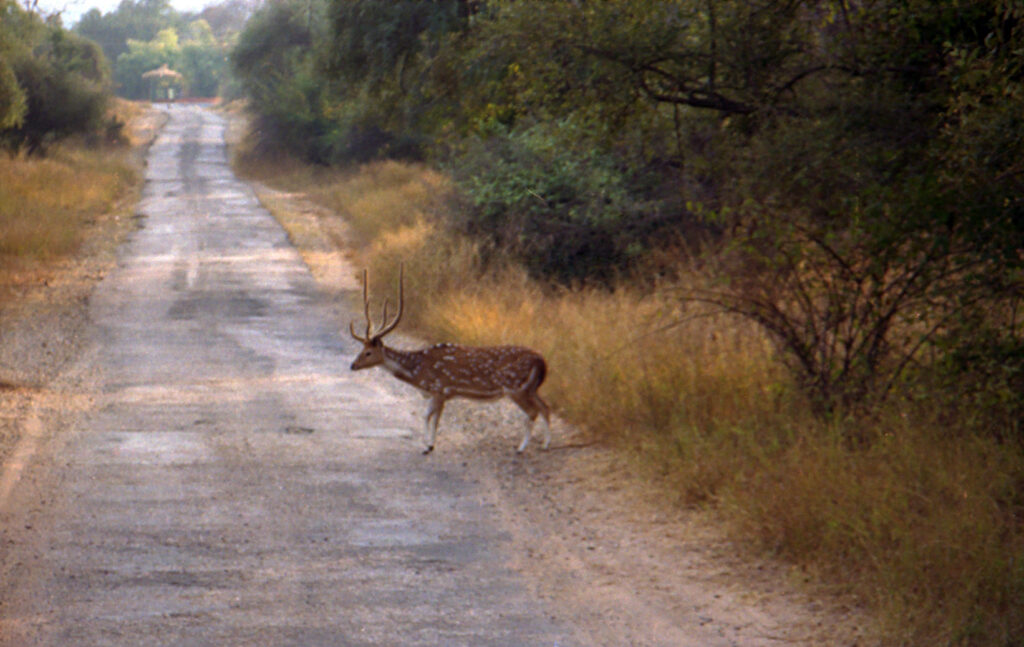
Do not automatically book two safaris solely to “guarantee” a tiger. Wild sightings are never guaranteed. Sariska is still rewarding for its dry Aravalli forest, sambar, chital, nilgai, wild boar, langurs, raptors and other birdlife. Rajasthan Tourism describes more than 220 bird species and highlights Kankwari Fort and the reserve’s temples as part of the wider landscape.
Safari booking checklist
Before paying for a cab or resort:
- Open the official booking page from the Rajasthan Forest Department’s ticket portal.
- Select the date, shift, zone/boarding point and vehicle or seat option carefully.
- Enter names and ID details exactly as shown on the original documents.
- Read cancellation rules before payment.
- Save the permit offline and confirm how early you must report.
- Recheck closure notices, especially around monsoon, weekly holidays and severe weather.
Avoid unofficial websites that mimic a government booking page. A .gov.in Rajasthan Forest or OBMS page is the authoritative starting point.
Stops, stays, best time and practical advice
The direct journey is short enough that you do not need a sightseeing stop. If the trip is a weekend rather than a strict safari run, choose one addition that fits the gate.
Places to visit between Jaipur and Sariska
| Place | When it fits | Planning note |
|---|---|---|
| Amer/Kukas side | Main-gate route from central Jaipur | Better treated as a Jaipur stop on another day; Amer Fort can consume several hours |
| Viratnagar/Bairat | Shahpura–Thanagazi route | Useful for history-minded travellers with daylight and no tight safari reporting time |
| Bhangarh Fort | Tehla/Ajabgarh approach | A genuine add-on, but not a quick main-gate roadside stop; entry is limited to daylight |
| Neelkanth temple area | Tehla-side itinerary | Confirm current road access and use daylight; allow more time than map distance suggests |
| Alwar City Palace and museum | Overnight or via-Alwar plan | Not on the fastest direct Jaipur–Sariska journey |
| Siliserh Lake | Alwar-side overnight/return | Best as a separate half-day addition rather than a pre-safari detour |
The Rajasthan Tourism Bhangarh guide confirms that the protected site is out of bounds before sunrise and after sunset. This matters if a map suggests squeezing it in after a late safari.
Resorts between Jaipur and Sariska: choose by gate, not by “Sariska” label
The most convenient stay is not always the property with “Sariska” in its name. Check actual driving time to the booked boarding point.
- Main Gate/Thanagazi side: best for early reporting at Sariska or Sadar Gate.
- Tehla/Ajabgarh side: best for a Tehla permit, Bhangarh combination or quieter southern-side stay.
- Alwar/Siliserh: offers more city services and rail convenience, but adds an early road transfer to the gate.
RTDC’s Tiger Den Sariska is one government-run reference property near the forest office. For any resort, verify recent reviews, meal availability, generator/power arrangements, family-room configuration and the road distance to your exact gate. Do not assume the hotel can issue a forest permit unless that service and the official booking number are documented.
Best time to visit Sariska from Jaipur
October to March is easiest for most Jaipur travellers because daytime conditions are more comfortable. December and January mornings can be cold and occasionally foggy, so carry layers and allow extra driving time.
April to June is much hotter, but dry conditions can concentrate animal activity around water. Heat management becomes essential: choose breathable clothing, cover exposed skin, hydrate and avoid a long midday bike ride.
July to September is the monsoon period, when core safari tourism is generally closed or restricted and forest roads may need recovery. The landscape can be beautiful, but a resort stay is not the same as a confirmed core safari. Check the live government notice before travelling.
Food, fuel and family considerations
Do not depend on finding a full meal inside the reserve. Eat before reporting, use a washroom near the gate and carry only what the rules allow. Keep all waste in the vehicle until it can be disposed of properly.
For children, pack a light jacket in winter, a cap in warmer months and a dust-protective scarf. Explain that the safari can involve long quiet periods and that animals may remain hidden. That small expectation-setting exercise often makes the day more enjoyable than promising a tiger.
The same realism applies to adults. Sariska is worth visiting from Jaipur if you enjoy a broader wildlife landscape, not only a checklist sighting. Respect speed limits, remain seated when instructed, keep voices low, never ask a driver to crowd an animal and do not feed wildlife.
Frequently asked questions
How far is Sariska from Jaipur by road?
Sariska is usually 110–120 km from central Jaipur by road when travelling to the main safari gate. Rajasthan Tourism uses 107 km as a general city-to-reserve figure. Your door-to-gate result may be higher, especially from Jaipur Airport or south Jaipur.
How long does it take to reach Sariska from Jaipur?
Allow 2.5–3 hours by car in normal conditions and up to 3.5 hours from the airport, during traffic, after rain or with a short stop. Do not use the fastest no-traffic estimate to schedule a fixed safari report.
Which is the best route from Jaipur to Sariska?
For Sariska Main/Sadar Gate, take NH 48 towards Shahpura, turn for the NH 248A/Thanagazi corridor and continue to the gate. For Tehla Gate, use the gate-specific route via the Jamwa Ramgarh–Ajabgarh side. Always match the route to the permit.
Can I visit Sariska from Jaipur in one day?
Yes. An afternoon safari is the most comfortable same-day option: leave Jaipur around 8–8:30 a.m., arrive well before reporting and expect to return in the evening. A morning safari usually requires a very early departure, so an overnight stay is safer and less tiring.
Are buses or trains available from Jaipur to Sariska?
There is no train to the reserve gate. Take a train to Alwar Junction and continue about 36–37 km by road, or consider Rajgarh for a pre-arranged Tehla-side transfer. Buses run towards Thanagazi and Alwar, but confirm the live RSRTC timing and last-mile connection before booking a fixed safari.
Final word
For planning, remember three numbers: 110–120 km, about three hours, and at least 45–60 minutes of reporting buffer. Then check the gate. Main/Sadar Gate usually suits the Shahpura–Thanagazi route; Tehla needs its own southern approach. Book the safari through the government portal before committing to transport, compare cab inclusions rather than headline fares, and build the day around daylight and realistic road time.